


Approaches to establish Q-markers for the quality standards of traditional Chinese medicines
- PMID: 28752028
- PMCID: PMC5518652
- DOI: 10.1016/j.apsb.2017.04.012
Approaches to establish Q-markers for the quality standards of traditional Chinese medicines
Abstract
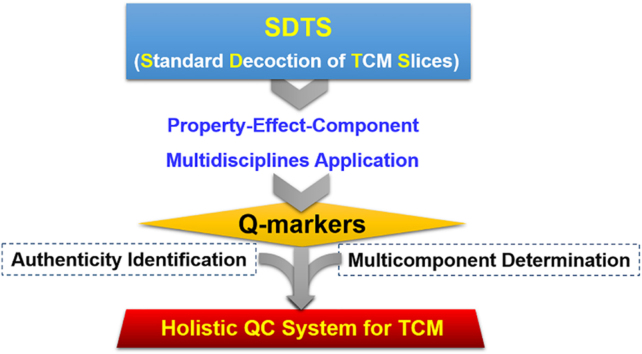
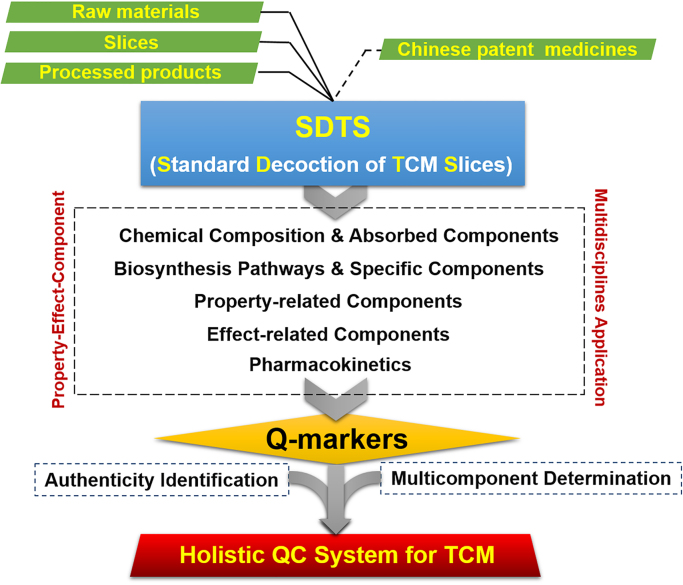
Traditional Chinese medicine (TCM) has played a pivotal role in maintaining the health of Chinese people and is now gaining increasing acceptance around the global scope. However, TCM is confronting more and more concerns with respect to its quality. The intrinsic "multicomponent and multitarget" feature of TCM necessitates the establishment of a unique quality and bioactivity evaluation system, which is different from that of the Western medicine. However, TCM is investigated essentially as "herbal medicine" or "natural product", and the pharmacopoeia quality monographs are actually chemical-markers-based, which can ensure the consistency only in the assigned chemical markers, but, to some extent, have deviated from the basic TCM theory. A concept of "quality marker" (Q-marker), following the "property-effect-component" theory, is proposed. The establishment of Q-marker integrates multidisciplinary technologies like natural products chemistry, analytical chemistry, bionics, chemometrics, pharmacology, systems biology, and pharmacodynamics, etc. Q-marker-based fingerprint and multicomponent determination conduce to the construction of more scientific quality control system of TCM. This review delineates the background, definition, and properties of Q-marker, and the associated technologies applied for its establishment. Strategies and approaches for establishing Q-marker-based TCM quality control system are presented and highlighted with a few TCM examples.
Keywords: Property-effect-component; Q-marker; Quality control; Traditional Chinese medicine.
Figures
References
-
- Guo D.A., Wu W.Y., Ye M., Liu X., Cordell G.A. A holistic approach to the quality control of traditional Chinese medicine. Science. 2015;347:S23–S31.
-
- Zhang B.L., Zhang J.H. Twenty years׳ review and prospect of modernization research on traditional Chinese medicine. China J Chin Mater Med. 2015;40:3331–3334. - PubMed
-
- Qiu S., Yang W.Z., Shi X.J., Yao C.L., Yang M., Liu X. A green protocol for efficient discovery of novel natural compounds: characterization of new ginsenosides from the stems and leaves of Panax ginseng as a case study. Anal Chim Acta. 2015;893:65–76. - PubMed
-
- Qiao X., Lin X.H., Ji S., Zhang Z.X., Bo T., Guo D.A. Global profiling and novel structure discovery using multiple neutral loss/precursor ion scanning combined with substructure recognition and statistical analysis (MNPSS): characterization of terpene-conjugated curcuminoids in Curcuma longa as a case study. Anal Chem. 2016;88:703–710. - PubMed
-
- Liang J., Wu W.Y., Sun G.X., Wang D.D., Hou J.J., Yang W.Z. A dynamic multiple reaction monitoring method for the multiple components quantification of complex traditional Chinese medicine preparations: niuhuang Shangqing pill as an example. J Chromatogr A. 2013;1294:58–69. - PubMed
Publication types
LinkOut - more resources
Full Text Sources
Other Literature Sources
