


Increased levels of red cell distribution width is correlated with presence of left atrial stasis in patients with non-valvular atrial fibrillation
- PMID: 28752145
- PMCID: PMC5530160
- DOI: 10.14744/nci.2017.72324
Increased levels of red cell distribution width is correlated with presence of left atrial stasis in patients with non-valvular atrial fibrillation
Abstract
Objective: Red cell distribution width (RDW) and neutrophil to lymphocyte ratio (NLR) have been found to be associated with non-valvular atrial fibrillation (AF) and cardiovascular diseases. However, correlation of these parameters with presence of left atrial (LA) thrombus and/or spontaneous echo contrast (SEC) in patients with non-valvular AF has not been clarified. This study was an investigation of correlation of RDW, NLR, and clinical risk factors with LA thrombus and dense SEC in patients with non-valvular AF in the Turkish population.
Methods: The demographic, laboratory, and echocardiographic properties of 619 non-valvular AF patients who underwent transesophageal echocardiography (TEE) examination before direct current cardioversion (DCCV) or AF ablation treatment were retrospectively investigated. Complete blood count (CBC) and biochemical parameters were studied 6 to 12 hours before TEE examination. Left atrial stasis (LAS) markers were noted as presence of left atrial/left atrial appendage (LA/LAA) thrombus or dense spontaneous echo contrast (DSEC).
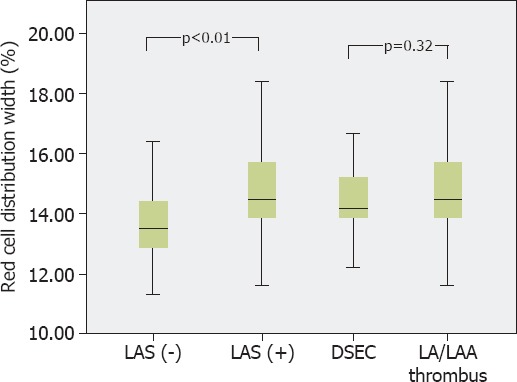
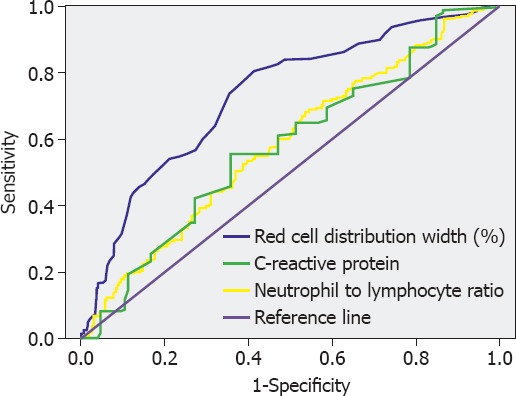
Results: Total of 325 (52%) patients with LAS were compared with 294 patients (48%) without LAS. In the LAS group, there were 274 (84%) patients with LA/LAA thrombus and 51 (16%) patients with DSEC. LAS (+) group, values for RDW (14.85±1.48 vs. 13.77±1.30; p<0.01), NLR (2.38 [1.58], vs. 2.10 [1.35]; p<0.01) and C-reactive protein (0.95 [0.61] vs. 0.88 [0.60] mg/L; p<0.01) were significantly higher than seen in LAS (-) group. In multivariate regression analysis, increased level of RDW, age, male gender, heart failure, duration of AF >6 months, and international normalized ratio <2 were independently correlated with presence of LAS.
Conclusion: Our study indicated that increased level of RDW is independently correlated with higher risk for development of LAS in patients with non-valvular AF.
Keywords: Left atrial thrombus; non-valvular atrial fibrillation; red cell distribution width.
Conflict of interest statement
Conflict of Interest: None declared.
Figures
References
-
- Morady F, Zipes DP. Atrial fibrillation:clinical features, mechanisms and management. In: Braunwald E, Libby P, Bonow RO, Mann DL, Zipes DP, editors. Braunwald’s heart disease. A textbook of cardiovascular medicine. 9th ed. Philadelphia, PA: WB Saunders Company; 2012. pp. 825–84.
-
- Khoo CW, Krishnamoorthy S, Lim HS, Lip GY. Atrial fibrillation, arrhythmia burden and thrombogenesis. Int J Cardiol. 2012;157:318–23. - PubMed
-
- Watson T, Shantsila E, Lip GY. Mechanisms of thrombogenesis in atrial fibrillation:Virchow’s triad revisited. Lancet. 2009;373:155–66. - PubMed
-
- Lappé JM, Horne BD, Shah SH, May HT, Muhlestein JB, Lappé DL, et al. Red cell distribution width, C-reactive protein, the complete blood count, and mortality in patients with coronary disease and a normal comparison population. Clin Chim Acta. 2011;412:2094–9. - PubMed
-
- Felker GM, Allen LA, Pocock SJ, Shaw LK, McMurray JJ, Pfeffer MA, et al. CHARM Investigators. Red cell distribution width as a novel prognostic marker in heart failure:data from the CHARM Program and the Duke Databank. J Am Coll Cardiol. 2007;50:40–7. - PubMed
LinkOut - more resources
Full Text Sources
Other Literature Sources
Research Materials