


Significance of long chain polyunsaturated fatty acids in human health
- PMID: 28752333
- PMCID: PMC5532176
- DOI: 10.1186/s40169-017-0153-6
Significance of long chain polyunsaturated fatty acids in human health
Abstract
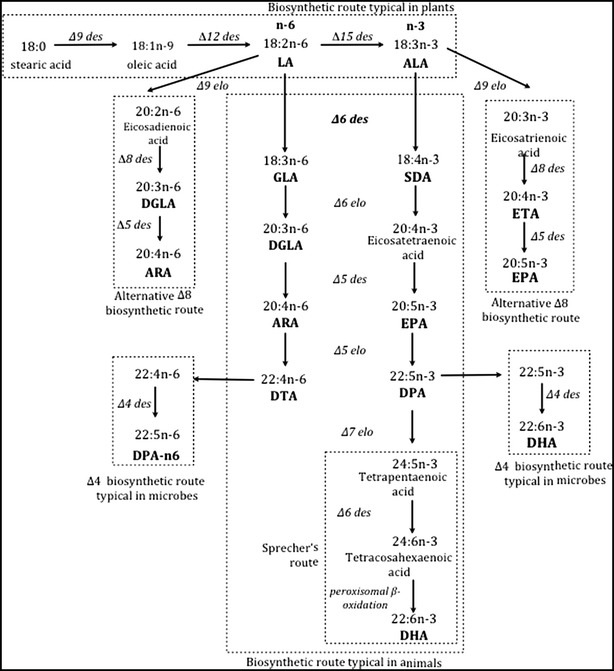
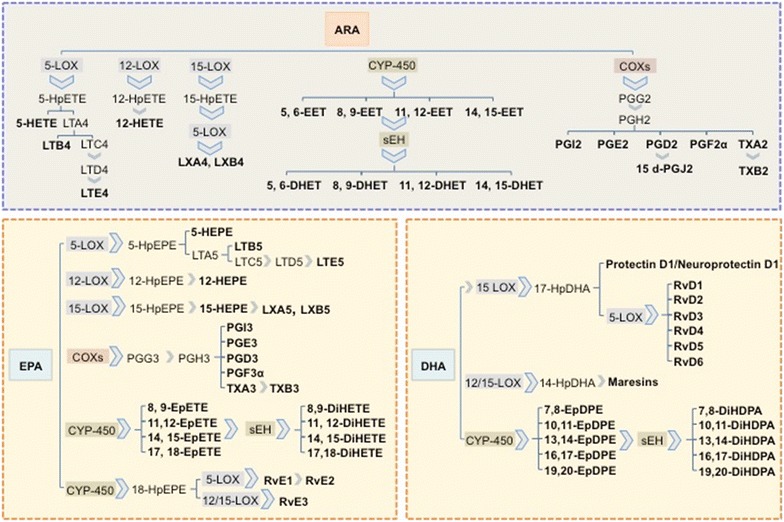
In the last decades, the development of new technologies applied to lipidomics has revitalized the analysis of lipid profile alterations and the understanding of the underlying molecular mechanisms of lipid metabolism, together with their involvement in the occurrence of human disease. Of particular interest is the study of omega-3 and omega-6 long chain polyunsaturated fatty acids (LC-PUFAs), notably EPA (eicosapentaenoic acid, 20:5n-3), DHA (docosahexaenoic acid, 22:6n-3), and ARA (arachidonic acid, 20:4n-6), and their transformation into bioactive lipid mediators. In this sense, new families of PUFA-derived lipid mediators, including resolvins derived from EPA and DHA, and protectins and maresins derived from DHA, are being increasingly investigated because of their active role in the "return to homeostasis" process and resolution of inflammation. Recent findings reviewed in the present study highlight that the omega-6 fatty acid ARA appears increased, and omega-3 EPA and DHA decreased in most cancer tissues compared to normal ones, and that increments in omega-3 LC-PUFAs consumption and an omega-6/omega-3 ratio of 2-4:1, are associated with a reduced risk of breast, prostate, colon and renal cancers. Along with their lipid-lowering properties, omega-3 LC-PUFAs also exert cardioprotective functions, such as reducing platelet aggregation and inflammation, and controlling the presence of DHA in our body, especially in our liver and brain, which is crucial for optimal brain functionality. Considering that DHA is the principal omega-3 FA in cortical gray matter, the importance of DHA intake and its derived lipid mediators have been recently reported in patients with major depressive and bipolar disorders, Alzheimer disease, Parkinson's disease, and amyotrophic lateral sclerosis. The present study reviews the relationships between major diseases occurring today in the Western world and LC-PUFAs. More specifically this review focuses on the dietary omega-3 LC-PUFAs and the omega-6/omega-3 balance, in a wide range of inflammation disorders, including autoimmune diseases. This review suggests that the current recommendations of consumption and/or supplementation of omega-3 FAs are specific to particular groups of age and physiological status, and still need more fine tuning for overall human health and well being.
Keywords: Disease; Health; Inflammation; Lipidomics; Lipids; Long chain polyunsaturated fatty acids; Omega-3; Resolvins.
Figures
References
-
- Simo C, Cifuentes A, GarciaCanas V. Fundamentals of advanced omics technologies: from genes to metabolites. Amsterdam: Elsevier Science Bv; 2014.
-
- Debnath M, Prasad GBKS, Bisen PS. Omics technology. molecular diagnostics: promises and possibilities. Dordrecht: Springer Netherlands; 2010. pp. 11–31.
Publication types
LinkOut - more resources
Full Text Sources
Other Literature Sources
Medical
Research Materials
Miscellaneous