


Longitudinal validity and reliability of the Myeloma Patient Outcome Scale (MyPOS) was established using traditional, generalizability and Rasch psychometric methods
- PMID: 28752440
- PMCID: PMC5655545
- DOI: 10.1007/s11136-017-1660-z
Longitudinal validity and reliability of the Myeloma Patient Outcome Scale (MyPOS) was established using traditional, generalizability and Rasch psychometric methods
Abstract
Purpose: The Myeloma Patient Outcome Scale (MyPOS) was developed to measure quality of life in routine clinical care. The aim of this study was to determine its longitudinal validity, reliability, responsiveness to change and its acceptability.
Methods: This 14-centre study recruited patients with multiple myeloma. At baseline and then every two months for 5 assessments, patients completed the MyPOS. Psychometric properties evaluated were as follows: (a) confirmatory factor analysis and scaling assumptions (b) reliability: Generalizability theory and Rasch analysis, (c) responsiveness and minimally important difference (MID) relating changes in scores between baseline and subsequent assessments to an external criterion, (d) determining the acceptability of self-monitoring.
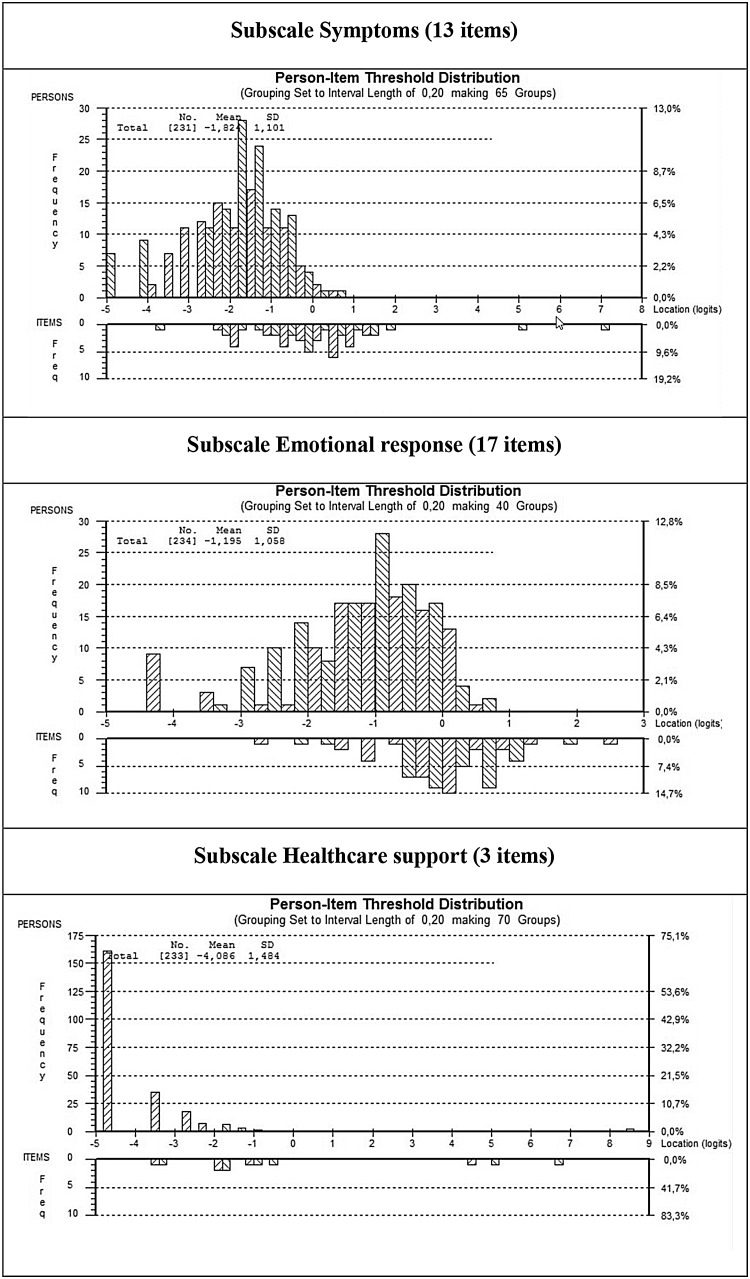
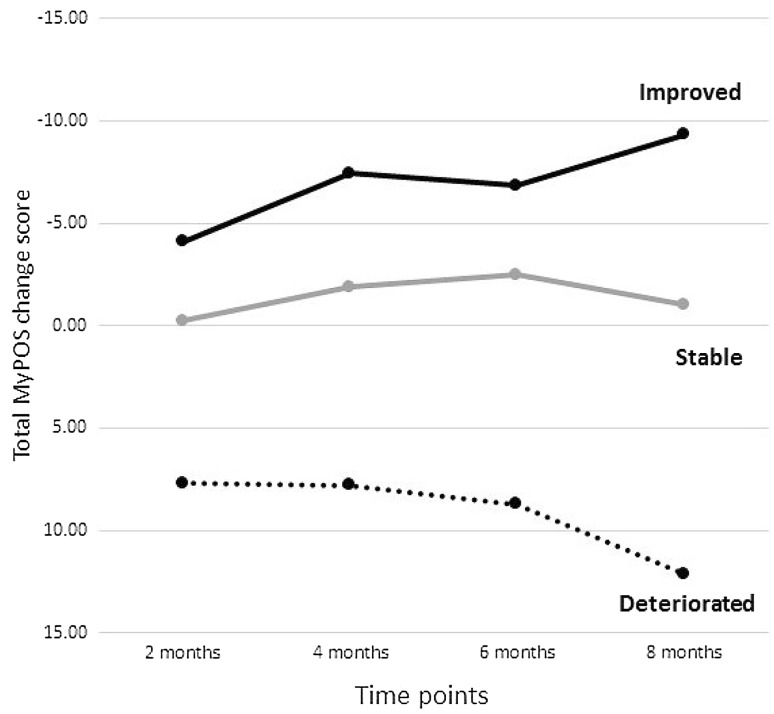
Results: 238 patients with multiple myeloma were recruited. Confirmatory factor analysis found three subscales; criteria for scaling assumptions were satisfied except for gastrointestinal items and the Healthcare support scale. Rasch analysis identified limitations of suboptimal scale-to-sample targeting, resulting in floor effects. Test-retest reliability indices were good (R = > 0.97). Responsiveness analysis yielded an MID of +2.5 for improvement and -4.5 for deterioration.
Conclusions: The MyPOS demonstrated good longitudinal measurement properties, with potential areas for revision being the Healthcare Support subscale and the rating scale. The new psychometric approaches should be used for testing validity of monitoring in clinical settings.
Keywords: Health status; Multiple myeloma; Quality of life; Rasch analysis; Responsiveness.
Conflict of interest statement
Conflicts of interest
All authors declare that they have no conflicts of interests.
Ethical approval
All procedures performed in studies involving human participants were in accordance with the ethical standards of the institutional and/or national research committee and with the 1964 Helsinki declaration and its later amendments or comparable ethical standards. Ethical and research governance approvals were obtained from the Central London Research Ethics Committee (reference number: 13/LO/1140) with further local Research and Development approvals obtained from all participating NHS hospital trusts. These collaborating centres were Bradford Teaching Hospitals NHS Foundation Trust, Burton Hospitals NHS Foundation Trust, Colchester Hospital University NHS Foundation Trust, East Cheshire NHS Trust, Epsom and St Helier University Hospitals NHS Trust, Guy’s and St Thomas’ NHS Foundation Trust, King’s College Hospital NHS Foundation Trust, Medway NHS Foundation Trust, Mid Yorkshire Hospitals NHS Trust, Royal Free London NHS Foundation Trust, Surrey and Sussex Healthcare NHS Trust, and the University Hospital Coventry and Warwickshire NHS Trust. These collaborating and supporting organisations were not involved in planning the study or preparing the manuscript.
Informed consent
Informed consent was obtained from all individual participants included in the study.
Figures
References
-
- World Health Organisation. (2015). Cancer. Fact sheet No. 297. Resource document. World Health Organisation. Retrieved March 03, 2000, from http://www.who.int/mediacentre/factsheets/fs297/en/.
-
- Siegel RL, Miller KD, Jemal A. Cancer statistics 2016. CA Cancer Journal for Clinicians. 2016;66(1):7–30. - PubMed
-
- Malvezzi M, Caroli G, Bertuccio P, Rosso T, Boffetta P, Levi F, et al. European cancer mortality predictions for the year 2016 with focus on leukaemias. Annals of Oncology. 2016;27:725–731. - PubMed
-
- Phekoo KJ, Schey SA, Richards MA, Bevan DH, Bell S, Gillett D, et al. A population study to define the incidence and survival of multiple myeloma in a National Health Service Region in UK. British Journal of Haematology. 2004;127(3):299–304. - PubMed
-
- Niscola P, Tendas A, Giovannini M, Scaramucci L, Perrotti A, Fabritiis P, et al. Caring for terminal patients in haematology: the urgent need of a new research agenda. Supportive Care in Cancer. 2015;23(1):5–7. - PubMed
Publication types
MeSH terms
LinkOut - more resources
Full Text Sources
Other Literature Sources
Medical
