. 2018 May;19(5):1075-1089.
doi: 10.1111/mpp.12587. Epub 2017 Oct 4.

The first phlebo-like virus infecting plants: a case study on the adaptation of negative-stranded RNA viruses to new hosts

Affiliations

The first phlebo-like virus infecting plants: a case study on the adaptation of negative-stranded RNA viruses to new hosts

Beatriz Navarro et al. Mol Plant Pathol. 2018 May.

Abstract

A novel negative-stranded (ns) RNA virus associated with a severe citrus disease reported more than 80 years ago has been identified. Transmission electron microscopy showed that this novel virus, tentatively named citrus concave gum-associated virus, is flexuous and non-enveloped. Notwithstanding, its two genomic RNAs share structural features with members of the genus Phlebovirus, which are enveloped arthropod-transmitted viruses infecting mammals, and with a group of still unclassified phlebo-like viruses mainly infecting arthropods. CCGaV genomic RNAs code for an RNA-dependent RNA polymerase, a nucleocapsid protein and a putative movement protein showing structural and phylogenetic relationships with phlebo-like viruses, phleboviruses and the unrelated ophioviruses, respectively, thus providing intriguing evidence of a modular genome evolution. Phylogenetic reconstructions identified an invertebrate-restricted virus as the most likely ancestor of this virus, revealing that its adaptation to plants was independent from and possibly predated that of the other nsRNA plant viruses. These data are consistent with an evolutionary scenario in which trans-kingdom adaptation occurred several times during the history of nsRNA viruses and followed different evolutionary pathways, in which genomic RNA segments were gained or lost. The need to create a new genus for this bipartite nsRNA virus and the impact of the rapid and specific detection methods developed here on citrus sanitation and certification are also discussed.

Keywords: citrus disease; concave gum; nsRNA virus; phylogeny; virus adaptation.


Figures

Figure 1
Figure 1
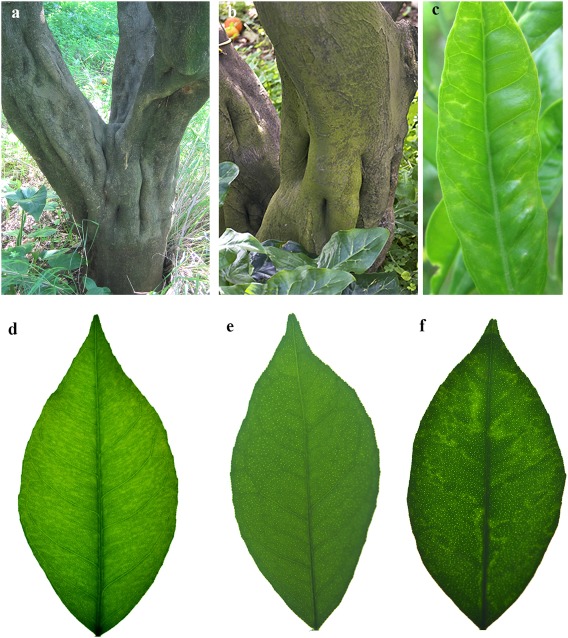
Symptoms of citrus concave gum disease. (a, b) Deeply depressed concavities on trunks and (c) chlorotic flecking observed in sweet orange trees (symptoms observed on the CGW2 tree are shown in a and c). (d) Chlorotic flecks and (f) oak‐leaf pattern in seedlings (cv. Madam vinous) graft inoculated with bark patches from a diseased tree. (e) Symptomless leaf from a negative control (cv. Madam vinous).
Figure 2
Figure 2
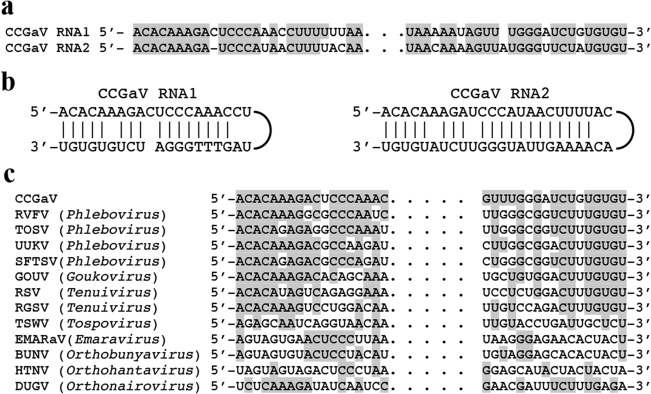
Terminal sequences of citrus concave gum‐associated virus genomic RNAs. (a) Alignment of 5′ (left) and 3′ (right) termini of CCGaV RNAs. (b) Panhandle structures formed by the 5′ and 3′ termini of CCGaV RNAs. (c) Alignment of CCGaV RNA1 termini with those of other negative‐stranded RNA (nsRNA) viruses. Identical nucleotides are in grey. BUNV, Bunyamwera virus; DUGV, Dugbe virus; EMARaV, European mountain ash ringspot‐associated virus; GOUV, Gouleako virus; HTNV, Hantaan virus; RGSV, rice grassy stunt virus; RSV, rice stripe virus; RVFV, Rift Valley fever virus; SFTSV, severe fever with thrombocytopenia syndrome; TOSV, Toscana virus; TSWV, tomato spotted wilt virus; UUKV, Uukuniemi virus.
Figure 3
Figure 3
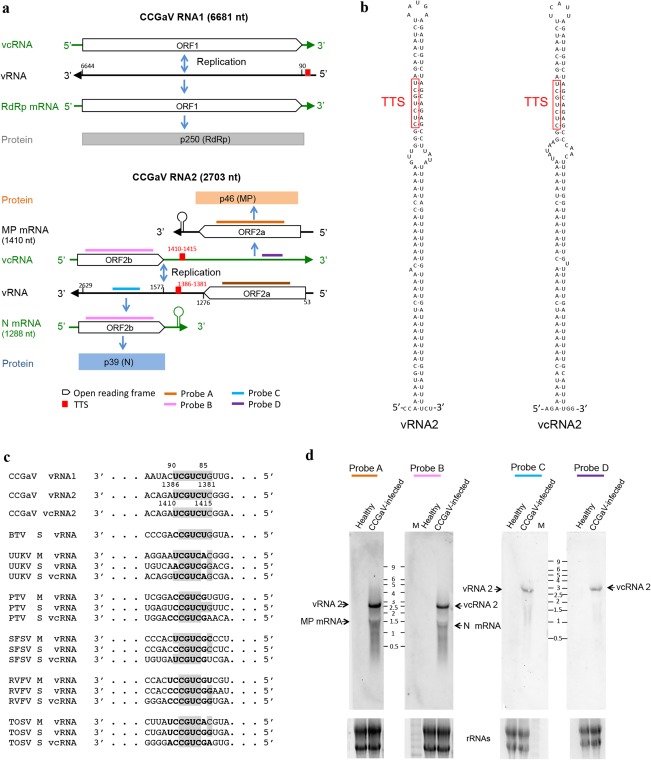
Citrus concave gum‐associated virus genome organization and expression strategy. (a) Schematic diagram. MP, movement protein; N, nucleocapsid; ORF, open reading frame; RdRp, RNA‐dependent RNA polymerase; vRNA, viral RNA; vcRNA, viral complementary RNA. (b) Stem loop and predicted transcription termination signal (TTS) motifs in the intergenic region (IR) of both RNA2 strands. (c) Alignment of TTS (in bold) identified in CCGaV RNAs with those of several phleboviruses and the phlebo‐like Bole tick virus (BTV) (TTS predicted in this study); nucleotides identical to CCGaV TTSs are in grey; PTV, Punta Toro virus; RVFV, Rift Valley fever virus; SFSV, sandfly fever Sicilian virus; TOSV, Toscana virus; UUKV, Uukuniemi virus. (d) Northern blot analysis of RNAs from citrus trees. M, Millennium RNA marker (Applied Biosystems/Ambion) with sizes (kb) indicated between the dashes. Equal loading assessed by ethidium bromide staining of rRNAs (bottom panels).
Figure 4
Figure 4
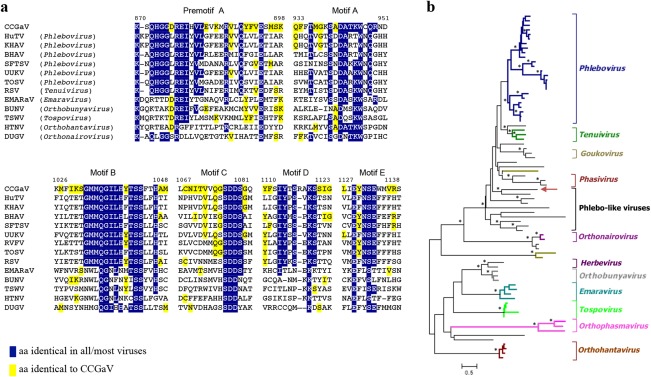
Relationships of citrus concave gum‐associated virus RNA‐dependent RNA polymerase (RdRp) with other negative‐stranded RNA (nsRNA) viruses. (a) Multiple alignment of RdRp conserved motifs. Positions in the CCGaV RdRp are reported. aa, amino acids; BHAV, Bhanja virus; BUNV, Bunyamwera virus; DUGV, Dugbe virus; EMARaV, European mountain ash ringspot‐associated virus; HTNV, Hantaan virus; HuTV, Huangpi tick virus 2; KHAV, Khasan virus; RSV, rice stripe virus; RVFV, Rift Valley fever virus; SFTSV, severe fever with thrombocytopenia syndrome; TOSV, Toscana virus; TSWV, tomato spotted wilt virus; UUKV, Uukuniemi virus. (b) Maximum‐likelihood (ML) phylogenetic analysis of polymerase proteins. The recognized genera and group of phlebo‐like viruses are shown. The black and ochre branches correspond to unclassified viruses infecting arthropods and fungi, respectively. Asterisks mark nodes with bootstrap values >90%. A detailed tree version is shown in Fig. S3 (see Supporting Information).
Figure 5
Figure 5
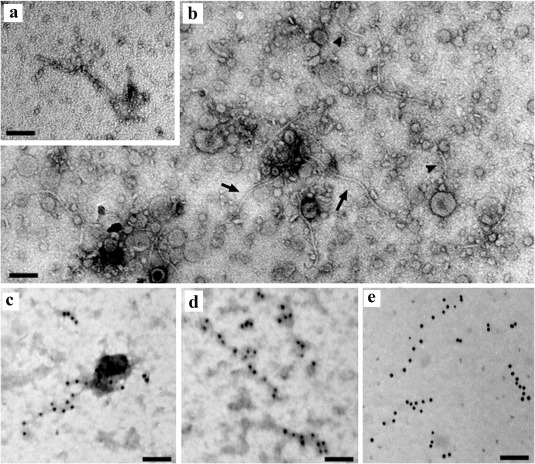
Electron micrograph of citrus concave gum‐associated virus (CCGaV) particles. (a) Negative staining of a particle from the sap. (b) Partially purified dip preparation with elongated flexuous particles of 200–300 nm (arrows) and shorter fragments thereof (arrowheads). (c–e) Immunolabelled gold particles, stained (c, d) and unstained (e). Bar, 100 nm.
Figure 6
Figure 6
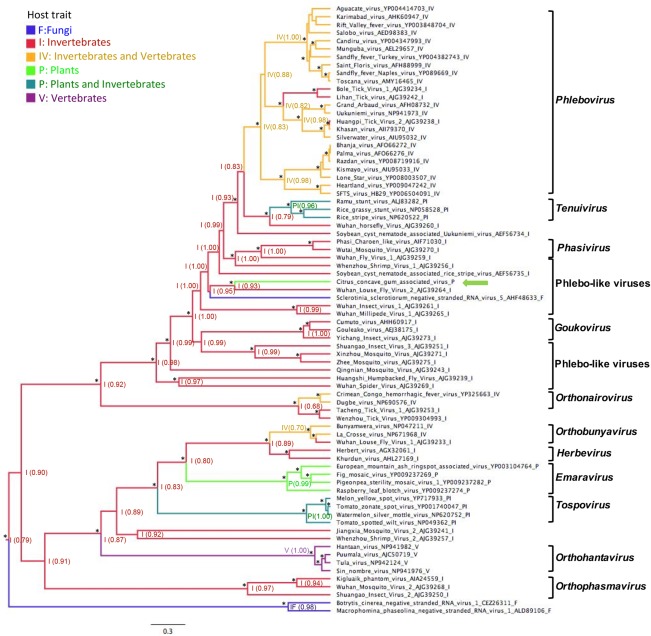
Ancestral state reconstruction of host trait based on the RNA‐dependent RNA polymerase (RdRp). The most probable host state is reported at each node with the posterior probability shown in parentheses. Asterisks denote a Bayesian posterior probability of >90%. Branches are colour coded according to the host state and are proportional to the genetic distances. The scale bar indicates substitutions per amino acid site. Square brackets delimit clusters of viruses belonging to the same genus, the name of which is on the right. citrus concave gum‐associated virus is indicated by a green arrow.

References

    1. Abascal, F. , Zardoya, R. and Posada, D. (2005) ProtTest: selection of best‐fit models of protein evolution. Bioinformatics, 21, 2104–2105. - PubMed
    1. Albariño, C.G. , Bird, B.H. and Nichol, S.T. (2007) A shared transcription termination signal on negative and ambisense RNA genome segments of Rift Valley fever, sandfly fever Sicilian, and Toscana viruses. J. Virol. 81, 5246–5256. - PMC - PubMed
    1. Alioto, D. , Gangemi, M. , Deaglio, S. , Sposato, P. , Noris, E. , Luisoni, E. and Milne, R.G. (1999) Improved detection of citrus psorosis virus using polyclonal and monoclonal antibodies. Plant Pathol. 48, 735–741.
    1. Armougom, F. , Moretti, S. , Poirot, O. , Audic, S. , Dumas, P. , Schaeli, B. , Keduas, V. and Notredame, C. (2006) Expresso: automatic incorporation of structural information in multiple sequence alignments using 3D‐Coffee. Nucleic Acids Res. 34, W604–W608. - PMC - PubMed
    1. Bekal, S. , Domier, L.L. , Niblack, T.L. and Lambert, K.N. (2011) Discovery and initial analysis of novel viral genomes in the soybean cyst nematode. J. Gen. Virol. 92, 1870–1879. - PubMed

Publication types

LinkOut - more resources