. 2017 Oct;19(10):4154-4163.
doi: 10.1111/1462-2920.13866. Epub 2017 Aug 14.

Systematic genetic dissection of chitin degradation and uptake in Vibrio cholerae

Affiliations

Systematic genetic dissection of chitin degradation and uptake in Vibrio cholerae

Chelsea A Hayes et al. Environ Microbiol. 2017 Oct.

Abstract

Vibrio cholerae is a natural resident of the aquatic environment, where a common nutrient is the chitinous exoskeletons of microscopic crustaceans. Chitin utilization requires chitinases, which degrade this insoluble polymer into soluble chitin oligosaccharides. These oligosaccharides also serve as an inducing cue for natural transformation in Vibrio species. There are 7 predicted endochitinase-like genes in the V. cholerae genome. Here, we systematically dissect the contribution of each gene to growth on chitin as well as induction of natural transformation. Specifically, we created a strain that lacks all 7 putative chitinases and from this strain, generated a panel of strains where each expresses a single chitinase. We also generated expression plasmids to ectopically express all 7 chitinases in our chitinase deficient strain. Through this analysis, we found that low levels of chitinase activity are sufficient for natural transformation, while growth on insoluble chitin as a sole carbon source requires more robust and concerted chitinase activity. We also assessed the role that the three uptake systems for the chitin degradation products GlcNAc, (GlcNAc)2 and (GlcN)2 , play in chitin utilization and competence induction. Cumulatively, this study provides mechanistic details for how this pathogen utilizes chitin to thrive and evolve in its environmental reservoir.


Figures

Fig. 1
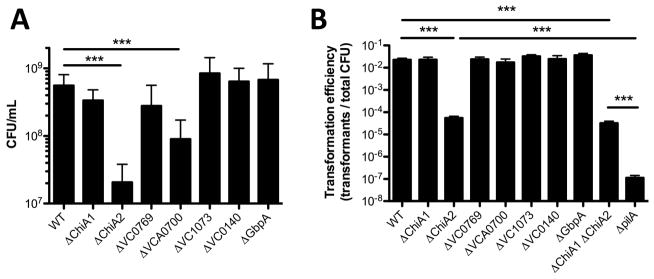
Fig. 1. Characterizing chitinase single mutants for growth on chitin and natural transformation
(A) Growth of the indicated mutant strains in M9 minimal medium with chitin as a sole carbon source. (B) Chitin-induced natural transformation of the indicated mutant strains. All data are shown as the mean ± SD and are from at least 3 independent biological replicates. *** = p<0.001.
Fig. 2
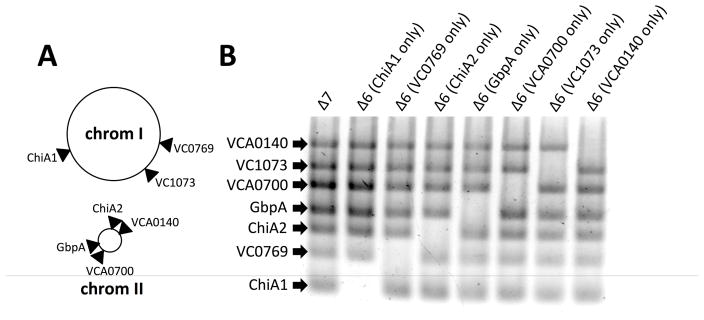
Fig. 2. MuGENT for systematic inactivation of all 7 chitinase-like genes
(A) Chromosomal map of the location of the seven chitinases inactivated in this study. (B) MASC-PCR of the indicated mutants. The presence of a band indicates that the gene indicated to the left is inactivated, while the absence of a band indicates that this gene is intact.
Fig. 3
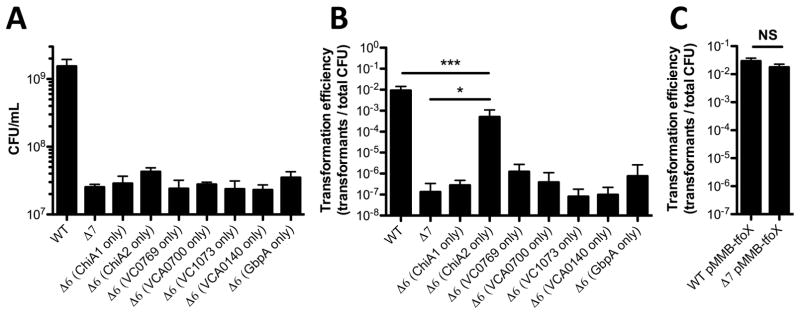
Fig. 3. ChiA2 is sufficient for natural transformation, but not growth on chitin
(A) Growth of the indicated mutant strains in M9 medium with chitin as a sole carbon source. (B) Chitin-induced natural transformation of the indicated mutant strains. (C) Chitin-independent natural transformation assay of the indicated mutants. TfoX was induced in these experiments with 100 μM IPTG. All data are shown as the mean ± SD and are from at least 3 independent biological replicates. * = p<0.05, *** = p<0.001, NS = not significant.
Fig. 4
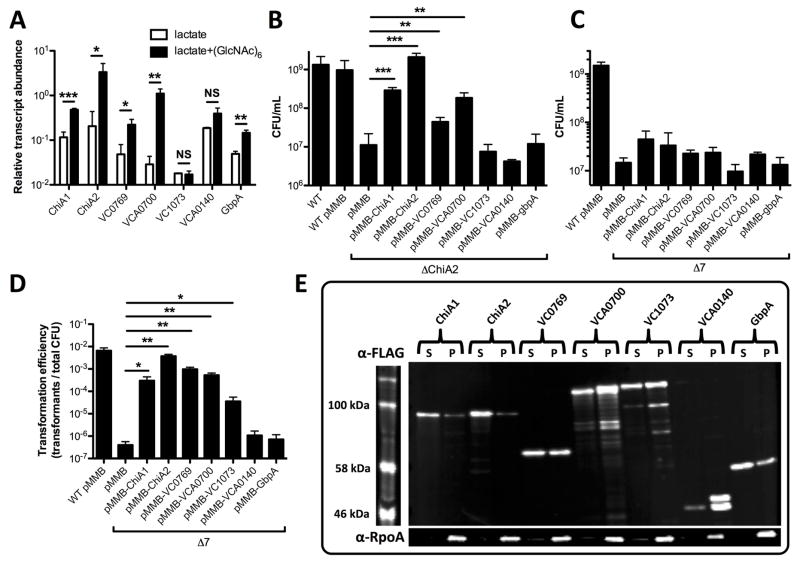
Fig. 4. Overexpression of single chitinases in a Δ7 strain recovers natural transformation but not growth on chitin
(A) Relative transcript abundance of the indicated genes from RNA-seq data. (B) Growth of the indicated mutant strains in M9 medium containing chitin as a sole carbon source. (C) Growth of the indicated mutant strains in M9 medium with chitin as a sole carbon source. (D) Chitin-induced natural transformation of the indicated mutant strains. Genes were induced in B, C and D with 100 μM IPTG. (E) Western blot analysis of strains in the Δ7 background harboring a pMMB expression construct with the C-terminally FLAG tagged chitinase indicated. Supernatant (S) and pellet (P) fractions were run for each strain and probed with α-FLAG (top) and α-RpoA (bottom) antibodies. All data in AD are shown as the mean ± SD and are from at least 3 independent biological replicates. * = p<0.05, ** = p<0.01, and *** = p<0.001, and NS = not significant.
Fig. 5
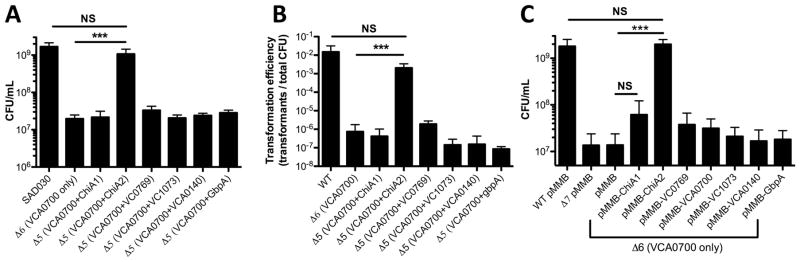
Fig. 5. ChiA2 and VCA0700 are sufficient for growth on chitin
(A) Growth of the indicated mutant strains in M9 medium with chitin as a sole carbon source. (B) Chitin-induced natural transformation of the indicated mutant strains. (C) Growth of the indicated strains in M9 medium with chitin as the sole carbon source and 100 μM IPTG. All data are shown as the mean ± SD and are from at least 3 independent biological replicates. *** = p<0.001, NS = not significant.
Fig. 6
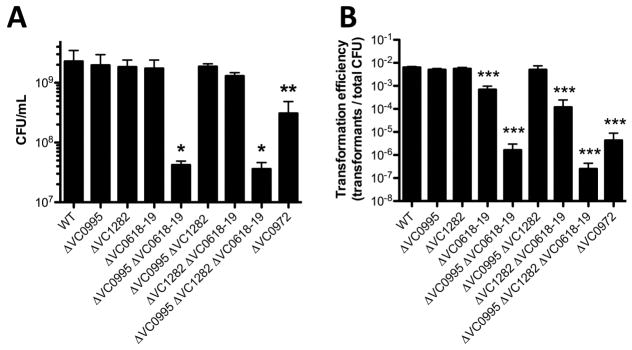
Fig. 6. Role of chitin transporters for growth on chitin and chitin-induced natural transformation
(A) Growth of the indicated mutant strains in M9 medium with chitin as a sole carbon source. (B) Chitin-induced natural transformation of the indicated mutant strains. All data are shown as the mean ± SD and are from at least 3 independent biological replicates. All statistical comparisons in A and B were made between the indicated mutant and the WT. * = p<0.05, ** = p<0.01, and *** = p<0.001.
Fig. 7
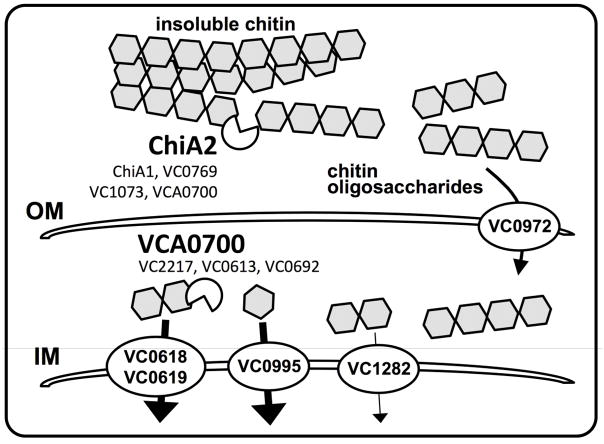
Fig. 7. Schematic of the chitin utilization pathway genetically dissected in this study
First, extracellular chitinases degrade insoluble chitin into soluble chitin oligosaccharides. While ChiA2 is the dominant enzyme required for this process, the chitinases ChiA1, VC0769, VC1073, and VCA0700 likely play some role. These soluble oligosaccharides are then taken up across the outer membrane (OM) and into the periplasm via the chitoporin encoded by VC0972. Then, these oligosaccharides are likely further broken down by the chitodextrinase VCA0700 and/or exochitinases (VC2217, VC0613, VC0692) into (GlcNAc)2 (aka chitobiose), GlcNAc, and (GlcN)2, which are taken up across the inner membrane (IM) into the cytoplasm by the transporters encoded by VC0618-0619, VC0995, and VC1282, respectively. Our results indicate that for robust growth on chitin, the transporters responsible for uptake of chitobiose and GlcNAc play the largest role.

References

    1. Afgan E, Baker D, van den Beek M, Blankenberg D, Bouvier D, Cech M, et al. The Galaxy platform for accessible, reproducible and collaborative biomedical analyses: 2016 update. Nucleic Acids Res. 2016;44:W3–W10. - PMC - PubMed
    1. Bassler BL, Yu C, Lee YC, Roseman S. Chitin utilization by marine bacteria. Degradation and catabolism of chitin oligosaccharides by Vibrio furnissii. J Biol Chem. 1991;266:24276–24286. - PubMed
    1. Burnette WN. “Western blotting”: electrophoretic transfer of proteins from sodium dodecyl sulfate--polyacrylamide gels to unmodified nitrocellulose and radiographic detection with antibody and radioiodinated protein A. Anal Biochem. 1981;112:195–203. - PubMed
    1. Colwell RR, Huq A, Islam MS, Aziz KM, Yunus M, Khan NH, et al. Reduction of cholera in Bangladeshi villages by simple filtration. Proc Natl Acad Sci U S A. 2003;100:1051–1055. - PMC - PubMed
    1. Dalia AB. RpoS is required for natural transformation of Vibrio cholerae through regulation of chitinases. Environ Microbiol. 2016;18:3758–3767. - PubMed

MeSH terms

LinkOut - more resources