


Bilingual language intrusions and other speech errors in Alzheimer's disease
- PMID: 28753438
- PMCID: PMC5595660
- DOI: 10.1016/j.bandc.2017.07.007
Bilingual language intrusions and other speech errors in Alzheimer's disease
Abstract
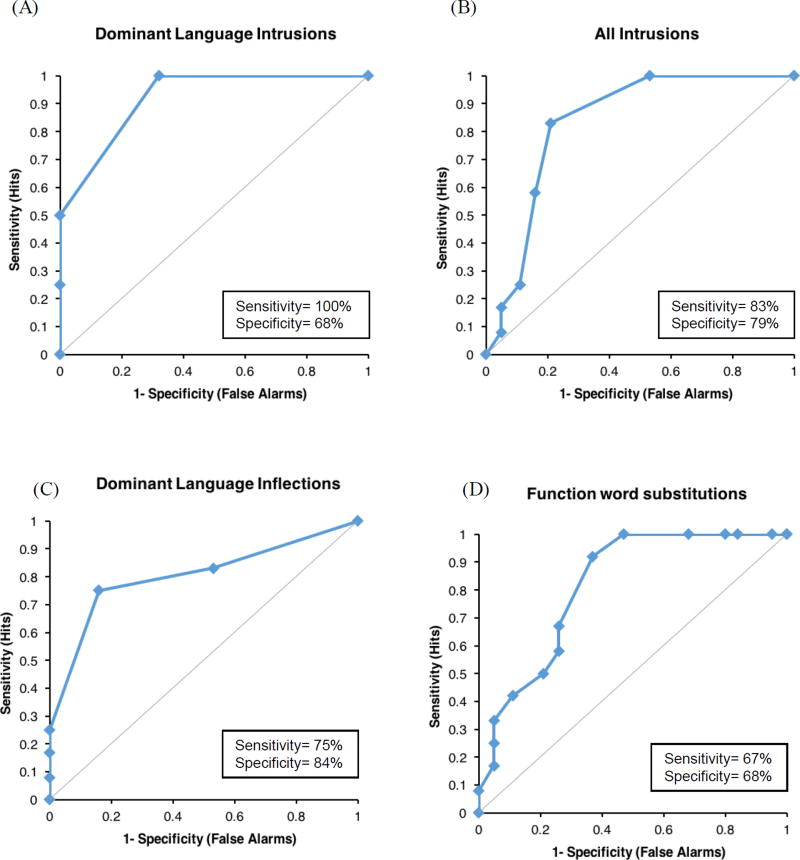
The current study investigated how Alzheimer's disease (AD) affects production of speech errors in reading-aloud. Twelve Spanish-English bilinguals with AD and 19 matched controls read-aloud 8 paragraphs in four conditions (a) English-only, (b) Spanish-only, (c) English-mixed (mostly English with 6 Spanish words), and (d) Spanish-mixed (mostly Spanish with 6 English words). Reading elicited language intrusions (e.g., saying la instead of the), and several types of within-language errors (e.g., saying their instead of the). Patients produced more intrusions (and self-corrected less often) than controls, particularly when reading non-dominant language paragraphs with switches into the dominant language. Patients also produced more within-language errors than controls, but differences between groups for these were not consistently larger with dominant versus non-dominant language targets. These results illustrate the potential utility of speech errors for diagnosis of AD, suggest a variety of linguistic and executive control impairments in AD, and reveal multiple cognitive mechanisms needed to mix languages fluently. The observed pattern of deficits, and unique sensitivity of intrusions to AD in bilinguals, suggests intact ability to select a default language with contextual support, to rapidly translate and switch languages in production of connected speech, but impaired ability to monitor language membership while regulating inhibitory control.
Keywords: Alzheimer’s disease; Bilingualism; Diagnosis; Reading-aloud; Speech errors; Switching.
Copyright © 2017 Elsevier Inc. All rights reserved.
Conflict of interest statement
The authors declared that they had no conflicts of interest with respect to their authorship or the publication of this article.
Figures


References
-
- Abutalebi J, Green D. Control mechanisms in bilingual language production: Neural evidence from language switching studies. Language and Cognitive Processes. 2008;23:557–582.
-
- Abutalebi J, Green DW. Bilingual language production: The neurocognition of language representation and control. Journal of Neurolinguistics. 2007;20:242–275.
-
- Adlam AL, Patterson K, Rogers TT, Nestor PJ, Salmond CH, Acosta-Cabronero J, et al. Semantic dementia and fluent primary progressive aphasia: Two sides of the same coin? Brain. 2006;129:3066–3080. - PubMed
-
- Agosta F, Pievani M, Geroldi C, Copetti M, Frisoni GB, Filippi M. Resting state fMRI in Alzheimer's disease: beyond the default mode network. Neurobiology of Aging. 2012;33:1564–1578. - PubMed
-
- Almor A, Kempler D, MacDonald MC, Andersen ES, Tyler LK. Why do Alzheimer patients have difficulty with pronouns? Working memory, semantics, and reference in comprehension and production in Alzheimer’s disease. Brain and Language. 1999;67:202–227. - PubMed
MeSH terms
Grants and funding
LinkOut - more resources
Full Text Sources
Other Literature Sources
Medical
