


Double impact: natural molluscicide for schistosomiasis vector control also impedes development of Schistosoma mansoni cercariae into adult parasites
- PMID: 28753630
- PMCID: PMC5550001
- DOI: 10.1371/journal.pntd.0005789
Double impact: natural molluscicide for schistosomiasis vector control also impedes development of Schistosoma mansoni cercariae into adult parasites
Abstract
Background: Schistosomiasis has been reported in 78 endemic countries and affects 240 million people worldwide. The digenetic parasite Schistosoma mansoni needs fresh water to compete its life cycle. There, it is susceptible to soluble compounds that can affect directly and/or indirectly the parasite's biology. The cercariae stage is one of the key points in which the parasite is vulnerable to different soluble compounds that can significantly alter the parasite's life cycle. Molluscicides are recommended by the World Health Organization for the control of schistosomiasis transmission and Euphorbia milii latex is effective against snails intermediate hosts.
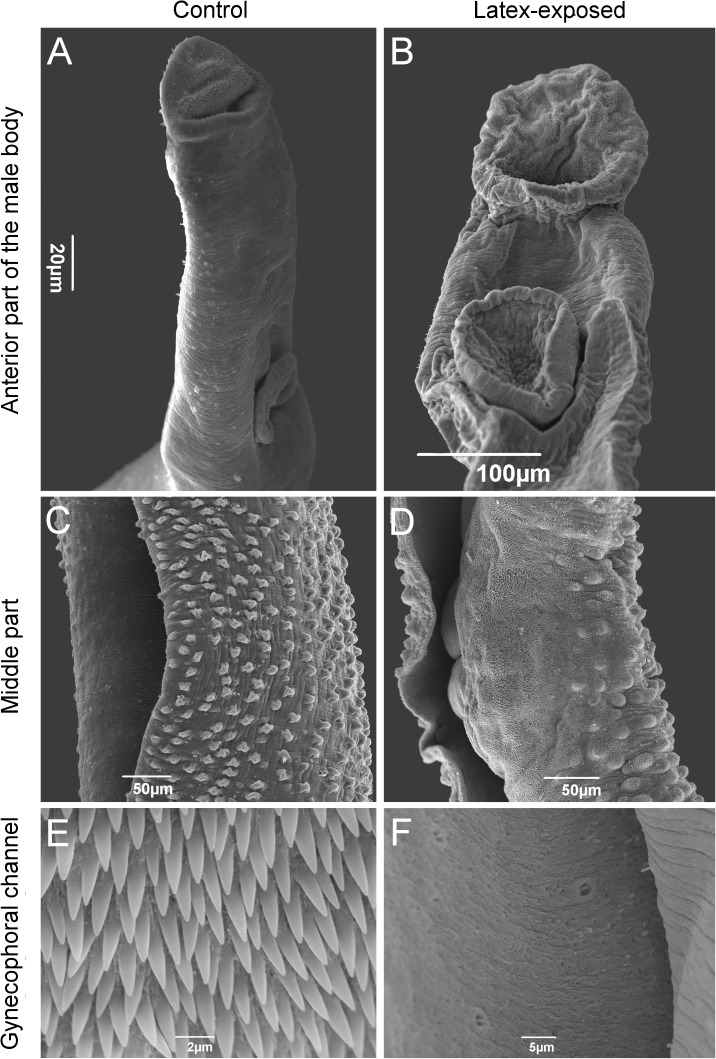
Methodology/principal findings: We used parasitological tools and electron microscopy to verify the effects of cercariae exposure to natural molluscicide (Euphorbia milii latex) on morphology, physiology and fitness of adult parasite worms. In order to generate insights into key metabolic pathways that lead to the observed phenotypes we used comparative transcriptomics and proteomics.
Conclusions/significance: We describe here that the effect of latex on the adult is not due to direct toxicity but it triggers an early change in developmental trajectory and perturbs cell memory, mobility, energy metabolism and other key pathways. We conclude that latex has not only an effect on the vector but applies also long lasting schistosomastatic action. We believe that these results are of interest not only to parasitologists since it shows that natural compounds, presumably without side effects, can have an impact that occurred unexpectedly on developmental processes. Such collateral damage is in this case positive, since it impacts the true target of the treatment campaign. This type of treatment could also provide a rational for the control of other pests. Our results will contribute to enforce the use of E. milii latex in Brazil and other endemic countries as cheap alternative or complement to mass drug treatment with Praziquantel, the only available drug to cure the patients (without preventing re-infection).
Conflict of interest statement
The authors have declared that no competing interests exist.
Figures
References
-
- Steinmann P, Keiser J, Bos R, et al. Schistosomiasis and water resources development: systematic review, meta-analysis, and estimates of people at risk. Lancet Infect Dis. 2006; 6: 411–425. doi: 10.1016/S1473-3099(06)70521-7 - DOI - PubMed
-
- World Health Organization (WHO). Prevention and control of schistosomiasis and soil-transmitted helminthiasis, WHO, Geneve; 2002. - PubMed
-
- King CH, Sutherland LJ, Bertsch D. Systematic review and meta-analysis of the impact of chemical-based mollusciciding for control of Schistosoma mansoni and S. haematobium transmission. Plos NTD. 2015; 9: e0004290 doi: 10.1371/journal.pntd.0004290 - DOI - PMC - PubMed
-
- World Health Organization (WHO) Report of the WHO strategic and technical advisory group for neglected tropical diseases WHO headquarters; 2014.
-
- Colley DG, Secor WE. A schistosomiasis research agenda. Plos NTD. 2007; 1: e32 doi: 10.1371/journal.pntd.0000032 - DOI - PMC - PubMed
MeSH terms
Substances
Grants and funding
LinkOut - more resources
Full Text Sources
Other Literature Sources
Molecular Biology Databases
