


Predicting Prostate Cancer Progression as a Function of ETS-related Gene Status, Race, and Obesity in a Longitudinal Patient Cohort
- PMID: 28753864
- PMCID: PMC7061732
- DOI: 10.1016/j.euf.2017.02.016
Predicting Prostate Cancer Progression as a Function of ETS-related Gene Status, Race, and Obesity in a Longitudinal Patient Cohort
Abstract
Background: ETS-related gene (ERG) oncogenic activation is the most common genomic alteration in prostate cancer (CaP) although it occurs less frequently in African American (AA) versus Caucasian (CA) patients, and the potential role of ERG as a prognostic marker has not been confirmed.
Objective: This study was conducted to confirm strong racial variation in the prevalence of ERG oncoprotein expression and to examine ERG oncoprotein expression, race, and body mass index as independent and joint predictors of CaP biochemical recurrence (BCR) following radical prostatectomy (RP).
Design, setting, and participants: A retrospective cohort study of CA and AA CaP patients enrolled at Walter Reed National Military Medical Center, who donated clinically annotated, whole-mounted, prostatectomy specimens between 1994 and 2014 following RP, was conducted.
Outcome measurements and statistical analysis: Kaplan-Meier (KM) estimation curves and multivariable Cox proportional hazards models were used to examine time to BCR as a function of ERG status, patient race, and obesity.
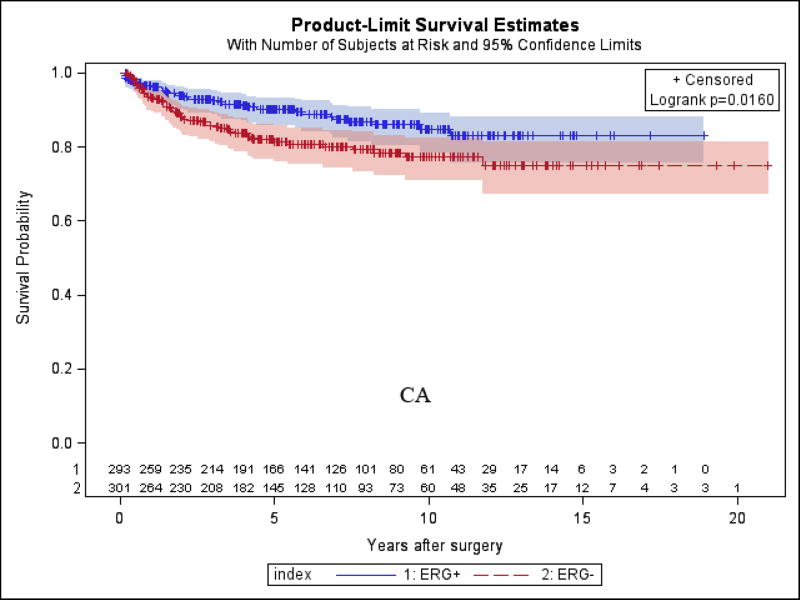
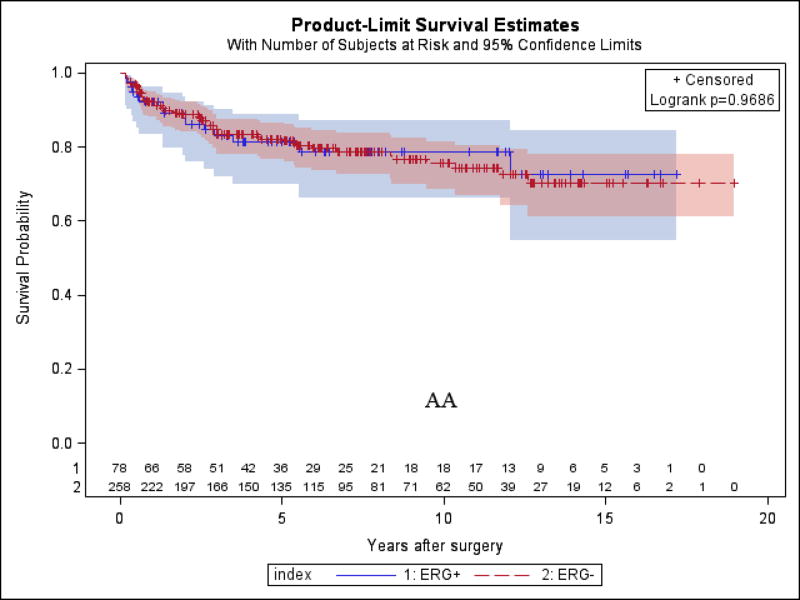
Results and limitations: Among 930 eligible patients (36.1% AA and 63.9% CA), with 155 (16.7%) BCR events and a median follow-up time of 5.1 yr, ERG oncoprotein expression was significantly less prevalent in index tumors of AA versus CA patients (23.2% vs 49.3%; p<0.0001). KM curves showed significantly poorer BCR-free survival for CA patients with ERG-negative index tumors but not for AA patients. Race-stratified multivariable analyses revealed a significant association between ERG-negative index tumors and poorer BCR-free survival among CA patients (hazards ratio=1.67, confidence interval=1.07, 2.61; p=0.024). Less heterogeneity in ERG expression among AA patients may reduce the ability to show its association with BCR.
Conclusions: Striking racial variation in ERG oncoprotein expression was confirmed. A novel observation was the importance of index tumor ERG-negative status in predicting CaP progression for CA patients.
Patient summary: ETS-related gene (ERG) typing of tumors may be useful in prognosticating prostate cancer aggressiveness.
Keywords: Biochemical recurrence; ERG fusion; Obesity; Prostate cancer; Race.
Copyright © 2017 European Association of Urology. All rights reserved.
Figures
References
-
- American Cancer Society. Cancer facts & figures. Atlanta, GA: American Cancer Society; 2016.
-
- Hu Y, Dobi A, Sreenath T, et al. Delineation of TMPRSS2-ERG splice variants in prostate cancer. Clin Cancer Res. 2008;14:4719–25. - PubMed
-
- Petrovics G, Liu A, Shaheduzzaman S, et al. Frequent overexpression of ETS-related gene-1 (ERG1) in prostate cancer transcriptome. Oncogene. 2005;24:3847–52. - PubMed
Publication types
MeSH terms
Substances
Grants and funding
LinkOut - more resources
Full Text Sources
Other Literature Sources
Medical
Miscellaneous
