


Th17 in Animal Models of Rheumatoid Arthritis
- PMID: 28753982
- PMCID: PMC5532581
- DOI: 10.3390/jcm6070073
Th17 in Animal Models of Rheumatoid Arthritis
Abstract
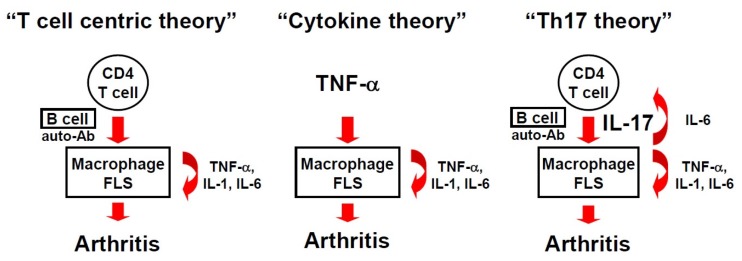
IL-17-secreting helper CD4 T cells (Th17 cells) constitute a newly identified subset of helper CD4 T cells that play a key role in the development of rheumatoid arthritis (RA) in its animal models. Recently, several models of spontaneous RA, which elucidate the mechanism of RA onset, have been discovered. These animal models shed new light on the role of Th17 in the development of autoimmune arthritis. Th17 cells coordinate inflammation and promote joint destruction, acting on various cells, including neutrophils, macrophages, synovial fibroblasts, and osteoclasts. Regulatory T cells cannot control Th17 cells under conditions of inflammation. In this review, the pathogenic role of Th17 cells in arthritis development, which was revealed by the recent animal models of RA, is discussed.
Keywords: IL-17-secreting helper CD4 T cells (Th17 cells); animal models; regulatory T cells; rheumatoid arthritis; synovial fibroblasts.
Conflict of interest statement
The author belongs to a department that is financially supported by four pharmaceutical companies (Mitsubishi-Tanabe, Chugai, Ayumi, UCB Japan). The author has received a research grand from Astellas and honoraria from Bristol-Myers Squibb.
Figures
References
Publication types
LinkOut - more resources
Full Text Sources
Other Literature Sources
Research Materials
