


Web-Based Interventions to Improve Mental Health, General Caregiving Outcomes, and General Health for Informal Caregivers of Adults With Chronic Conditions Living in the Community: Rapid Evidence Review
- PMID: 28754652
- PMCID: PMC5554353
- DOI: 10.2196/jmir.7564
Web-Based Interventions to Improve Mental Health, General Caregiving Outcomes, and General Health for Informal Caregivers of Adults With Chronic Conditions Living in the Community: Rapid Evidence Review
Abstract
Background: Most adults with chronic conditions live at home and rely on informal caregivers to provide support. Caregiving can result in negative impacts such as poor mental and physical health. eHealth interventions may offer effective and accessible ways to provide education and support to informal caregivers. However, we know little about the impact of Web-based interventions for informal caregivers of community-dwelling adults with chronic conditions.
Objective: The purpose of this rapid evidence review was to assess the impact of Web-based interventions on mental health, general caregiving outcomes, and general health for informal caregivers of persons with chronic conditions living in the community.
Methods: A rapid evidence review of the current literature was employed to address the study purpose. EMBASE, MEDLINE, PsychInfo, CINAHL, Cochrane, and Ageline were searched covering all studies published from January 1995 to July 2016. Papers were included if they (1) included a Web-based modality to deliver an intervention; (2) included informal, unpaid adult caregivers of community-living adults with a chronic condition; (3) were either a randomized controlled trial (RCT) or controlled clinical trial (CCT); and (4) reported on any caregiver outcome as a result of use or exposure to the intervention.
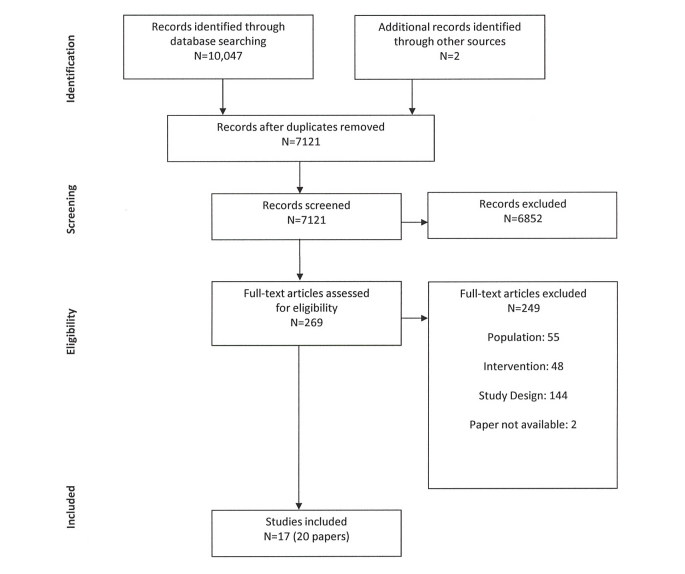
Results: A total of 20 papers (17 studies) were included in this review. Study findings were mixed with both statistically significant and nonsignificant findings on various caregiver outcomes. Of the 17 included studies, 10 had at least one significant outcome. The most commonly assessed outcome was mental health, which included depressive symptoms, stress or distress, and anxiety. Twelve papers examined the impact of interventions on the outcome of depressive symptoms; 4 found a significant decrease in depressive symptoms. Eight studies examined the outcome of stress or distress; 4 of these found a significant reduction in stress or distress as a result of the intervention. Three studies examined the outcome of anxiety; 2 of these found significant reductions in anxiety. Other significant results of the interventions were seen in the outcomes of caregiver gain (ie, positive aspects of caregiving), knowledge, bonding, reduction of anger-hostility, and negative mood. Based on this review, it is not possible to determine which interventions were most effective since studies differed in their design, sample, and intervention. Study results suggest that Web-based interventions may result in reduced depressive symptoms, anxiety, and stress or distress among informal caregivers of adults with chronic conditions in the community.
Conclusions: This is the first review assessing the impact of Web-based technologies on mental health, general caregiving outcomes, and general health for caregivers of adults with chronic conditions living in the community. Further rigorous research is needed that includes adequately powered studies examining the critical components of the intervention and the dosage needed to have an effect.
Keywords: Internet; adult; caregivers; chronic disease; review.
©Jenny Ploeg, Maureen Markle-Reid, Ruta Valaitis, Carrie McAiney, Wendy Duggleby, Amy Bartholomew, Diana Sherifali. Originally published in the Journal of Medical Internet Research (http://www.jmir.org), 28.07.2017.
Conflict of interest statement
Conflicts of Interest: None declared.
References
-
- World Health Organization . WHO. World Health Organization; 2014. [2017-02-22]. Global status report on noncommunicable diseases http://www.who.int/nmh/publications/ncd-status-report-2014/en/ 6oTPg6jwb
-
- Centers for Disease Control and Prevention CDC. 2016. [2017-02-22]. Chronic disease overview https://www.cdc.gov/chronicdisease/overview/ 6oTQB8tsJ - PubMed
-
- Fisher K, Griffith L, Gruneir A, Panjwani D, Gandhi S, Sheng LL, Gafni A, Chris P, Markle-Reid M, Ploeg J. Comorbidity and its relationship with health service use and cost in community-living older adults with diabetes: a population-based study in Ontario, Canada. Diabetes Res Clin Pract. 2016 Dec;122:113–23. doi: 10.1016/j.diabres.2016.10.009. - DOI - PubMed
-
- Ontario Ministry of Health and Long-Term Care Ontario. 2016. Sep, [2017-02-22]. Developing Ontario's dementia strategy: a discussion paper https://files.ontario.ca/developing_ontarios_dementia_strategy_-_a_discu... 6oTQMA2dA.
-
- Fox S. Pew Research Center. Washington: Pew Internet & American Life Project, Pew Research Center; 2011. Feb 28, [2017-02-22]. Peer-to-peer health care http://www.pewinternet.org/2011/02/28/peer-to-peer-health-care-2/ 6oTQhnsir
Publication types
MeSH terms
LinkOut - more resources
Full Text Sources
Other Literature Sources
Medical
