. 2018 Feb;9(1):51-63.
doi: 10.1007/s12975-017-0555-1. Epub 2017 Jul 28.

Chronic Remote Ischemic Conditioning Is Cerebroprotective and Induces Vascular Remodeling in a VCID Model

Affiliations

Chronic Remote Ischemic Conditioning Is Cerebroprotective and Induces Vascular Remodeling in a VCID Model

Mohammad Badruzzaman Khan et al. Transl Stroke Res. 2018 Feb.

Abstract

Vascular contributions to cognitive impairment and dementia (VCID) make up 50% of the cases of dementia. The purpose of this study was to determine the effect of chronic remote ischemic conditioning (C-RIC) on improving long-term (6 months) outcomes and cerebral blood flow (CBF) and collateral formation in a mouse model of VCID. Adult C57BL/6J male mice (10 weeks) were randomly assigned to four different groups: (1) sham-bilateral carotid artery stenosis (BCAS), (2) BCAS + sham RIC, (3) BCAS+C-RIC for 1 month (1MO), and (4) BCAS+C-RIC-4 months (4MO). CBF, cognitive impairment, and functional outcomes were performed up for 6 months after BCAS surgery. The expression of CD31, α-SMA, and myelin basic protein (MBP) was assessed by immunohistochemistry (IHC). Additional set of mice were randomized to sham, BCAS, and BCAS+C-RIC. The cerebrovascular angioarchitecture was studied with micro-CT. RIC therapy for either 1 or 4 months significantly improved CBF, new collateral formation, functional and cognitive outcomes, and prevented white matter damage. There was no difference between C-RIC for 1 or 4 months; IHC studies at 6 months showed an increase in brain CD31 and α-SMA expression indicating increased angiogenesis and MBP indicating preservation of white matter in animals receiving RIC. One month of daily RIC is as effective as 4 months of daily RIC in improving CBF, angiogenesis, and long-term functional outcomes (6 months) in a VCID model. This suggests that 1 month of RIC is sufficient to reduce cognitive impairment and induce beneficial cerebrovascular remodeling.

Keywords: Angiogenesis, collateral remodeling, white matter degeneration; Cerebral blood flow (CBF); Chronic remote ischemic conditioning (C-RIC); Vascular contributions to cognitive impairment and dementia (VCID).


Conflict of interest statement

Funding

This work was supported by the NIH/NINDS R21NS090609-01A1. We are special thankful to Mr. Richard Goodman, Hatteras Instruments, Cary, NC, in accepting a proposed design and making a multichannel non-invasive programmable remote ischemic conditioner and for a generous gift to our laboratory.

Conflict of Interest

The authors declare that they have no conflict of interest.

Ethical Approval

All applicable institutional and national guidelines for the care and use of animals were followed.

Figures
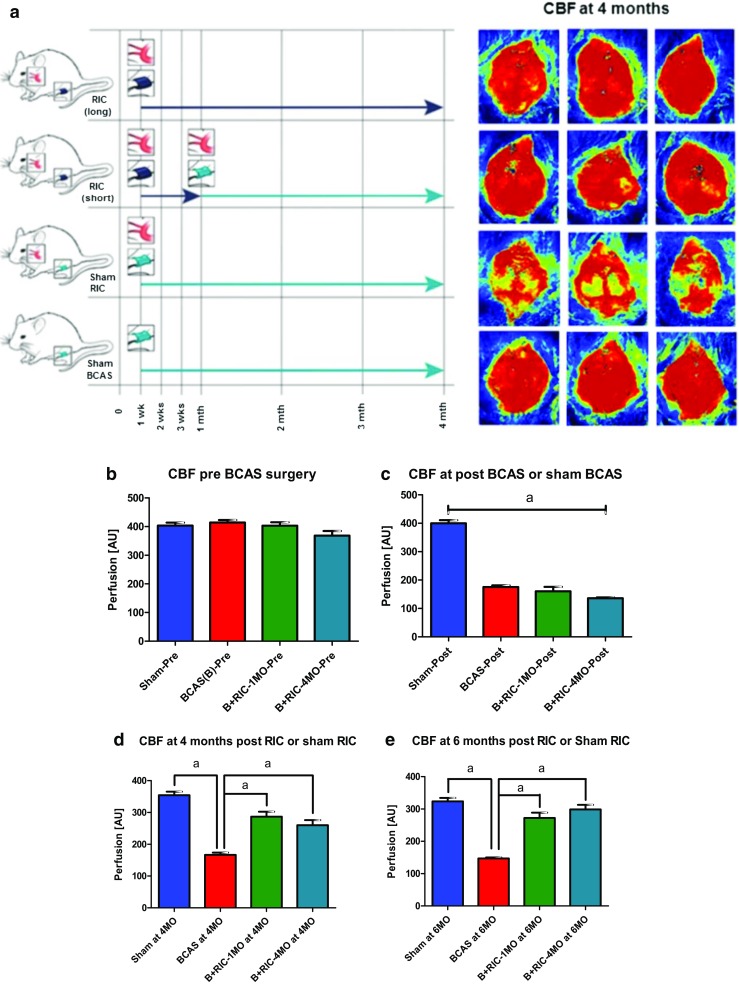
Fig. 1
Fig. 1
Measuring of CBF changes by Laser Speckle Contrast Imager (LSCI), remote ischemic conditioning (RIC) (1-MO and 4-MO therapy at 4MO and 6MO) increases cerebral blood flow (CBF) in bilateral carotid artery stenosis (BCAS) mice. a Mice underwent BCAS and were randomized to RIC daily for 4 months (long with dark blue arrow, top row), RIC daily for 1 month (short with dark blue arrow, second row), or sham RIC (green arrow, third row). The bottom row shows mice with sham BCAS surgery (no coils). CBF was measured at 4 and 6 months (Supplemental Fig. 2) in all mice. Daily RIC for 1 month produced similar increases in CBF to daily RIC for 4 months. Red indicates higher blood flow. be Absolute value of cerebral perfusion in perfusion unit (PU) at different time points where pre (prior to BCAS), post (after BCAS and prior to RIC), at 4 months (4MO) and at 6 months (6MO); pre and post sham operation, BCAS with sham RIC; and BCAS+RIC with 1MO and 4MO. Using repeated measures mixed models, there is no significant difference between CBF in the 1MO and 4MO therapy groups but both groups are significantly higher than the BCAS sham group at 4MO and at 6MO (N = 7 to 10/groups; a p < 0.0001 vs BCAS+sham-RIC; a p < 0.0001 vs BCAS+RIC-1MO and BCAS+RIC-4MO)
Fig. 2
Fig. 2
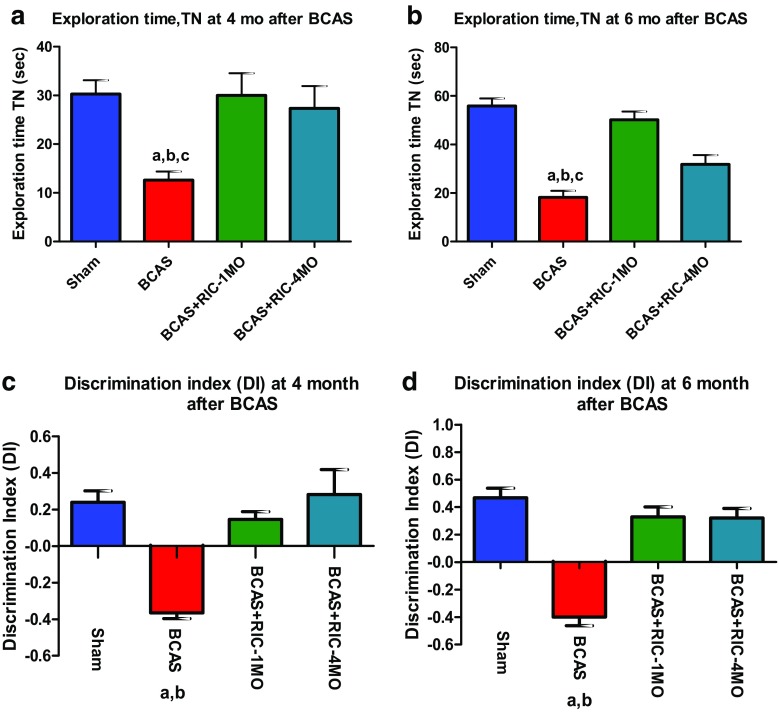
Using a repeated measures mixed model for time of exploration across (a) and (b),(a) time of exploration (TN) spent with the novel object at 4 months (4MO) after sham operation, BCAS, and BCAS+RIC with 1MO and 4MO. The RIC for 1MO and 4MO groups shows no significant difference but is significantly different than BCAS (sham RIC). Values are indicated as mean ± SE. a p < 0.001 vs sham; b p < 0.001 vs BCAS+RIC-1MO; c p < 0.01 vs BCAS+RIC-4MO. (b) TN spent with the novel object at 6 months (6MO) after sham operation, BCAS, and BCAS+RIC with 1MO and 4MO. Values are indicated as mean ± SE. a p < 0.001 vs sham; b p < 0.001 vs BCAS+RIC-1MO; c p < 0.01 vs BCAS+RIC-4MO. Using a repeated measures mixed model for the discrimination index across (c) and (d), (c) the discrimination index (DI) at 4 months (4MO) after sham operation, BCAS, and BCAS+RIC with 1MO and 4MO.The BCAS+RIC with 1MO and 4MO groups show no significant difference from one another but both are significantly different from the BCAS sham RIC. Values are indicated as mean ± SE. a p < 0.0001 vs sham; b p < 0.0001 vs BCAS+RIC-1MO and BCAS+RIC-4MO. (d) The discrimination index (DI) at 6 months (6MO) after sham operation, BCAS, and BCAS+RIC with 1MO and 4MO. There is no difference between 1MO and 4MO RIC groups, but both are significantly different than BCAS (sham RIC). Values are indicated as mean ± SE. a p < 0.0001 vs sham; b p < 0.0001 vs BCAS+RIC-1MO and BCAS+RIC-4MO
Fig. 3
Fig. 3
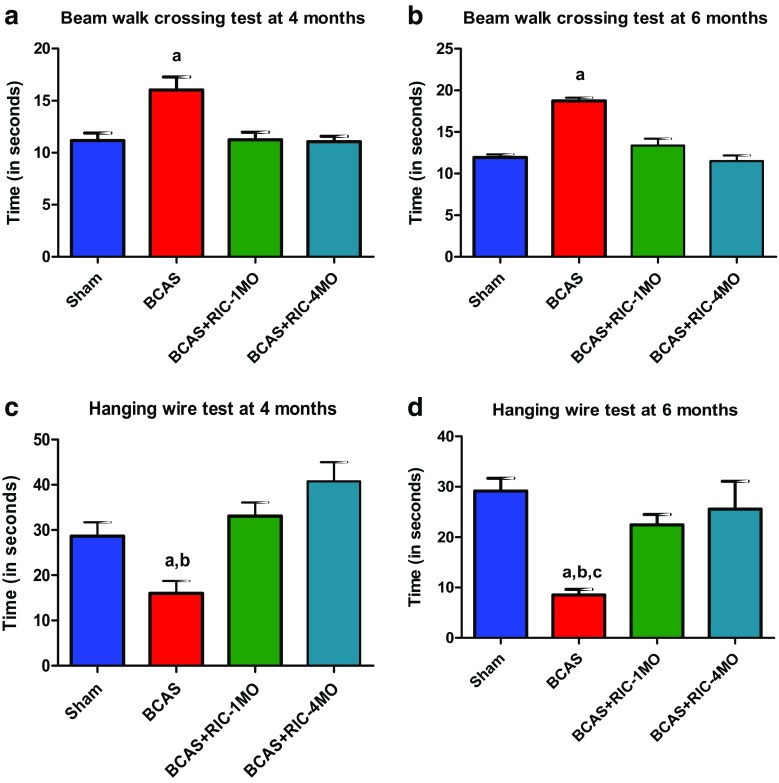
RIC prevents motor/muscular impairment after BCAS. Using a repeated measures mixed model for beam walk across (a) and (b), (a) time of crossing on a beam at 4 months (4MO) after sham operation, BCAS, and BCAS+RIC with 1MO and 4MO. Values are indicated as mean ± SE. a p < 0.0001 vs sham, BCAS+RIC-1MO, and BCAS+RIC-4MO. (b) Time of crossing on a beam at 6 months (6MO) after sham operation, BCAS, and BCAS+RIC with 1MO and 4MO. Values are indicated as mean ± SE.a p < 0.0001 vs sham, BCAS+RIC-1MO, and BCAS+RIC-4MO. Using a repeated measures mixed model for the hanging wire test across (c) and (d), (c) cord-wire hanging test for muscular impairment at 4 months (4MO) after sham operation, BCAS, and BCAS+RIC with 1MO and 4MO. Values are indicated as mean ± SE. a p = 0.0008 vs sham; b p < 0.0001 vs BCAS+RIC-1MO and BCAS+RIC-4MO. (d) Cord-wire hanging test for muscular impairment at 6 months (4MO) after sham operation, BCAS, and BCAS+RIC with 1MO and 4MO. There is no difference between 1MO and 4MO RIC groups, but both significantly are different than BCAS (sham RIC). Values are indicated as mean ± SE. a p < 0.0001 vs sham; b p = 0.0008 vs BCAS+RIC-1MO; c p = 0.0001 BCAS+RIC-4MO
Fig. 4
Fig. 4
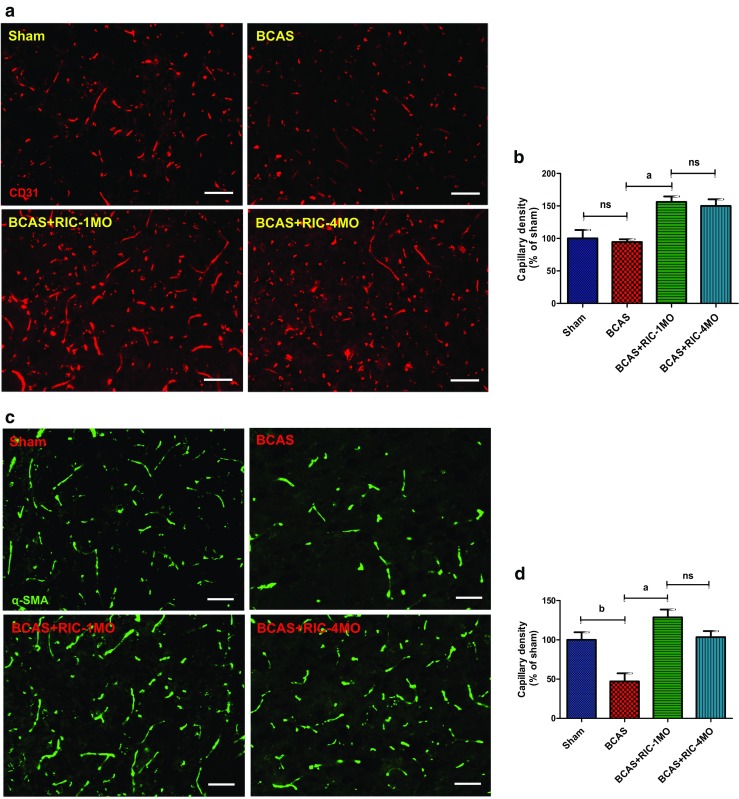
RIC promotes angiogenesis and arteriogenesis. a, c Representative photomicrographs of single immunofluorescence for CD31 (red, (a)) and α-SMA (green, (c)) or double immunofluorescence (Supplemental Figs. 4 and 5 for CD31 and α-SMA with DAPI) for vessels in the striatum (caudoputamen) of each indicated group at 6 months with or without RIC therapy (scale bar for CD31 and α-SMA = 20 μm/20×). b, d The quantitative analysis shows of capillary density at 6 months in each indicated group (N = 4 to 6/group; b p < 0.01 vs sham; a p < 0.001 vs BCAS+RIC-1M/4MO)
Fig. 5
Fig. 5
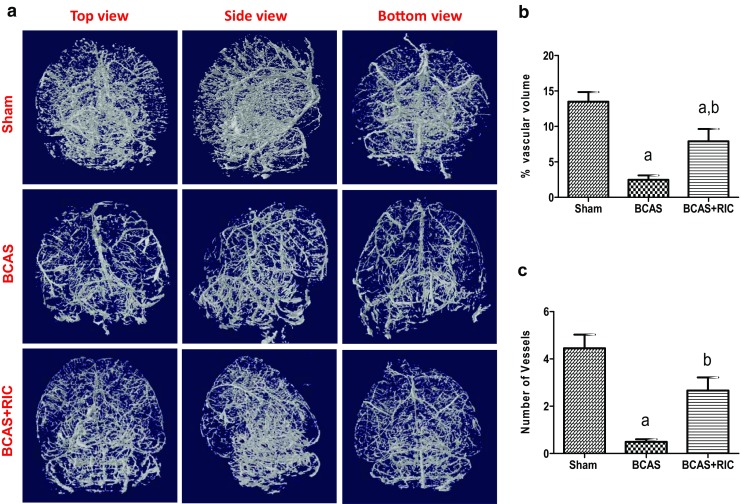
RIC facilitates cerebrovascular angioarchitecture with 3 weeks treatment after BCAS. (a) Representative 3D images showing the whole cerebrovascular angioarchitecture from a top, side, and bottom view of sham, BCAS, and BCSA+RIC groups of mice brain. Histogram showing vascular volume percentage (b) and number of vessels (c) for linear space between vessels, density, and lumen thickness (Supplemental Fig. 9A–C). N = 8/group, a p < 0.01 vs sham; b p < 0.05 vs BCAS
Fig. 6
Fig. 6
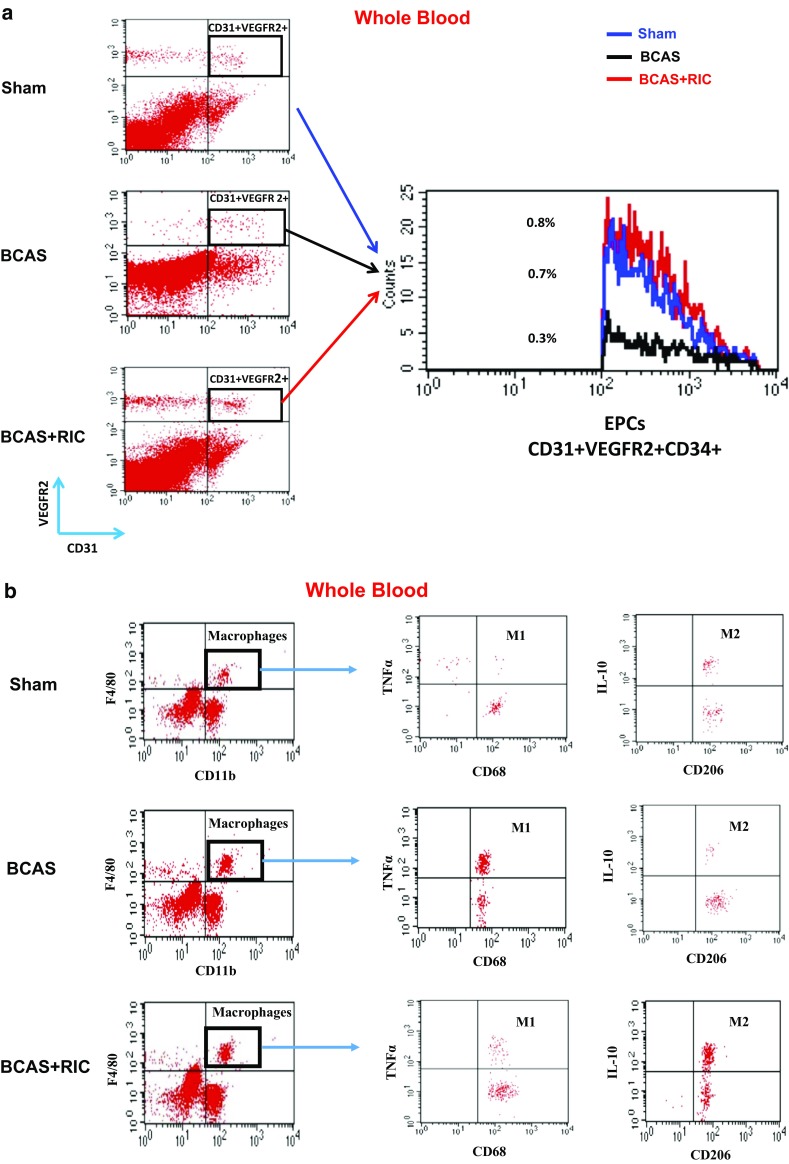
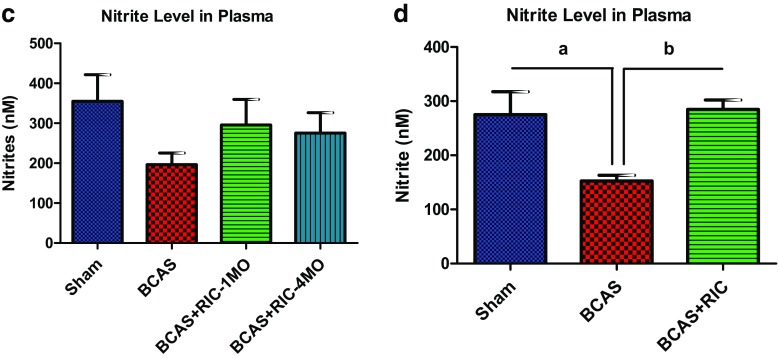
RIC therapy activates endothelial progenitor cells (EPCs) and increases M2/M1 macrophages in the blood 3 weeks treatment. (a) Flow cytometry graphs showing a significant increase the EPCs count, as indicated by increased expression of CD31, VEGFR2, and CD34. (b) Dropped CBF in BCAS group results in recruitment of macrophages in response to chronic ischemia. RIC therapy decreased the level of inflammatory M1 macrophages while it enhanced the level of anti-inflammatory M2 macrophages in the blood (as indicated by the expression of CD11b, F4/80; CD68, TNFα; and CD206, IL-10). However, a high level of circulating M1 macrophage was counted in BCAS groups, indicating high inflammatory burden. RIC therapy activated circulating EPCs, thus reduced the vascular injury and protects ischemic brain. (c) RIC therapy with 1-MO or 4-MO showed a trend but insignificant increase in plasma nitrite levels at 6 months compared to BCAS group. However, RIC therapy for 3 weeks post BCAS significantly increased the plasma nitrite levels compared to BCAS sham RIC (d). Values are indicated as mean ± SD. a p = 0.0092 vs sham; b p = 0.0044 vs BCAS+RIC
Fig. 6
Fig. 6
RIC therapy activates endothelial progenitor cells (EPCs) and increases M2/M1 macrophages in the blood 3 weeks treatment. (a) Flow cytometry graphs showing a significant increase the EPCs count, as indicated by increased expression of CD31, VEGFR2, and CD34. (b) Dropped CBF in BCAS group results in recruitment of macrophages in response to chronic ischemia. RIC therapy decreased the level of inflammatory M1 macrophages while it enhanced the level of anti-inflammatory M2 macrophages in the blood (as indicated by the expression of CD11b, F4/80; CD68, TNFα; and CD206, IL-10). However, a high level of circulating M1 macrophage was counted in BCAS groups, indicating high inflammatory burden. RIC therapy activated circulating EPCs, thus reduced the vascular injury and protects ischemic brain. (c) RIC therapy with 1-MO or 4-MO showed a trend but insignificant increase in plasma nitrite levels at 6 months compared to BCAS group. However, RIC therapy for 3 weeks post BCAS significantly increased the plasma nitrite levels compared to BCAS sham RIC (d). Values are indicated as mean ± SD. a p = 0.0092 vs sham; b p = 0.0044 vs BCAS+RIC

References

    1. Iadecola C. The pathobiology of vascular dementia. Neuron. 2013;80(4):844–866. doi: 10.1016/j.neuron.2013.10.008. - DOI - PMC - PubMed
    1. Snowdon DA, Greiner LH, Mortimer JA, Riley KP, Greiner PA, Markesbery WR. Brain infarction and the clinical expression of Alzheimer disease. The Nun Study. JAMA. 1997;277(10):813–817. doi: 10.1001/jama.1997.03540340047031. - DOI - PubMed
    1. Snyder HM, Corriveau RA, Craft S, Faber JE, Greenberg SM, Knopman D, et al. Vascular contributions to cognitive impairment and dementia including Alzheimer’s disease. Alzheimers Dement : J Alzheimers Assoc. 2015;11(6):710–717. doi: 10.1016/j.jalz.2014.10.008. - DOI - PMC - PubMed
    1. Corriveau RA, Bosetti F, Emr M, Gladman JT, Koenig JI, Moy CS, et al. The science of vascular contributions to cognitive impairment and dementia (VCID): a framework for advancing research priorities in the cerebrovascular biology of cognitive decline. Cell Mol Neurobiol. 2016;36(2):281–288. doi: 10.1007/s10571-016-0334-7. - DOI - PMC - PubMed
    1. Verdelho A, Madureira S, Ferro JM, Baezner H, Blahak C, Poggesi A, et al. Physical activity prevents progression for cognitive impairment and vascular dementia: results from the LADIS (Leukoaraiosis and Disability) study. Stroke. 2012;43(12):3331–3335. doi: 10.1161/STROKEAHA.112.661793. - DOI - PubMed

Publication types

MeSH terms

LinkOut - more resources