


Treadmill interventions in children under six years of age at risk of neuromotor delay
- PMID: 28755534
- PMCID: PMC6483121
- DOI: 10.1002/14651858.CD009242.pub3
Treadmill interventions in children under six years of age at risk of neuromotor delay
Abstract
Background: Delayed motor development may occur in children with Down syndrome, cerebral palsy, general developmental delay or children born preterm. It limits the child's exploration of the environment and can hinder cognitive and social-emotional development. Literature suggests that task-specific training, such as locomotor treadmill training, facilitates motor development.
Objectives: To assess the effectiveness of treadmill interventions on locomotor development in children with delayed ambulation or in pre-ambulatory children (or both), who are under six years of age and who are at risk for neuromotor delay.
Search methods: In May 2017, we searched CENTRAL, MEDLINE, Embase, six other databases and a number of trials registers. We also searched the reference lists of relevant studies and systematic reviews.
Selection criteria: We included randomised controlled trials (RCTs) and quasi-RCTs that evaluated the effect of treadmill intervention in the target population.
Data collection and analysis: Four authors independently extracted the data. Outcome parameters were structured according to the International Classification of Functioning, Disability and Health model.
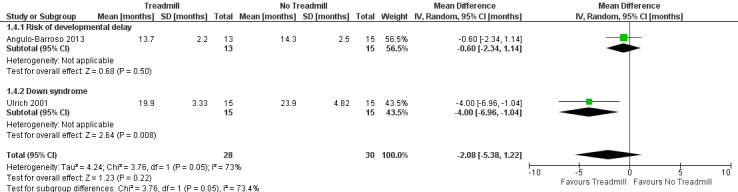
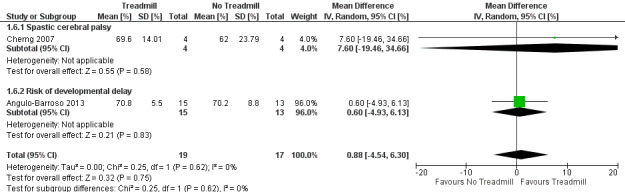
Main results: This is an update of a Cochrane review from 2011, which included five trials. This update includes seven studies on treadmill intervention in 175 children: 104 were allocated to treadmill groups, and 71 were controls. The studies varied in population (children with Down syndrome, cerebral palsy, developmental delay or at moderate risk for neuromotor delay); comparison type (treadmill versus no treadmill; treadmill with versus without orthoses; high- versus low-intensity training); study duration, and assessed outcomes. Due to the diversity of the studies, only data from five studies were used in meta-analyses for five outcomes: age of independent walking onset, overall gross motor function, gross motor function related to standing and walking, and gait velocity. GRADE assessments of quality of the evidence ranged from high to very low.The effects of treadmill intervention on independent walking onset compared to no treadmill intervention was population dependent, but showed no overall effect (mean difference (MD) -2.08, 95% confidence intervals (CI) -5.38 to 1.22, 2 studies, 58 children; moderate-quality evidence): 30 children with Down syndrome benefited from treadmill training (MD -4.00, 95% CI -6.96 to -1.04), but 28 children at moderate risk of developmental delay did not (MD -0.60, 95% CI -2.34 to 1.14). We found no evidence regarding walking onset in two studies that compared treadmill intervention with and without orthotics in 17 children (MD 0.10, 95% CI -5.96 to 6.16), and high- versus low-intensity treadmill interventions in 30 children with Down syndrome (MD -2.13, 95% -4.96 to 0.70).Treadmill intervention did not improve overall gross motor function (MD 0.88, 95% CI -4.54 to 6.30, 2 studies, 36 children; moderate-quality evidence) or gross motor skills related to standing (MD 5.41, 95% CI -1.64 to 12.43, 2 studies, 32 children; low-quality evidence), and had a negligible improvement in gross motor skills related to walking (MD 4.51, 95% CI 0.29 to 8.73, 2 studies, 32 children; low-quality evidence). It led to improved walking skills in 20 ambulatory children with developmental delay (MD 7.60, 95% CI 0.88 to 14.32, 1 study) and favourable gross motor skills in 12 children with cerebral palsy (MD 8.00, 95% CI 3.18 to 12.82). A study which compared treadmill intervention with and without orthotics in 17 children with Down syndrome suggested that adding orthotics might hinder overall gross motor progress (MD -8.40, 95% CI -14.55 to -2.25).Overall, treadmill intervention showed a very small increase in walking speed compared to no treadmill intervention (MD 0.23, 95% CI 0.08 to 0.37, 2 studies, 32 children; high-quality evidence). Treadmill intervention increased walking speed in 20 ambulatory children with developmental delay (MD 0.25, 95% CI 0.08 to 0.42), but not in 12 children with cerebral palsy (MD 0.18, 95% CI -0.09 to 0.45).
Authors' conclusions: This update of the review from 2011 provides additional evidence of the efficacy of treadmill intervention for certain groups of children up to six years of age, but power to find significant results still remains limited. The current findings indicate that treadmill intervention may accelerate the development of independent walking in children with Down syndrome and may accelerate motor skill attainment in children with cerebral palsy and general developmental delay. Future research should first confirm these findings with larger and better designed studies, especially for infants with cerebral palsy and developmental delay. Once efficacy is established, research should examine the optimal dosage of treadmill intervention in these populations.
Conflict of interest statement
Marta Valentin Gudiol is an author on Angulo‐Barroso 2013 and did not extract data from this study. Katrin Mattern‐Baxter (KMB) is an author on Mattern‐Baxter 2013 and was not involved in extracting data from this study. KMB is employed as an Associate Professor at California State University, Sacramento, and is paid as a Consultant for local school‐based services for children with developmental disability and as a Physical Therapist at Physical Edge. KMB and her institution receive funds from the Thrasher Fund grant for an unrelated project. KMB received fees from Kaiser Community Benefit grants to develop continuing education courses for physical therapists in 2013 and 2014. Classes were held free for physical therapists. KMB received travel and accommodation expenses from The Douglas Education Service District, Oregon, to hold a continuing education class at the Therapy in Educational Settings conference in Oregon in 2014. KMB presented an educational session at the American Physical Therapy Association’s (APTA) Combined Sections Meeting in 2015 and 2016, and KMB's expenses were covered by the APTA. Montserat Girabent Farrés ‐ none known. Caritat Bagur‐Calafat ‐ none known. Mijna Hadders‐Algra (MHA) is employed as a Professor of developmental neurology and receives payment for lectures carried out across the world on the subject. MHA's institution receives grants for work on early intervention. MHA received royalties for two books at Mac Keith Press ('Postural control: a key issue in developmental disorders' and 'The examination of the child with minor neurological dysfunction'), and one Dutch book on the general principles of infant motor development. MHA declares that none of these books address the issue of intervention by means of treadmill locomotion. Rosa Maria Angulo‐Barroso is an author on the Angulo‐Barroso 2013, Ulrich 2001 and Ulrich 2008 studies, and was not involved in extracting data from these studies.
Figures



Update of
-
Treadmill interventions with partial body weight support in children under six years of age at risk of neuromotor delay.Cochrane Database Syst Rev. 2011 Dec 7;(12):CD009242. doi: 10.1002/14651858.CD009242.pub2. Cochrane Database Syst Rev. 2011. Update in: Cochrane Database Syst Rev. 2017 Jul 29;7:CD009242. doi: 10.1002/14651858.CD009242.pub3. PMID: 22161449 Updated.
References
References to studies included in this review
Angulo‐Barroso 2013 {published and unpublished data}
-
- Angulo‐Barroso RM. Walking patterns in infants at moderate risk for neuromotor disabilities with or without treadmill training [personal communication]. Email to: M Valentín‐Gudiol 20 July 2011.
-
- Angulo‐Barroso RM, Tiernan C, Chen LC, Valentin‐Gudiol M, Ulrich D. Treadmill training in moderate risk preterm infants promotes stepping quality ‐ results of a small randomised controlled trial. Research in Developmental Disabilities 2013;34(11):3629‐38. [DOI: 10.1016/j.ridd.2013.07.037] - DOI - PubMed
-
- Chen L, Looper J, Neary H, Ulrich D, Angulo‐Barroso R. Walking patterns in infants at moderate risk for neuromotor disabilities with or without treadmill training. Journal of Sport and Exercise Psychology 2008;30 Suppl:S40‐S41.
-
- Valentín‐Gudiol M. Walking patterns in infants at moderate risk for neuromotor disabilities with or without treadmill training [personal communication]. Email to: RM Angulo‐Barroso 17 June 2011.
Cherng 2007 {published data only}
-
- Cherng R, Liu C, Lau T, Hong R. Effects of treadmill training with body weight support on gait and gross motor function in children with spastic cerebral palsy. American Journal of Physical Medicine and Rehabilitation 2007;86(7):548‐55. [PUBMED: 17581289] - PubMed
Looper 2010 {published data only}
Lowe 2015 {published data only}
Mattern‐Baxter 2013 {published data only (unpublished sought but not used)}
-
- Mattern‐Baxter K, McNeil S, Mansoor JK. Effects of home‐based locomotor treadmill training on gross motor function in young children with cerebral palsy: a quasi‐randomized controlled trial. Archives of Physical Medicine and Rehabilitation 2013;94(11):2061‐7. [DOI: 10.1016/j.apmr.2013.05.012; PUBMED: 23747646] - DOI - PubMed
Ulrich 2001 {published data only}
Ulrich 2008 {published data only}
-
- Angulo‐Barroso RM, Wu J, Ulrich DA. Long‐term effects of different treadmill interventions on gait development in new walkers with Down syndrome. Gait and Posture 2008;27(2):231‐8. [PUBMED: 17499993] - PubMed
-
- Wu J, Looper J, Ulrich BD, Ulrich DA, Angulo‐Barroso RM. Exploring effects of different treadmill interventions on walking onset and gait patterns in infants with Down syndrome. Developmental Medicine & Child Neurology 2007;49(11):839–45. [PUBMED: 17979862] - PubMed
-
- Wu J, Looper J, Ulrich DA, Angulo‐Barroso RM. Effects of various treadmill interventions on the development of joint kinematics in infants with Down syndrome. Physical Therapy 2010;90(9):1265‐76. [PUBMED: 20651010] - PubMed
-
- Wu J, Ulrich DA, Looper J, Tiernan CW, Angulo‐Barroso RM. Strategy adoption and locomotor adjustment in obstacle clearance of newly walking toddlers with down syndrome after different treadmill interventions. Experimental Brain Research 2008;186(2):261‐72. [DOI: 10.1007/s00221-007-1230-7] - DOI - PubMed
References to studies excluded from this review
Borggraefe 2007 {published data only}
-
- Borggraefe I, Kumar A, Schaefer JS, Berweck S, Meyer‐Heim A, Hufschmidt A, et al. Robotic assisted treadmill therapy for children with a central gait impairment. Monatsschrift Kinderheilkunde 2007;155(6):529‐34.
Borggraefe 2010 {published data only}
-
- Borggraefe I, Kiwull L, Schaefer JS, Koerte I, Blaschek A, Meyer‐Heim A, et al. Sustainability of motor performance after robotic‐assisted treadmill therapy in children: an open, non‐randomized baseline‐treatment study. European Journal of Physical and Rehabilitation Medicine 2010;46(2):125‐31. [PUBMED: 20485217] - PubMed
Campbell 2012 {published data only}
-
- Campbell SK, Gaebler‐Spira D, Zawacki L, Clark A, Boynewicz K, Regnier RA, et al. Effects on motor development of kicking and stepping exercise in preterm infants with periventricular brain injury: a pilot study. Journal of Pediatric Rehabilitation Medicine 2012;5(1):15‐27. [DOI: 10.3233/PRM-2011-0185; PMC3584696; PUBMED: 22543889] - DOI - PMC - PubMed
Christensen 2014 {published data only}
Dodd 2007 {published data only}
Duarte 2014 {published data only}
-
- Duarte ND, Grecco LAC, Galli M, Fregni F, Santos Oliveira C. Effect of transcranial direct‐current stimulation combined with treadmill training on balance and functional performance in children with cerebral palsy: a double‐blind randomized controlled trial. PLOS One 2014;9(8):e105777. - PMC - PubMed
El‐Shamy 2017 {published data only}
Grecco 2013a {published data only}
Grecco 2013b {published data only}
-
- Grecco LAC, Tomita SM, Christovão TC, Pasini H, Sampaio LM, Oliveira CS. Effect of treadmill gait training on static and functional balance in children with cerebral palsy: a randomized controlled trial. Brazilian Journal of Physical Therapy 2013;17(1):17‐23. [PUBMED: 23538455] - PubMed
Grecco 2013c {published data only}
-
- Grecco LAC, Zanon N, Sampaio LMM, Oliveira CS. A comparison of treadmill training and overground walking in ambulant children with cerebral palsy: randomized controlled clinical trial. Clinical Rehabilitation 2013;27(8):686‐96. - PubMed
Hilderley 2016 {published data only}
-
- Hilderley AJ, Fehlings D, Lee GW, Wright FV. Comparison of a robotic‐assisted gait training program with a program of functional gait training for children with cerebral palsy: design and methods of a two group randomized controlled cross‐over trial. Springerplus 2016;5(1):1886. [DOI: 10.1186/s40064-016-3535-0; PMC5084143] - DOI - PMC - PubMed
Johnston 2011 {published data only}
-
- Johnston TE, Watson KE, Ross SA, Gates PE, Gaughan JP, Lauer RT, et al. Effects of a supported speed treadmill training exercise program on impairment and function for children with cerebral palsy. Developmental Medicine and Child Neurology 2011;53(8):742‐50. [DOI: 10.1111/j.1469-8749.2011.03990.x; PUBMED: 21679357] - DOI - PubMed
Jung 2016 {published data only}
Kurz 2011 {published data only}
Lowe 2013 {published data only}
-
- Lowe LM. Treadmill Training With Partial Body Weight Support In Ambulatory Children With Developmental Delay [dissertation]. University of Central Arkansas, 2013.
Maltais 2003 {published data only}
Matsuno 2010 {published data only}
-
- Matsuno VM, Camargo MR, Palma GC, Alveno D, Barela AM. Analysis of partial body weight support during treadmill and overground walking of children with cerebral palsy. Revista Brasileira De Fisioterapia 2010;14(5):404‐10. [PUBMED: 21180866] - PubMed
Meyer‐Heim 2007 {published data only}
-
- Meyer‐Heim A, Borggraefe I, Ammann‐Reiffer C, Berweck S, Sennhauser FH, Colombo G, et al. Feasibility of robotic‐assisted locomotor training in children with central gait impairment. Developmental Medicine and Child Neurology 2007;49(12):900‐6. [DOI: 10.1111/j.1469-8749.2007.00900.x; PUBMED: 18039236] - DOI - PubMed
Mussleman 2007 {published data only}
Pang 2003 {published data only}
Pantall 2011 {published data only}
Phillips 2007 {published data only}
-
- Phillips JP, Sullivan KJ, Burtner PA, Caprihan A, Provost B, Bernitsky‐Beddingfield A. Ankle dorsiflexion fMRI in children with cerebral palsy undergoing intensive body‐weight‐supported treadmill training: a pilot study. Developmental Medicine and Child Neurology 2007;49(1):39‐44. [DOI: 10.1111/j.1469-8749.2007.0102a.x; PUBMED: 17209975] - DOI - PubMed
Romei 2012 {published data only}
-
- Romei M, Montinaro A, Piccinini L, Maghini C, Germiniasi C, Bo I, et al. Efficacy of robotic‐assisted gait training compared with intensive task‐oriented physiotherapy for children with cerebral palsy. The Fourth IEEE RAS/EMBS International Conference on Biomedical Robotics and Biomechatronics; 2012 June 24‐27; Rome, Italy. 2012:1890‐4. [DOI: 10.1109/BioRob.2012.6290748] - DOI
Sarhan 2014 {published data only}
-
- Sarhan RS, Chevidikunnan MF, Gaowgzeh RA. Locomotor treadmill training program using driven gait orthosis versus manual treadmill therapy on motor output in spastic diplegic cerebral palsy children. Nitte University Journal of Health Science 2014;4(4):10‐17.
Schindl 2000 {published data only}
-
- Schindl MR, Forstner C, Kern H, Hesse S. Treadmill training with partial body weight support in nonambulatory patients with cerebral palsy. Archives of Physical Medicine and Rehabilitation 2000;81(3):301‐6. [PUBMED: 10724074] - PubMed
Schlittler 2011 {published data only}
-
- Schlittler CX, Lopes TF, Raniero EP, Barela JA. Treadmill training effects on walking acquisition and motor development in infants at risk of developmental delay. Revista Paulista de Pediatria 2011;29(1):91‐9. [DOI: 10.1590/S0103-05822011000100015] - DOI
Scholtes 2012 {published data only}
-
- Scholtes VA, Becher JG, Janssen‐Potten Y, Dekkers H, Smallenbroek L, Dallmeijer AJ. Effectiveness of functional progressive resistance exercise training on walking ability in children with cerebral palsy: a randomized controlled trial.. Research in Developmental Disabilities 2012;33(1):181‐8. [DOI: 10.1016/j.ridd.2011.08.026; PUBMED: 22093663] - DOI - PubMed
Schroeder 2014 {published data only}
-
- Schroeder AS, Kries R, Riedel C, Homburg M, Auffermann H, Blaschek A, et al. Patient‐specific determinants of responsiveness to robot‐enhanced treadmill therapy in children and adolescents with cerebral palsy. Developmental Medicine & Child Neurology 2014;56(12):1172‐9. [DOI: 10.1111/dmcn.12564; PUBMED: 25154424] - DOI - PubMed
Sherief 2015 {published data only}
-
- Sherief AEAA, Abo Gazya AA, Gafaar AE. Integrated effect of treadmill training combined with dynamic ankle foot orthosis on balance in children with hemiplegic cerebral palsy. Egyptian Journal of Medical Human Genetics 2015;16(2):173‐9. [DOI: 10.1016/j.ejmhg.2014.11.002] - DOI
Siekerman 2015 {published data only}
Smania 2011 {published data only}
Su 2013 {published data only}
-
- Su IY, Chung KK, Chow DH. Treadmill training with partial body weight support compared with conventional gait training for low‐functioning children and adolescents with nonspastic cerebral palsy: a two‐period crossover study. Prosthetics & Orthotics International 2013;37(6):445‐53. [DOI: 10.1177/0309364613476532; PUBMED: 23436693] - DOI - PubMed
Teulier 2009 {published data only}
References to ongoing studies
NCT02424526 {unpublished data only}
-
- NCT02424526. Intensive home‐based treadmill training and walking attainment in young children with cerebral palsy. clinicaltrials.gov/ct2/show/NCT02424526 (first received 16 April 2015). [NCT02424526]
Additional references
Adolph 1998
-
- Adolph KE, Vereijken B, Denny MA. Learning to crawl. Child Development 1998;69(5):1299‐312. [PUBMED: 9839417] - PubMed
Adolph 2012
Anderson 2013
Angulo‐Barroso 2008
Angulo‐Barroso 2010
Barbeau 1987
-
- Barbeau H, Rossignol S. Recovery of locomotion after chronic spinalization in the adult cat. Brain Research 1987;412(1):84‐95. [PUBMED: 3607464] - PubMed
Bayley 1993
-
- Bayley N. Manual for the Bayley Scales of Infant Development II. 2nd Edition. San Antonio (TX): The Psychological Corporation, 1993.
Beck 2010
Begnoche 2007
Bertenthal 1984
-
- Bertenthal BI, Campos JJ, Barrett KC. Self‐produced locomotion: an organizer of emotional, cognitive, and social development in infancy. In: Emde RN, Harmon RJ editor(s). Continuities and Discontinuities in Development. New York: Plenum, 1984:175–210. [DOI: 10.1007/978-1-4613-2725-7_8] - DOI
Bertenthal 1990
-
- Bertenthal BI, Campos JJ. A systems approach to the organizing effects of self‐produced locomotion during infancy. Advances in Infancy Research 1990;6:1‐60.
Bilney 2003
-
- Bilney B, Morris M, Webster K. Concurrent related validity of the GAITRite walkway system for quantification of the spatial and temporal parameters of gait. Gait Posture 2003;17(1):68‐74. [PUBMED: 12535728] - PubMed
Blackman 2002
-
- Blackman JA. Early intervention: a global perspective. Infants and Young Children 2002;15(2):11‐9.
Bly 1995
-
- Bly L, Ariz TN. Motor Skills Acquisition in the First Year, An Illustrated Guide to Normal Development. Therapy Skills Builders, 1995.
Bodkin 2003
-
- Bodkin AW, Baxter RS, Heriza CB. Treadmill training for an infant born preterm with a grade III intraventricular hemorrhage. Physical Therapy 2003;83(12):1107‐18. [PUBMED: 14640869] - PubMed
Bohannon & Smith 1987
-
- Bohannon RW, Smith MB. Interrater reliability of a modified Ashworth scale of muscle spasticity. Physical Therapy 1987;67(2):206‐7. [PUBMED: 3809245] - PubMed
Boyd 1999
-
- Boyd R, Fatone S, Rodda J, Olesch C, Starr R, Cullis E, et al. High‐ or low‐technology measurements of energy expenditure in clinical gait analysis?. Developmental Medicine and Child Neurology 1999;41(10):676‐82. [PUBMED: 10587044] - PubMed
Butler 2001
-
- Butler C, Darrah J. Effects of neurodevelopmental treatment (NDT) for cerebral palsy: an AACPDM evidence report. Developmental Medicine & Child Neurology 2001;43(11):778‐90. [PUBMED: 11730153] - PubMed
Campbell 2006
-
- Campbell SK, Palisano RJ, Vander Linden DW. Physical Therapy for Children. St Louis (MO): Elsevier Saunders, 2006.
Campos 1989
-
- Campos JJ, Bertenthal BI. Locomotion and psychological development in infancy. In: Morrison F, Lord C, Keating D editor(s). Applied Developmental Psychology. New York: Academic Press, 1989:230–58.
Case‐Smith 1998
-
- Case‐Smith J, Heaphy T, Marr D, Galvin B, Koch V, Ellis MG, et al. Fine motor and functional performance outcomes in preschool children. American Journal of Occupational Therapy 1998;52:788‐96. [DOI: 10.5014/ajot.52.10.788] - DOI
Cernak 2008
Chen 2008
-
- Chen L, Looper J, Neary H, Ulrich D, Angulo‐Barroso R. Walking patterns in infants at moderate risk for neuromotor disabilities with or without treadmill training. Journal of Sport and Exercise Psychology 2008;30 Suppl:S40‐S41.
Clearfield 2004
Clearfield 2011
Cotman 2002a
-
- Cotman CW, Berchtold NC. Exercise: a behavioral intervention to enhance brain health and plasticity. Trends in Neurosciences 2002;25(6):295‐301. [PUBMED: 12086747] - PubMed
Cotman 2002b
-
- Cotman CW, Engesser‐Cesar C. Exercise enhances and protects brain function. Exercise and Sport Sciences Reviews 2002;30(2):75‐9. [PUBMED: 11991541] - PubMed
Cunha 2016
-
- Cunha AB, Lobo MA, Kokkoni E, Galloway JC, Tudella E. Effect of short‐term training on reaching behavior in infants: a randomized controlled clinical trial. Journal of Motor Behavior 2016;48(2):132‐42. - PubMed
Damiano 2006
-
- Damiano DL. Activity, activity, activity: rethinking our physical therapy approach to cerebral palsy. Physical Therapy 2006;86(11):1534‐40. [PUBMED: 17094192] - PubMed
Damiano 2009
Davis 1994
-
- Davis DW, Thelen E, Keck J. Treadmill stepping in infants born prematurely. Early Human Development 1994;39(3):211‐23. [PUBMED: 7712955] - PubMed
Day 2004
-
- Day JA, Fox EJ, Lowe J, Swales HB, Behrman AL. Locomotor training with partial body weight support on a treadmill in a nonambulatory child with spastic tetraplegic cerebral palsy: a case report. Pediatric Physical Therapy 2004;16(2):106‐13. [DOI: 10.1097/01.PEP.0000127569.83372.C8; PUBMED: 17057535] - DOI - PubMed
De Bode 2007
De Graaf‐Peters 2006
De Graaf‐Peters 2007
-
- Graaf‐Peters VB, Blauw‐Hospers CH, Dirks T, Bakker H, Bos AF, Hadders‐Algra M. Development of postural control in typically developing children and children with cerebral palsy: possibilities for intervention?. Neuroscience and Biobehavioral Reviews 2007;31(8):1191‐200. [DOI: 10.1016/j.neubiorev.2007.04.008; PUBMED: 17568673] - DOI - PubMed
Deeks 1997a
-
- Deeks J. Are you sure that's a standard deviation? (part 1). Cochrane News 1997; Vol. 10, issue 11‐12.
Deeks 1997b
-
- Deeks J. Are you sure that's a standard deviation? (part 2). Cochrane News 1997; Vol. 11, issue 11‐2.
Deeks 2011
-
- Deeks JJ, Higgins JPT, Altman DG. Chapter 9: Analysing data and undertaking meta‐analyses. In: Higgins JP, Green S, editor(s). Cochrane Handbook for Systematic Reviews of Interventions Version 5.1.0 (updated March 2011). The Cochrane Collaboration, 2011. Available from handbook.cochrane.org.
Down's Syndrome Association
-
- What is the incidence of Down's Syndrome?. www.downs‐syndrome.org.uk/for‐new‐parents/faqs/general/ (accessed 19 April 2011).
Edgerton 1997
-
- Edgerton VR, Leon RD, Tillakaratne N, Recktenwald MR, Hodgson JA, Roy RR. Use‐dependent plasticity in spinal stepping and standing. Advances in Neurology 1997;72:233‐47. [PUBMED: 8993702] - PubMed
Eidelberg 1980
-
- Eidelberg E, Story JL, Meyer BL, Nystel J. Stepping by chronic spinal cats. Experimental Brain Research 1980;40(3):241‐6. [PUBMED: 7428879] - PubMed
Eng 2007
Eyre 2003
Feldman 1990
-
- Feldman AB, Haley SM, Coryell J. Concurrent and construct validity of the Pediactric Evaluation of DIsability Inventory. Physical Therapy 1990;70(10):602‐10. [PUBMED: 2217539] - PubMed
Formiga 2011
Frey 2016
Gamble 2005
Gordon 2011
Goyen 2002
-
- Goyen TA. Longitudinal motor development of "apparently normal" high‐risk infants at 18 months, 3 and 5 years. Early Human Development 2002;70(1‐2):103‐15. [PUBMED: 12441208] - PubMed
GRADEproGDT 2015 [Computer program]
-
- GRADE Working Group, McMaster University. GRADEpro GDT. Version accessed prior to 16 April 2017. Hamilton, ON: GRADE Working Group, McMaster University, 2014.
Graham 2004
-
- Graham HK, Harvey A, Rodda J, Nattrass GR, Pirpiris M. The Functional Mobility Scale (FMS). Journal of Pediatric Orthopaedics 2004;24(5):514‐20. [PUBMED: 15308901] - PubMed
Hadders‐Algra 1996
Hadders‐Algra 2014
Hadders‐Algra 2017
-
- Hadders‐Algra M, Boxum AG, Hielkema T, Hamer EG. Effect of early intervention in infants at very high risk of cerebral palsy: a systematic review. Developmental Medicine and Child Neurology 2017;59:246‐58. - PubMed
Harbourne 2003
Heineman 2008
Higgins 2011a
-
- Higgins JPT, Altman DG, Sterne JAC. Chapter 8: Assessing risk of bias in included studies. In: Higgins JP, Green S, editor(s). Cochrane Handbook for Systematic Reviews of Interventions Version 5.1.0 (updated March 2011). The Cochrane Collaboration, 2011. Available from handbook.cochrane.org.
Higgins 2011b
-
- Higgins JPT, Deeks JJ. Chapter 7: Selecting studies and collecting data. In: Higgins JP, Green S, editor(s). Cochrane Handbook for Systematic Reviews of Interventions Version 5.1.0 (updated March 2011). The Cochrane Collaboration, 2011. Available from handbook.cochrane.org.
Higgins 2011c
-
- Higgins JPT, Deeks JJ, Altman DG. Chapter 16: Special topics in statistics. In: Higgins JP, Green S, editor(s). Cochrane Handbook for Systematic Reviews of Interventions Version 5.1.0 (updated March 2011). The Cochrane Collaboration, 2011. Available from handbook.cochrane.org.
Hodgson 1994
-
- Hodgson JA, Roy RR, Leon R, Dobkin B, Edgerton VR. Can the mammalian lumbar spinal cord learn a motor task?. Medicine and Science in Sports and Exercise 1994;26(12):1491‐7. [PUBMED: 7869884] - PubMed
Jones 1999
Kermoian 1988
-
- Kermoian R, Campos JJ. Locomotor experience: a facilitator of spatial cognitive development. Child Development 1988;59(4):908‐17. [PUBMED: 3168629] - PubMed
Kleim 2008
Kolb 2013
Kolobe 2014
-
- Kolobe TH, Christy JB, Gannotti ME, Heathcock JC, Damiano DL, Taub E, et al. Research summit III proceedings on dosing in children with an injured brain or cerebral palsy: executive summary. Physical Therapy 2014;94(7):907‐20. [DOI: 10.2522/ptj.20130024; PMC4078265; PUBMED: 24525862] - DOI - PMC - PubMed
Lepage 1998
-
- Lepage C, Noreau L, Bernard PM. Association between characteristics of locomotion and accomplishment of life habits in children with cerebral palsy. Physical Therapy 1998;78(5):458‐69. [PUBMED: 9597060] - PubMed
Lie 2010
Looper 2006
Luo 2009
Mattern‐Baxter 2009a
Mattern‐Baxter 2009b
Menz 2004
Moher 2009
Molina‐Rueda 2010
-
- Molina‐Rueda F, Aguila‐Maturana AM, Molina‐Rueda MJ, Miangolarra‐Page JC. Treadmill training with or without partial body weight support in children with cerebral palsy: systematic review and meta‐analysis [Pasarela rodante con o sin sistema de suspensión del peso corporal en niños con parálisis cerebral infantil: revisión sistemática y metaanálisis]. Revista de Neurologia 2010;51(3):135‐45. [PUBMED: 20645264] - PubMed
Morgan 2013
Morgan 2016
Murray 2007
Mutlu 2009
Nelson 2000
-
- Nelson CA. Neural plasticity and human development: the role of early experience in sculpting memory systems. Developmental Science 2000;3(2):115‐36. [DOI: 10.1111/1467-7687.00104] - DOI
Newell 1991
Novak 2013
Palisano 1997
Pin 2010
Prins 2010
Prosser 2007
Provost 2007
-
- Provost B, Dieruf K, Burtner PA, Phillips JP, Bernitsky‐Beddingfield A, Sullivan K, et al. Endurance and gait in children with cerebral palsy after intensive body weight‐supported treadmill training. Pediatric Physical Therapy 2007;19(1):2‐10. [DOI: 10.1097/01.pep.0000249418.25913.a3; PUBMED: 17304092] - DOI - PubMed
Review Manager 2014 [Computer program]
-
- Nordic Cochrane Centre, The Cochrane Collaboration. Review Manager 5 (RevMan 5). Version 5.3. Copenhagen: Nordic Cochrane Centre, The Cochrane Collaboration, 2014.
Richards 1997
-
- Richards CL, Malouin F, Dumas F, Marcoux S, Lepage C, Menier C. Early and intensive treadmill locomotor training for young children with cerebral palsy: a feasibility study. Pediatric Physical Therapy 1997;9(4):158‐65.
Riethmuller 2009
-
- Riethmuller AM, Jones RA, Okely AD. Efficacy of interventions to improve motor development in young children: a systematic review. Pediatrics 2009;124(4):e782‐92. - PubMed
Rosenbloom 1971
-
- Rosenbloom L. The contribution of motor behaviour to child development. Physiotherapy 1971;57(4):159‐62. [PUBMED: 4252512] - PubMed
Roze 2010
Russell 2002
-
- Russell DJ, Rosenbaum PL, Avery LM, Lane M. Gross Motor Function Measure (GMFM 66 & GMFM 88) User's Manual. Clinics in Developmental Medicine N0. 159. London: McKeith Press, 2002.
Sackett 1996
Schünemann 2011a
-
- Schünemann HJ, Oxman AD, Higgins JPT, Vist GE, Glasziou P, Guyatt GH. Chapter 11: Presenting results and 'Summary of findings' tables. In: Higgins JP, Green S, editor(s). Cochrane Handbook for Systematic Reviews of Interventions Version 5.1.0 (updated March 2011). The Cochrane Collaboration, 2011. Available from handbook.cochrane.org.
Schünemann 2011b
-
- Schünemann HJ. Oxman AD, Vist GE, Higgins JPT, Deeks JJ, Glasziou P. Chapter 12: Interpreting results and drawing conclusions. In: Higgins JP, Green S, editor(s). Cochrane Handbook for Systematic Reviews of Interventions Version 5.1.0 (updated March 2011). The Cochrane Collaboration, 2011. Available from handbook.cochrane.org.
Sherrington 1910
Sterne 2011
-
- Sterne JAC, Egger M, Moher D. Chapter 10: Addressing reporting biases. In: Higgins JP, Green S, editor(s). Cochrane Handbook for Systematic Reviews of Interventions Version 5.1.0 (updated March 2011). The Cochrane Collaboration, 2011. Available from handbook.cochrane.org.
Stiles 2000
Stiles 2005
Sullivan 2007
-
- Sullivan KJ, Brown DA, Klasses T, Mulroy S, Ge T, Azen SP, et al. Effects of task‐specific locomotor and strength training in adults who were ambulatory after stroke: results of the STEPS randomized clinical trial. Physical Therapy 2007;87(12):1580‐602. [DOI: 10.2522/ptj.20060310; PUBMED: 17895349] - DOI - PubMed
Surveillance CP Europe
-
- Surveillance of Cerebral Palsy in Europe. www‐rheop.ujf‐grenoble.fr/scpe2/site_scpe/index.php (accessed 5 March 2011).
Sveistrup 1997
-
- Sveistrup H, Woollacott MH. Practice modifies the developing automatic postural response. Experimental Brain Research 1997;114(1):33‐43. [PUBMED: 9125449] - PubMed
Teulier 2015
Thelen 1986
-
- Thelen E. Treadmill‐elicited stepping in 7‐month‐old infants. Child Development 1986;57(6):1498‐506. [PUBMED: 3802974] - PubMed
Thelen 1991
-
- Thelen E, Ulrich BD. Hidden skills: a dynamic systems analysis of treadmill stepping during the first year. Monographs of the Society for Research in Child Development 1991;56(1):1‐98. [PUBMED: 1922136] - PubMed
Ulrich 1992
-
- Ulrich BD, Ulrich DA, Collier DH. Alternating stepping patterns: hidden abilities of 11‐month‐old infants with Down syndrome. Developmental Medicine and Child Neurology 1992;34(3):233‐9. [PUBMED: 1532783] - PubMed
Ulrich 1995
-
- Ulrich BD, Ulrich DA, Collier DH, Cole EL. Developmental shifts in the ability of infants with Down syndrome to produce treadmill steps. Physical Therapy 1995;75(1):14‐23. [PUBMED: 7809193] - PubMed
Van Hartingsveldt 2005
-
- Hartingsveldt MJ, Cup E, Oostendorp RA. Reliability and validity of the fine motor scale of the Peabody Developmental Motor Scales–2. Occupational Therapy International 2005;12(1):1‐13. [PUBMED: 15962696] - PubMed
Varni 2003
-
- Varni JW, Burwinkle TM, Seid M, Skarr D. The PedsQL 4.0 as a paediatric population health measure: feasibility, reliability, and validity. Ambulatory Pediatrics 2003;3(6):329‐41. [PUBMED: 14616041] - PubMed
Verschuren 2008
Volpe 2009
Walle 2014
Webb 2001
Webster 2005
WHO 2005
-
- International Classification of Functioning, Disability and Health for Children and Youth. apps.who.int/classifications/icfbrowser/ (accessed 10 February 2011).
WHO 2006
Willoughby 2009
Wu 2007
-
- Wu J, Looper J, Ulrich BD, Ulrich D, Angulo‐Barroso R. Exploring effects of different treadmill interventions on walking onset and gait patterns in infants with Down syndrome. Developmental Medicine and Child Neurology 2007;49(11):839‐45. [DOI: 10.1111/j.1469-8749.2007.00839.x; PUBMED: 17979862] - DOI - PubMed
Wu 2008
-
- Wu J, Ulrich D, Looper J, Tiernan C, Angulo‐Barroso R. Strategy adoption and locomotor adjustment in obstacle clearance of newly walking toddlers with down syndrome after different treadmill interventions. Experimental Brain Research 2008;186(2):261‐72. [DOI: 10.1007/s00221-007-1230-7; PUBMED: 18064443] - DOI - PubMed
Wu 2010
Ziviani 2010
References to other published versions of this review
Valentin‐Gudiol 2011p
-
- Valentin‐Gudiol M, Mattern‐Baxter K, Girabent‐Farrés M, Bagur‐Calafat C, Hadders‐Algra M, Angulo‐Barroso R. Treadmill interventions with partial body weight support in children under 6 years of age at risk of neuromotor delay. Cochrane Database of Systematic Reviews 2011, Issue 7. [DOI: 10.1002/14651858.CD009242.pub2] - DOI - PubMed
Valentin‐Gudiol 2011r
-
- Valentin‐Gudiol M, Mattern‐Baxter K, Girabent‐Farrés M, Bagur‐Calafat C, Hadders‐Algra M, Angulo‐Barroso R. Treadmill interventions with partial body weight support in children under six years of age at risk of neuromotor delay. Cochrane Database of Systematic Reviews 2011, Issue 12. [DOI: 10.1002/14651858.CD009242] - DOI - PubMed
Publication types
MeSH terms
LinkOut - more resources
Full Text Sources
Other Literature Sources
Medical
