


Is Google Trends a reliable tool for digital epidemiology? Insights from different clinical settings
- PMID: 28756828
- PMCID: PMC7320449
- DOI: 10.1016/j.jegh.2017.06.001
Is Google Trends a reliable tool for digital epidemiology? Insights from different clinical settings
Abstract
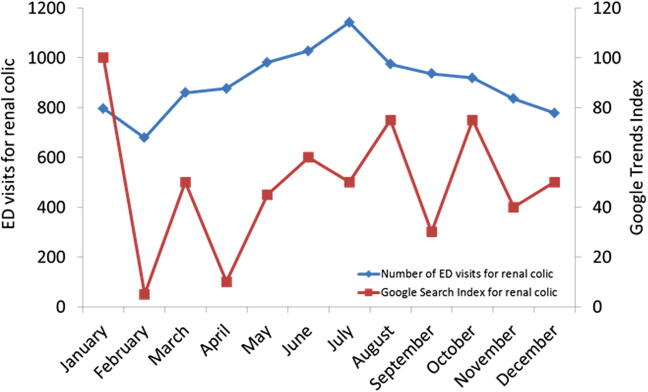
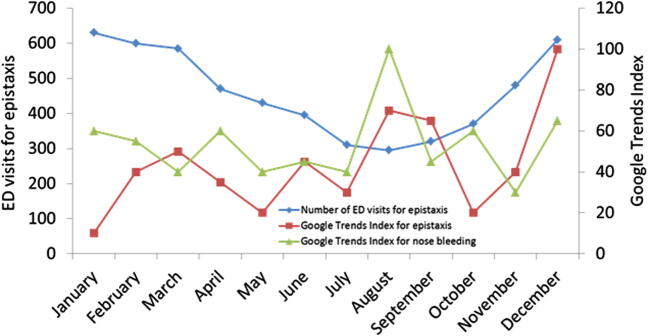
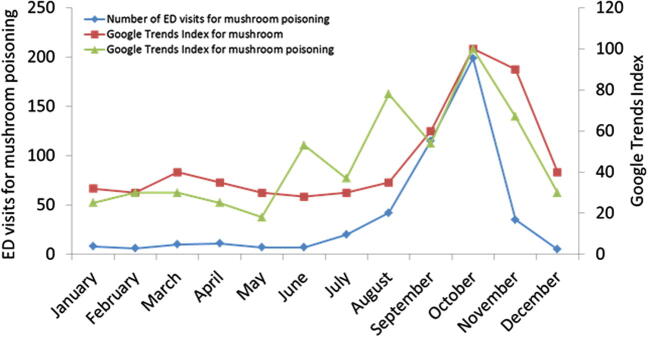
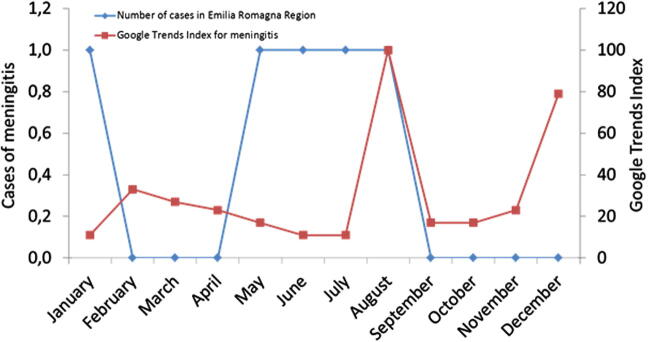
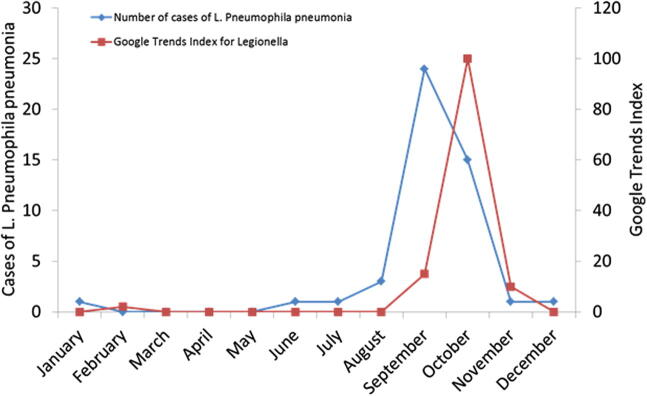
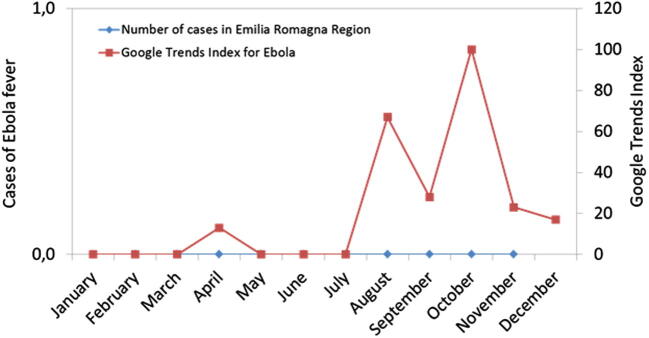
Internet-derived information has been recently recognized as a valuable tool for epidemiological investigation. Google Trends, a Google Inc. portal, generates data on geographical and temporal patterns according to specified keywords. The aim of this study was to compare the reliability of Google Trends in different clinical settings, for both common diseases with lower media coverage, and for less common diseases attracting major media coverage. We carried out a search in Google Trends using the keywords "renal colic", "epistaxis", and "mushroom poisoning", selected on the basis of available and reliable epidemiological data. Besides this search, we carried out a second search for three clinical conditions (i.e., "meningitis", "Legionella Pneumophila pneumonia", and "Ebola fever"), which recently received major focus by the Italian media. In our analysis, no correlation was found between data captured from Google Trends and epidemiology of renal colics, epistaxis and mushroom poisoning. Only when searching for the term "mushroom" alone the Google Trends search generated a seasonal pattern which almost overlaps with the epidemiological profile, but this was probably mostly due to searches for harvesting and cooking rather than to for poisoning. The Google Trends data also failed to reflect the geographical and temporary patterns of disease for meningitis, Legionella Pneumophila pneumonia and Ebola fever. The results of our study confirm that Google Trends has modest reliability for defining the epidemiology of relatively common diseases with minor media coverage, or relatively rare diseases with higher audience. Overall, Google Trends seems to be more influenced by the media clamor than by true epidemiological burden.
Keywords: Digital epidemiology; Epistaxis; Google Trends; Mushroom poisoning; Renal colic.
Copyright © 2017 Ministry of Health, Saudi Arabia. Published by Elsevier Ltd. All rights reserved.
Conflict of interest statement
None declared.
Figures
Comment in
-
Seasonal variation in systemic lupus erythematosus and rheumatoid arthritis: An ecological study based on internet searches.Autoimmun Rev. 2019 Aug;18(8):825-827. doi: 10.1016/j.autrev.2019.06.001. Epub 2019 Jun 6. Autoimmun Rev. 2019. PMID: 31176877 No abstract available.
References
-
- Barrett-Connor E, Ayanian JZ, Brown ER, et al. A Nationwide framework for surveillance of cardiovascular and chronic lung diseases. Washington (DC): National Academies Press (US); 2011. - PubMed
-
- Google Google Trends. Available: < http://www.google.com/trends/>. [Accessed 2017 March 15].
MeSH terms
LinkOut - more resources
Full Text Sources
Other Literature Sources
