. 2017 Aug 7;27(15):2389-2396.e4.
doi: 10.1016/j.cub.2017.06.076. Epub 2017 Jul 27.

Whole-Brain Calcium Imaging Reveals an Intrinsic Functional Network in Drosophila

Affiliations

Whole-Brain Calcium Imaging Reveals an Intrinsic Functional Network in Drosophila

Kevin Mann et al. Curr Biol. .

Abstract

A long-standing goal of neuroscience has been to understand how computations are implemented across large-scale brain networks. By correlating spontaneous activity during "resting states" [1], studies of intrinsic brain networks in humans have demonstrated a correspondence with task-related activation patterns [2], relationships to behavior [3], and alterations in processes such as aging [4] and brain disorders [5], highlighting the importance of resting-state measurements for understanding brain function. Here, we develop methods to measure intrinsic functional connectivity in Drosophila, a powerful model for the study of neural computation. Recent studies using calcium imaging have measured neural activity at high spatial and temporal resolution in zebrafish, Drosophila larvae, and worms [6-10]. For example, calcium imaging in the zebrafish brain recently revealed correlations between the midbrain and hindbrain, demonstrating the utility of measuring intrinsic functional connections in model organisms [8]. An important component of human connectivity research is the use of brain atlases to compare findings across individuals and studies [11]. An anatomical atlas of the central adult fly brain was recently described [12]; however, combining an atlas with whole-brain calcium imaging has yet to be performed in vivo in adult Drosophila. Here, we measure intrinsic functional connectivity in Drosophila by acquiring calcium signals from the central brain. We develop an alignment procedure to assign functional data to atlas regions and correlate activity between regions to generate brain networks. This work reveals a large-scale architecture for neural communication and provides a framework for using Drosophila to study functional brain networks.

Keywords: Drosophila; brain networks; calcium imaging; functional connectivity.


Figures

Figure 1
Figure 1. Alignment of brain atlas to functional brain data
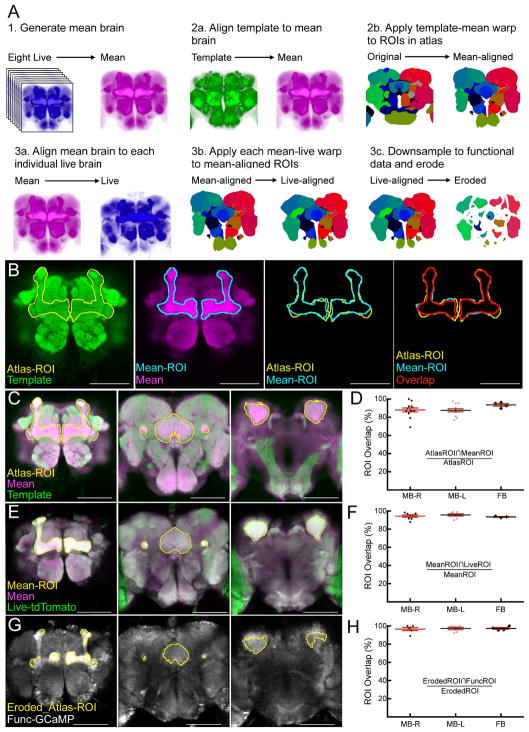
(A) Schematic of three-step brain alignment. (1) Eight anatomical scans of a myr:tdTomato channel from live animals were aligned to each other and averaged to generate the “mean” brain. (2a) Template brain was aligned to the mean brain. (2b) Fly brain atlas was warped to the mean brain according to the parameters in (2a). (3a) Mean brain was aligned to each individual live anatomical scan. (3b) Fly brain atlas was warped to each individual animal according to the parameters in (3a). (3c) Fly brain atlas was downsampled to the functional resolution scan and eroded by one voxel at the edges of each ROI. Examples shown in (A) are single slices used only for visualization purposes. (B) Example of the calculation of overlap shown in d, f, and h. From left to right: Post-alignment of template brain (green) to mean brain, showing ROIs from the fly brain atlas (Atlas-ROI, yellow) corresponding to the mushroom bodies (MB). Mean brain (magenta) with manually drawn ROIs corresponding to the MB of the same section (Mean-ROI, blue). Overlay of the fly brain atlas ROIs and manually drawn ROIs. Overlay of the fly brain atlas and manual ROIs also depicting the overlap (AtlasROI∩MeanROI) (red). (C) Example overlays of template (green) and mean brain (magenta) with Atlas-ROIs (yellow) from the MBs and the fan-shaped body (FB) anterior to posterior (left to right). (D) Quantification of overlap between atlas-ROIs and mean-ROIs expressed as a percent of in-plane area of the atlas-ROI. ROIs were drawn at 20μm intervals (MB, 26 in-plane ROIs, 13 in each hemisphere) and 15μm intervals (FB, 4 in-plane ROIs). (E) Example overlays of mean brain (magenta) and live anatomical scan (Anat-tdTomato, green) with Mean-ROIs (yellow) from the MBs and the FSB body anterior to posterior (left to right). (F) Quantification of overlap between mean-ROIs and live-ROIs expressed as a percent of in-plane area of the mean-ROI. (G) Example overlays of eroded fly brain atlas ROIs (Eroded-ROI, yellow) and functional data (Func-GCaMP). (H) Quantification of overlap between eroded-ROIs and func-ROIs. Note that no images used to create the “mean” brain were used to quantify registration quality. For panels D, F, and H, individual points represent the overlap for each in-plane ROI. Data is plotted as the mean ± SEM. Scale bars are 100μm. See also Figure S1. Description of ROI terminology: Mean-ROI, manually drawn ROIs from the mean brain; Atlas-ROI, ROIs from the atlas; Live-ROI, manually drawn ROIs from live anatomical data; Func-ROI, manually drawn ROIs from functional GCaMP data (Func-ROI); Eroded_Atlas-ROI, ROIs from the atlas that have been resampled to functional resolution and eroded by one voxel.
Figure 2
Figure 2. Functional imaging data and time series correlations between regions
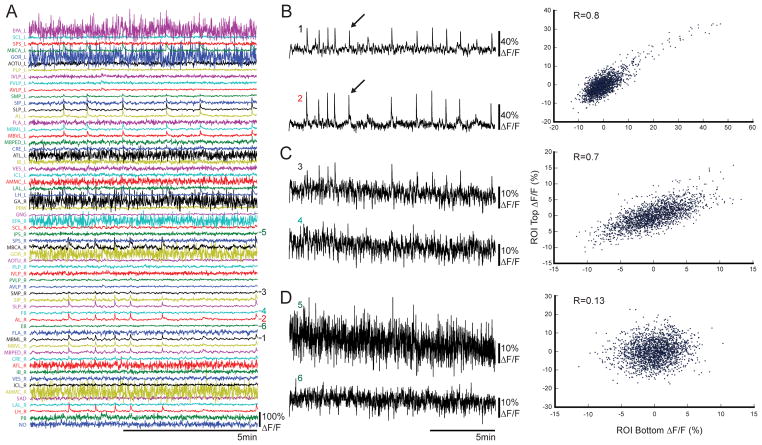
(A) Example ΔF/F traces of atlas ROIs (N = 61) from a single fly for 8.5 minutes (half of an imaging session). Numbers to the right of each trace correspond to those used for correlations in B–D. (B–D) Scatter plots of ΔF/F values from left, with top trace (ordinate) plotted against the bottom trace (abscissa) and their corresponding Pearson’s correlation values calculated from correlating the time series between ROIs (R). (B) Example of highly-correlated brain regions that show large calcium excursions (arrows show example excursion from both regions). (C) Example of highly-correlated brain regions that do not show large calcium excursions. (D) Example of weakly-correlated brain regions. Regions shown are (1) right mushroom body medial lobe (MBML_R), (2) right antennal lobe (AL_R), (3) right superior medial protocerebrum (SMP_R), (4) fan-shaped body (FB), (5) right inferior posterior slope (IPS_R), (6) ellipsoid body (EB). See also Figure S2.
Figure 3
Figure 3. Whole-brain intrinsic functional connectivity
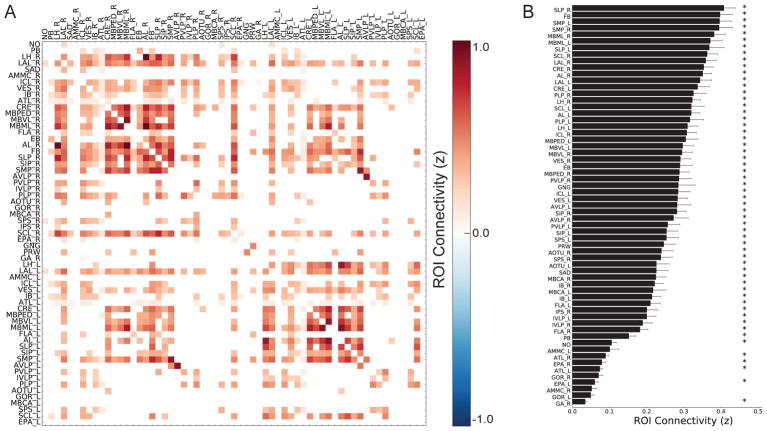
(A) Significant functional connections between brain atlas regions (N = 61 ROIs). For significant functional connections, the strength of each connection represents the Fisher transformed correlation value (z) between atlas regions, averaged across all N = 18 animals. Non-significant functional connections are presented as white cells. Significance of functional connections was calculated using a one-sample t-test against zero across all flies at α = 0.001 Bonferroni-corrected for all connections tested (number of connections = 1830, p < 5.46e–7). (B) Average Fisher-transformed correlation values of each atlas region to all other regions. Bars are plotted as mean ± SEM. Significance of ROI functional connectivity was calculated using a one-sample t-test against zero across all flies at α = 0.001 Bonferroni-corrected for all regions tested (number of regions = 61, p < 1.64e–5). *p < 0.001. See also Figures S2–S3, Table S1.
Figure 4
Figure 4. Organizational properties of intrinsic brain networks network in Drosophila
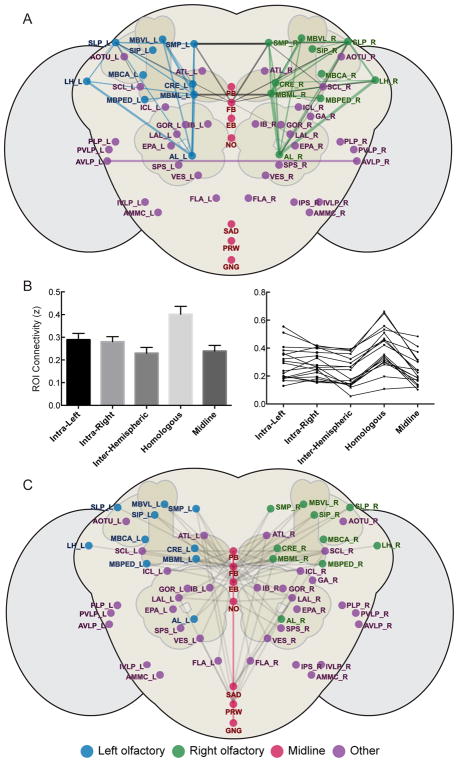
(A) Fly brain network with labeled atlas regions represented as circles and functional connections between them represented as lines. Atlas regions are shown over a schematized fly brain with optic lobes (lighter, lateral) antennal lobes and mushroom bodies (darker, dorsal), and esophageal foramen (white, medial). Here, the top 3% of significant functional connections in the central fly brain are shown. The 3% cutoff corresponds to a 0.61–1.03 range of correlation values. It should be noted that this cutoff was chosen only for visualization purposes. Groups of brain regions are colored as follows: left olfactory-related regions (blue), right olfactory-related (green), midline regions (magenta), all other regions (purple). Functional connections between brain regions of the same group are colored the same as the regions themselves, while functional connections between regions of different groups are colored grey. Functional connections are weighted according to their average functional connectivity strength (reflected in the width of the line). See also Figure S4. (B) Lateralization of functional connectivity within and between hemispheres. (Left) Connectivity is presented as the average Fisher z-transformed values (i.e., connectivity calculated for each fly and averaged across flies) between groups of regions depending on hemispheric location (mean ± SEM across flies). For each fly, intra-hemispheric functional connectivity (Intra-Left, Intra-Right) was calculated by averaging functional connectivity values within left and right hemisphere atlas regions, respectively. Inter-hemispheric functional connectivity (Inter-Hemispheric) was calculated by averaging functional connectivity values between left and right hemisphere atlas regions. Homologous region functional connectivity (Homologous) was calculated by identifying regions with left-right pairs and averaging functional connectivity over these pairs. Midline functional connectivity (Midline) was calculated by averaging functional connectivity between midline regions and lateral brain regions. (Right) Individual animal values (N = 18) for data presented in (B, Left). (C) Midline functional connections, with similar coloring as in (A). Here, all significant midline functional connections are presented at a fixed connection width (i.e., functional connectivity strength is not incorporated into line width).

References

    1. Power JD, Schlaggar BL, Petersen SE. Studying brain organization via spontaneous fMRI signal. Neuron. 2014;84:681–696. - PMC - PubMed
    1. Smith SM, Fox PT, Miller KL, Glahn DC, Fox PM, Mackay CE, Filippini N, Watkins KE, Toro R, Laird AR, et al. Correspondence of the brain’s functional architecture during activation and rest. Proc Natl Acad Sci USA. 2009;106:13040–13045. - PMC - PubMed
    1. Vaidya CJ, Gordon EM. Phenotypic variability in resting-state functional connectivity: current status. Brain Connect. 2013;3:99–120. - PMC - PubMed
    1. Chan MY, Park DC, Savalia NK, Petersen SE, Wig GS. Decreased segregation of brain systems across the healthy adult lifespan. Proc Natl Acad Sci USA. 2014;111:E4997–5006. - PMC - PubMed
    1. Fornito A, Zalesky A, Breakspear M. The connectomics of brain disorders. Nat Rev Neurosci. 2015;16:159–172. - PubMed

LinkOut - more resources