Review
. 2017 Jul 29;18(8):1649.
doi: 10.3390/ijms18081649.

Adipokines and Non-Alcoholic Fatty Liver Disease: Multiple Interactions

Affiliations
Review

Adipokines and Non-Alcoholic Fatty Liver Disease: Multiple Interactions

Timon E Adolph et al. Int J Mol Sci. .

Abstract

Accumulating evidence links obesity with low-grade inflammation which may originate from adipose tissue that secretes a plethora of pro- and anti-inflammatory cytokines termed adipokines. Adiponectin and leptin have evolved as crucial signals in many obesity-related pathologies including non-alcoholic fatty liver disease (NAFLD). Whereas adiponectin deficiency might be critically involved in the pro-inflammatory state associated with obesity and related disorders, overproduction of leptin, a rather pro-inflammatory mediator, is considered of equal relevance. An imbalanced adipokine profile in obesity consecutively contributes to metabolic inflammation in NAFLD, which is associated with a substantial risk for developing hepatocellular carcinoma (HCC) also in the non-cirrhotic stage of disease. Both adiponectin and leptin have been related to liver tumorigenesis especially in preclinical models. This review covers recent advances in our understanding of some adipokines in NAFLD and associated HCC.

Keywords: Adipokines; hepatocellular cancer; metabolic inflammation; metabolism; non-alcoholic fatty liver disease (NAFLD).


Conflict of interest statement

The authors declare no conflict of interest.

Figures
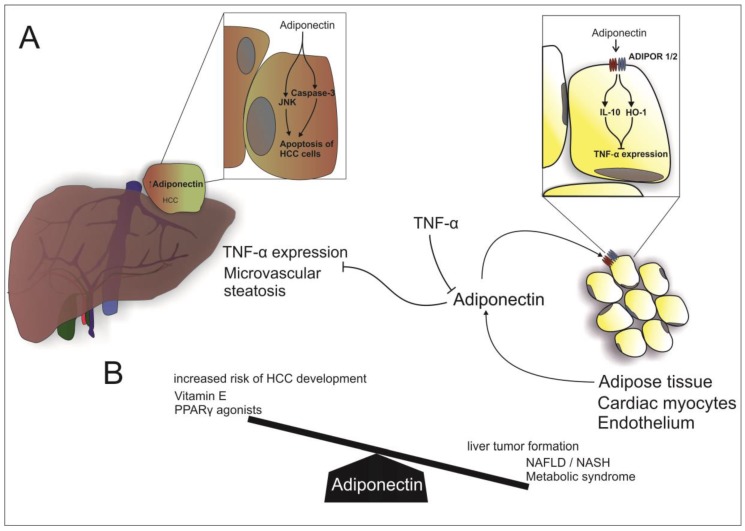
Figure 1
Figure 1
Adiponectin in NAFLD: (A) Beside cardiac myocytes and endothelial cells, adiponectin is mostly secreted by adipose tissue. Adiponectin acts in a paracrine manner via binding to ADIPOR 1/2 (Adiponectin receptor 1 and 2) and thereby inducing IL-10 (Interleukin 10) and HO-1 (Heme oxigenase-1), resulting in an inhibition of TNFα (tumor necrosis factor α) expression. Vice versa, TNFα dampens adiponectin transcription. Furthermore, adiponectin inhibits hepatic TNFα expression and microvascular steatosis. In HCC, adiponectin stimulates apoptosis of cancer cells by activation of Caspase 3 and JAK (Jun N-terminal kinase); (B) High levels of adiponectin are associated with an increased risk of HCC and the use of Vitamin E and Peroxisome proliferator-activated receptors γ agonists. On the other hand, low levels of adiponectin are associated with hepatic tumor formation, NAFLD, NASH and the metabolic syndrome.
Figure 2
Figure 2
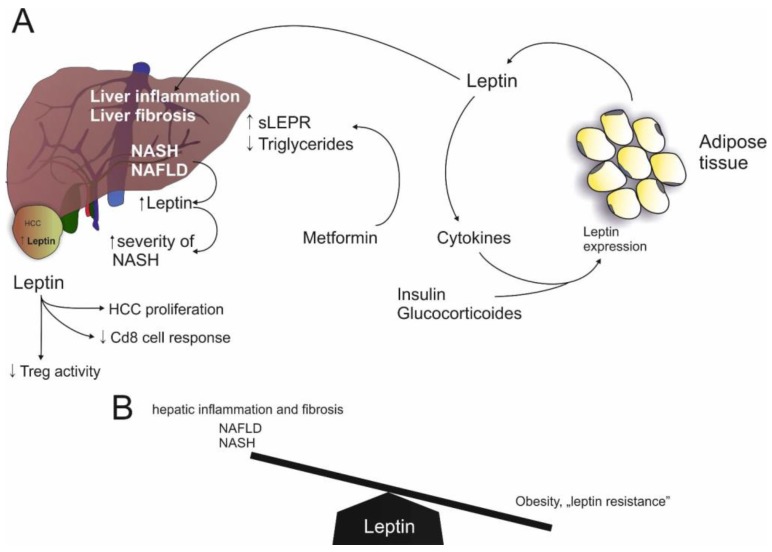
Leptin in NAFLD: (A) Leptin expression is induced by insulin, glucocorticoids and cytokines and leptin stimulates cytokine expression. Furthermore, leptin induces hepatic inflammation and fibrosis. Likewise, NAFLD and NASH are associated with increased leptin levels. On the other hand, Metformin induces sLEPR (soluble leptin receptor). In HCC, leptin induces proliferation but reduces CD8 response and Treg (regulatory T cell) activity; (B) Increased levels of leptin are associated with hepatic inflammation and fibrosis, as seen in NAFLD and NASH. On the other hand, low leptin levels are associated with leptin resistance in obesity.

References

    1. Apovian C.M. The obesity epidemic—Understanding the disease and the treatment. N. Engl. J. Med. 2016;374:177–179. doi: 10.1056/NEJMe1514957. - DOI - PubMed
    1. Angulo P. Nonalcoholic fatty liver disease. N. Engl. J. Med. 2002;346:1221–1231. doi: 10.1056/NEJMra011775. - DOI - PubMed
    1. Brestoff J.R., Artis D. Immune regulation of metabolic homeostasis in health and disease. Cell. 2015;161:146–160. doi: 10.1016/j.cell.2015.02.022. - DOI - PMC - PubMed
    1. Tilg H., Moschen A.R. Adipocytokines: Mediators linking adipose tissue, inflammation and immunity. Nat. Rev. Immunol. 2006;6:772–783. doi: 10.1038/nri1937. - DOI - PubMed
    1. Tilg H. Adipocytokines in nonalcoholic fatty liver disease: Key players regulating steatosis, inflammation and fibrosis. Curr. Pharm. Des. 2010;16:1893–1895. doi: 10.2174/138161210791208929. - DOI - PubMed

MeSH terms

LinkOut - more resources