


Barriers to sexual and reproductive healthcare services as experienced by female sex workers and service providers in Dhaka city, Bangladesh
- PMID: 28759575
- PMCID: PMC5536311
- DOI: 10.1371/journal.pone.0182249
Barriers to sexual and reproductive healthcare services as experienced by female sex workers and service providers in Dhaka city, Bangladesh
Abstract
Objectives: This study aimed to identify the barriers female sex workers (FSWs) in Bangladesh face with regard to accessing sexual and reproductive health (SRH) care, and assess the satisfaction with the healthcare received.
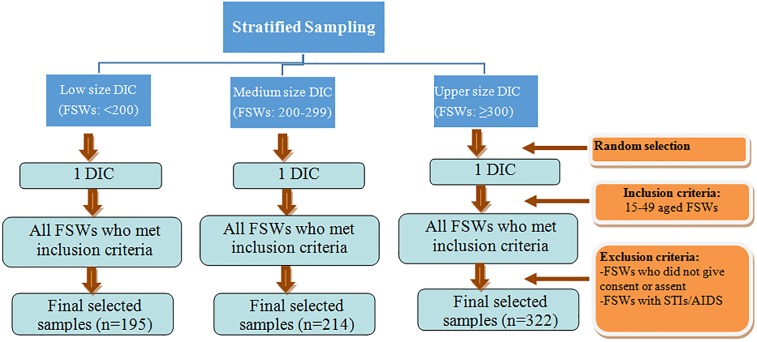
Methods: Data were collected from coverage areas of four community-based drop-in-centers (DICs) in Dhaka where sexually transmitted infection (STI) and human immunovirus (HIV) prevention interventions have been implemented for FSWs. A total of 731 FSWs aged 15-49 years were surveyed. In addition, in-depth interviews (IDIs) were conducted with 14 FSWs and 9 service providers. Respondent satisfaction was measured based on recorded scores on dignity, privacy, autonomy, confidentiality, prompt attention, access to social support networks during care, basic amenities, and choice of institution/care provider.
Results: Of 731 FSWs, 353 (51%) reported facing barriers when seeking sexual and reproductive healthcare. Financial problems (72%), shame about receiving care (52.3%), unwillingness of service providers to provide care (39.9%), unfriendly behavior of the provider (24.4%), and distance to care (16.9%) were mentioned as barriers. Only one-third of the respondents reported an overall satisfaction score of more than fifty percent (a score of between 9 and16) with formal healthcare. Inadequacy or lack of SRH services and referral problems (e.g., financial charge at referral centers, unsustainable referral provision, or unknown location of referral) were reported by the qualitative FSWs as the major barriers to accessing and utilizing SRH care.
Conclusions: These findings are useful for program implementers and policy makers to take the necessary steps to reduce or remove the barriers in the health system that are preventing FSWs from accessing SRH care, and ultimately meet the unmet healthcare needs of FSWs.
Conflict of interest statement
References
-
- NASP & UNAIDS (2009) Size Estimation. Available from http://files.unaids.org/en/dataanalysis/knowyourresponse/countryprogress.... [Accessed 15th June 2015]
-
- Khan MR, Turner AN, Pettifor A, Van Damme KV, Rabenja NL, Ravelomanana N, et al. Unmet need for contraception among sex workers in Madagascar. Contraception. 2009; 79(3):221–227. doi: 10.1016/j.contraception.2008.09.011 - DOI - PMC - PubMed
-
- Delvaux T, Crabbé F, Seng S, Laga M. The need for family planning and safe abortion services among women sex workers seeking STI care in Cambodia. Reproductive Health Matters. 2003; 11(21):88–95. - PubMed
-
- Todd CS, Alibayeva G, Sanchez JL, Bautista CT, Carr JK, Earhart KC. Utilization of contraception and abortion and its relationship to HIV infection among female sex workers in Tashkent, Uzbekistan. Contraception. 2006; 74(4):318–323. doi: 10.1016/j.contraception.2006.04.006 - DOI - PubMed
MeSH terms
LinkOut - more resources
Full Text Sources
Other Literature Sources
Medical
