


Contamination with HIV antibody may be responsible for false positive results in specimens tested on automated platforms running HIV 4th generation assays in a region of high HIV prevalence
- PMID: 28759622
- PMCID: PMC5536287
- DOI: 10.1371/journal.pone.0182167
Contamination with HIV antibody may be responsible for false positive results in specimens tested on automated platforms running HIV 4th generation assays in a region of high HIV prevalence
Abstract
Introduction: In South Africa where the prevalence of HIV infection is very high, 4th generation HIV antibody/p24 antigen combo immunoassays are the tests of choice for laboratory based screening. Testing is usually performed in clinical pathology laboratories on automated analysers. To investigate the cause of false positive results on 4th generation HIV testing platforms in public sector laboratories, the performance of two automated platforms was compared in a clinical pathology setting, firstly on routine diagnostic specimens and secondly on known sero-negative samples.
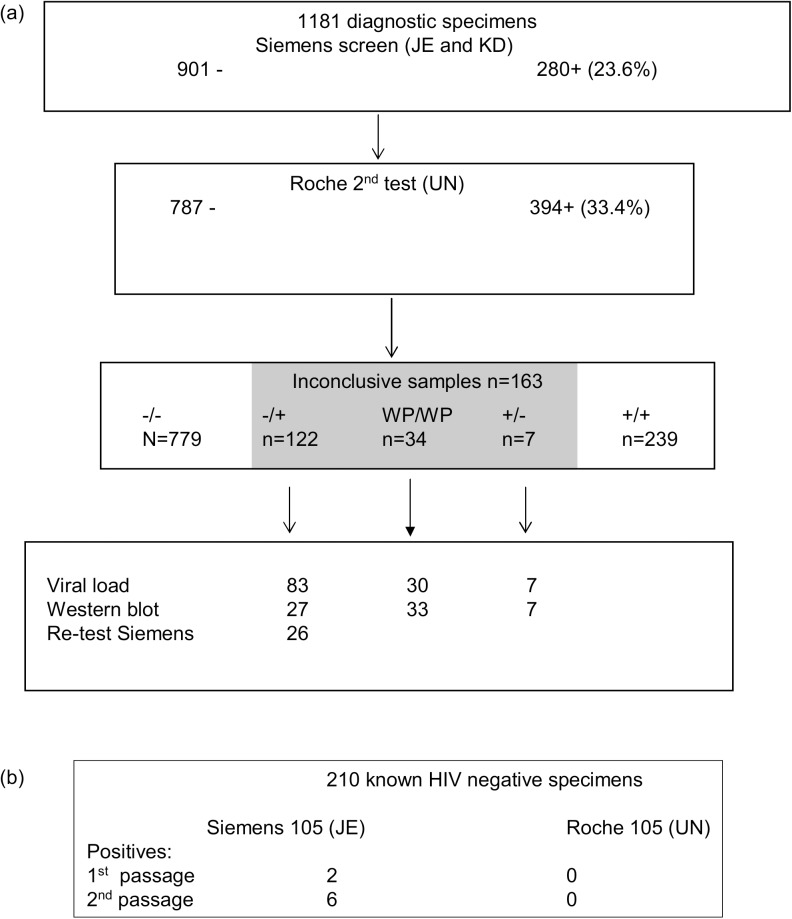
Methods: Firstly, 1181 routine diagnostic specimens were sequentially tested on Siemens and Roche automated 4th generation platforms. HIV viral load, western blot and follow up testing were used to determine the true status of inconclusive specimens. Subsequently, known HIV seronegative samples from a single donor were repeatedly tested on both platforms and an analyser was tested for surface contamination with HIV positive serum to identify how suspected specimen contamination could be occurring.
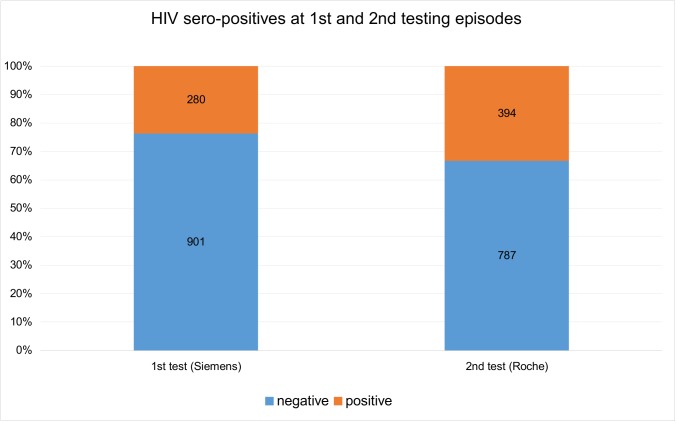
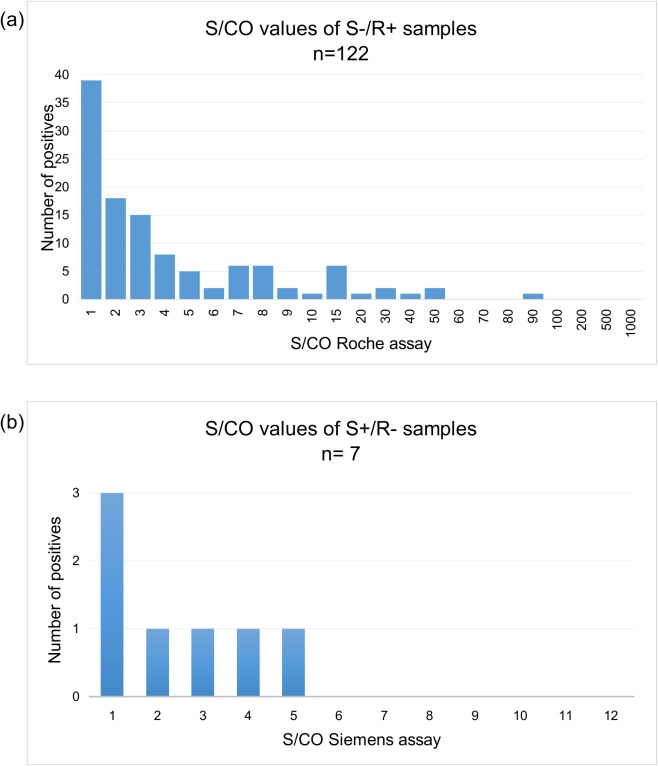
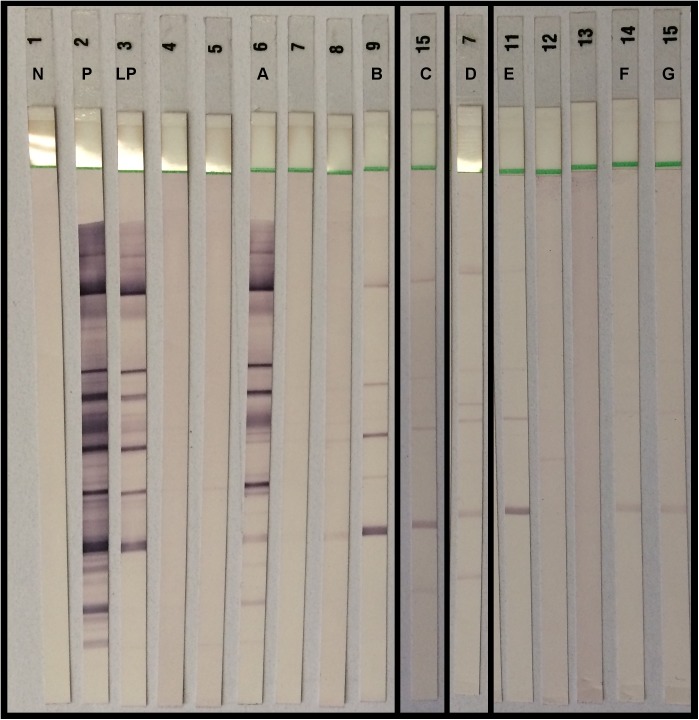
Results: Serial testing of diagnostic specimens yielded 163 weakly positive or discordant results. Only 3 of 163 were conclusively shown to indicate true HIV infection. Specimen contamination with HIV antibody was suspected, based on the following evidence: the proportion of positive specimens increased on repeated passage through the analysers; viral loads were low or undetectable and western blots negative or indeterminate on problem specimens; screen negative, 2nd test positive specimens tested positive when reanalysed on the screening assay; follow up specimens (where available) were negative. Similarly, an increasing number of known negative specimens became (repeatedly) sero-positive on serial passage through one of the analysers. Internal and external analyser surfaces were contaminated with HIV serum, evidence that sample splashes occur during testing.
Conclusions: Due to the extreme sensitivity of these assays, contamination with minute amounts of HIV antibody can cause a negative sample to test positive. Better contamination control measures are needed on analysers used in clinical pathology environments, especially in regions where HIV sero-prevalence is high.
Conflict of interest statement
Figures
References
-
- Simbayi, L. C., Shisana, O., Rehle, T., Onoya, D., Jooste, S., Zungu, N., et al. South African National HIV Prevalence, Incidence and Behaviour Survey, 2012. 2014. Available from: http://www.hsrc.ac.za/en/research-data/view/6871 - PubMed
-
- Wolpaw BJ, Mathews C, Chopra M, Hardie D, de Azevedo V, Jennings K, et al. The failure of routine rapid HIV testing: a case study of improving low sensitivity in the field. BMC Health Serv Res [Internet]. 2010;10:73 Available from: http://www.pubmedcentral.nih.gov/articlerender.fcgi?artid=2851712&tool=p... doi: 10.1186/1472-6963-10-73 - DOI - PMC - PubMed
-
- Begg K, Young T, Stone P. Analysis of POCT / VCT performed at South African primary health care clinics. 2012;1–44. Avaiable from: http://www.sead.co.za/downloads/POCT-clinics-2011.pdf
-
- World Health Organization. Recommendations for the selection and use of HIV antibody tests. Wkly Epidemiol Rec. 1997;72(12):81–8. - PubMed
-
- Alexander TS. Human Immunodeficiency Virus Diagnostic Testing: 30 Years of Evolution. Clin Vaccine Immunol [Internet]. 2016;23(4):249–53. Available from: doi: http://cvi.asm.org/lookup/doi/10.1128/CVI.00053-16 - DOI - PMC - PubMed
MeSH terms
Substances
LinkOut - more resources
Full Text Sources
Other Literature Sources
Medical
Molecular Biology Databases
