


The Effects of Injury Prevention Programs on the Biomechanics of Landing Tasks: A Systematic Review With Meta-analysis
- PMID: 28759729
- PMCID: PMC6604048
- DOI: 10.1177/0363546517716930
The Effects of Injury Prevention Programs on the Biomechanics of Landing Tasks: A Systematic Review With Meta-analysis
Abstract
Background: Anterior cruciate ligament (ACL) tear is a common injury in sports and often occurs during landing from a jump.
Purpose: To synthesize the evidence on the effects of injury prevention programs (IPPs) on landing biomechanics as they relate to the ligament, quadriceps, trunk, and leg dominance theories associated with ACL injury risk.
Study design: Meta-analysis.
Methods: Six electronic databases were searched for studies that investigated the effect of IPPs on landing task biomechanics. Prospective studies that reported landing biomechanics at baseline and post-IPP were included. Results from trunk, hip, and knee kinematics and kinetics related to the ACL injury theories were extracted, and meta-analyses were performed when possible.
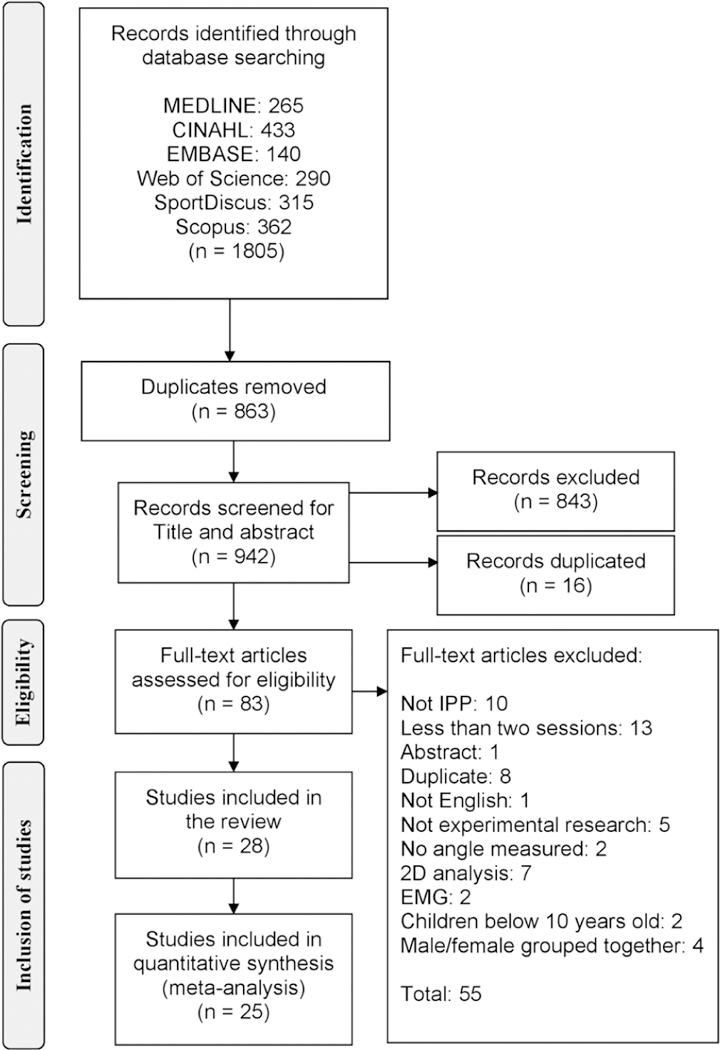
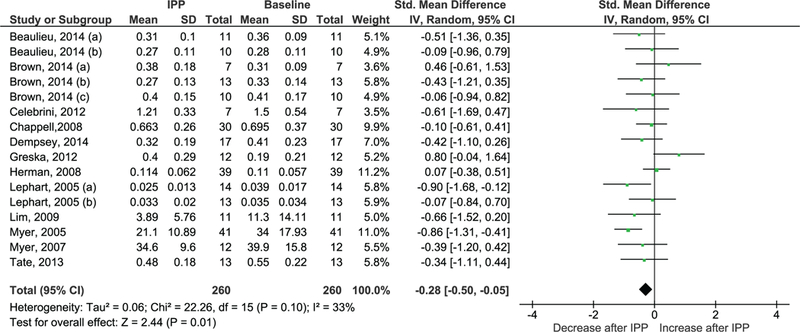
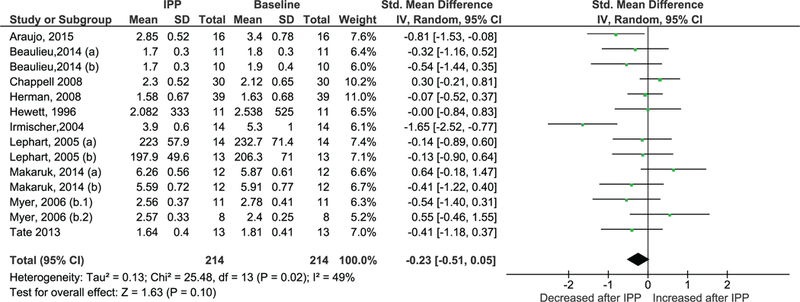
Results: The criteria were met by 28 studies with a total of 466 participants. Most studies evaluated young females, bilateral landing tasks, and recreational athletes, while most variables were related to the ligament and quadriceps dominance theories. An important predictor of ACL injury, peak knee abduction moment, decreased ( P = .01) after the IPPs while other variables related to the ligament dominance theory did not change. Regarding the quadriceps dominance theory, after the IPPs, angles of hip flexion at initial contact ( P = .009), peak hip flexion ( P = .002), and peak knee flexion ( P = .007) increased, while knee flexion at initial contact did not change ( P = .18). Moreover, peak knee flexion moment decreased ( P = .005) and peak vertical ground-reaction force did not change ( P = .10).
Conclusion: The exercises used in IPPs might have the potential to improve landing task biomechanics related to the quadriceps dominance theory, especially increasing peak knee and hip flexion angles. Importantly, peak knee abduction moment decreased, which indicates that IPPs influence a desired movement strategy to help athletes overcome dangerous ligament dominance loads arising from lack of frontal plane control during dynamic tasks. The lack of findings for some biomechanical variables suggests that future IPPs may be enhanced by targeting participants' baseline profile deficits, highlighting the need to deliver an individualized and task-specific IPP.
Keywords: kinematics; kinetics; neuromuscular training; sports injury.
Conflict of interest statement
One or more of the authors has declared the following potential conflict of interest
Figures
References
-
- Ardern CL, Taylor NF, Feller JA, Webster KE. Fifty-five per cent return to competitive sport following anterior cruciate ligament reconstruction surgery: an updated systematic review and meta-analysis including aspects of physical functioning and contextual factors. Br J Sports Med. 2014;48(21):1543–1552. - PubMed
-
- Beaulieu ML, Palmieri-Smith RM. Real-time feedback on knee abduction moment does not improve frontal-plane knee mechanics during jump landings. Scand J Med Sci Sports. 2014;24(4):692–699. - PubMed
-
- Beynnon BD, Fleming BC. Anterior cruciate ligament strain in-vivo: a review of previous work. J Biomech. 1998;31(6):519–525. - PubMed
-
- Brown SR, Brughelli M, Hume PA. Knee mechanics during planned and unplanned sidestepping: a systematic review and meta-analysis. Sports Med. 2014;44(11):1573–1588. - PubMed
Publication types
MeSH terms
Grants and funding
LinkOut - more resources
Full Text Sources
Other Literature Sources
Medical
Miscellaneous
