The Utility of Outpatient Commitment: I. A Need for Treatment and a Least Restrictive Alternative to Psychiatric Hospitalization
- PMID: 28760100
- PMCID: PMC7138506
- DOI: 10.1176/appi.ps.201600161
The Utility of Outpatient Commitment: I. A Need for Treatment and a Least Restrictive Alternative to Psychiatric Hospitalization
Abstract
Objectives: This study examined whether psychiatric patients assigned to community treatment orders (CTOs), outpatient commitment in Victoria, Australia, have a greater need for treatment to protect their health and safety than patients not assigned to CTOs. It also considered whether such treatment is provided in a least restrictive manner-that is, in a way that contributes to reduced use of psychiatric hospitalization.
Methods: The sample included 11,424 patients first placed on a CTO between 2000 and 2010, and 16,161 patients not placed on a CTO. Need for treatment was independently assessed with the Health of the Nation Outcome Scales (HoNOS) at hospital admission and at discharge. Ordinary least-squares and Poisson regressions were used to assess savings in hospital days attributable to CTO placement.
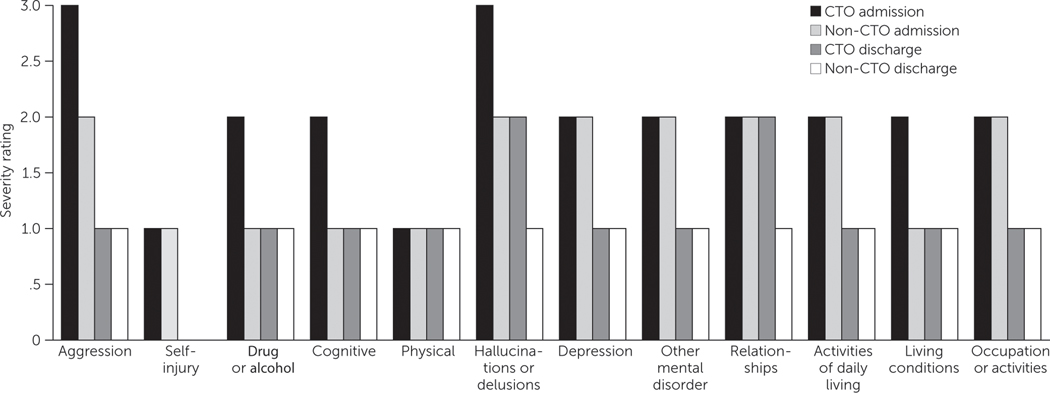
Results: HoNOS ratings indicated that at admission and discharge, the CTO cohort's need for treatment exceeded that of the non-CTO cohort, particularly in areas indicating potential dangerous behavior. When analyses adjusted for the propensity to be selected into the CTO cohort and other factors, the mean duration of an inpatient episode was 4.6 days shorter for the CTO cohort than for the non-CTO cohort, and a reduction of 10.4 days per inpatient episode was attributable to each CTO placement.
Conclusions: CTO placement may have helped patients with a greater need for treatment to experience shorter hospital stays. Whether the CTO directly enabled the fulfillment of unsought but required treatment needs that protected patient health and safety is a question that needs to be addressed in future research.
Keywords: Involuntary commitment, Outpatient commitment, Admissions & readmissions, Civil law, Deinstitutionalization.
Figures
Comment in
-
Effectiveness of Community Treatment Orders? Two Studies With Unusual Outcomes and an Atypical Population.Psychiatr Serv. 2017 Dec 1;68(12):1322-1323. doi: 10.1176/appi.ps.681102. Psychiatr Serv. 2017. PMID: 29191150 No abstract available.
References
-
- Glover-Thomas NR: Reconstructing Mental Health Law and Policy. London, Lexis Nexis Butterworths Tolley, 2002
-
- Involuntary Outpatient Commitment: Summary of State Statutes Washington, DC, Bazelon Center for Mental Health Law, 2004
-
- Torrey EF, Zdanowicz M: Outpatient commitment: what, why, and for whom. Psychiatric Services 52:337–341, 2001 - PubMed
-
- Gerrand V: Transforming Mental Health Services From 1993. to 1998 in Victoria, Australia: A Case Study of Policy Implementation. Melbourne, University of Melbourne, Department of Political Science, 2005
-
- Van Putten RA, Santiago JM, Berren MR: Involuntary outpatient commitment in Arizona: a retrospective study. Psychiatric Services 39:953–958, 1988 - PubMed
MeSH terms
Grants and funding
LinkOut - more resources
Full Text Sources
Other Literature Sources
Medical