. 2017 Aug 1;8(1):170.
doi: 10.1038/s41467-017-00261-9.

Charge carrier localised in zero-dimensional (CH3NH3)3Bi2I9 clusters

Affiliations

Charge carrier localised in zero-dimensional (CH3NH3)3Bi2I9 clusters

Chengsheng Ni et al. Nat Commun. .

Abstract

A metal-organic hybrid perovskite (CH3NH3PbI3) with three-dimensional framework of metal-halide octahedra has been reported as a low-cost, solution-processable absorber for a thin-film solar cell with a power-conversion efficiency over 20%. Low-dimensional layered perovskites with metal halide slabs separated by the insulating organic layers are reported to show higher stability, but the efficiencies of the solar cells are limited by the confinement of excitons. In order to explore the confinement and transport of excitons in zero-dimensional metal-organic hybrid materials, a highly orientated film of (CH3NH3)3Bi2I9 with nanometre-sized core clusters of Bi2I93- surrounded by insulating CH3NH3+ was prepared via solution processing. The (CH3NH3)3Bi2I9 film shows highly anisotropic photoluminescence emission and excitation due to the large proportion of localised excitons coupled with delocalised excitons from intercluster energy transfer. The abrupt increase in photoluminescence quantum yield at excitation energy above twice band gap could indicate a quantum cutting due to the low dimensionality.Understanding the confinement and transport of excitons in low dimensional systems will aid the development of next generation photovoltaics. Via photophysical studies Ni et al. observe 'quantum cutting' in 0D metal-organic hybrid materials based on methylammonium bismuth halide (CH3NH3)3Bi2I9.


Conflict of interest statement

The authors declare no competing financial interests.

Figures
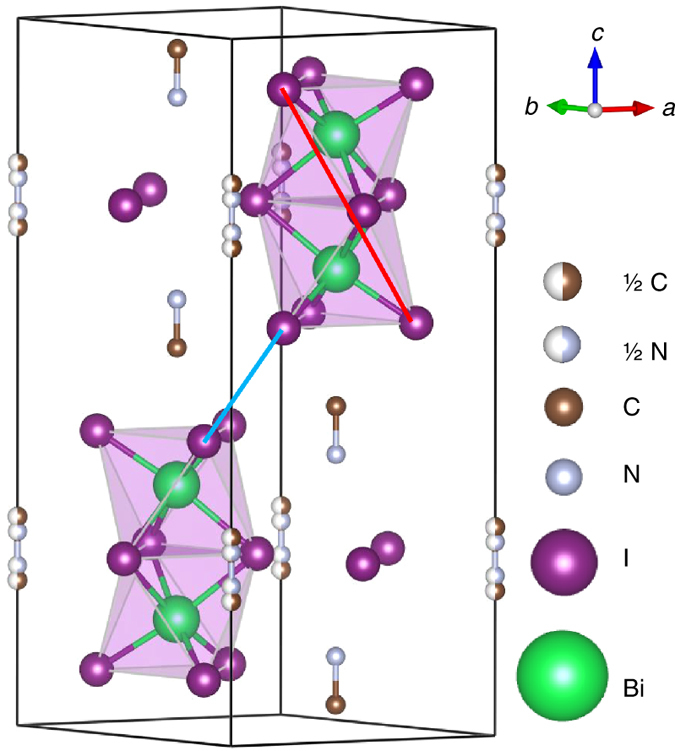
Fig. 1
Fig. 1
Crystal structure of (CH3NH3)3Bi2I9 from single-crystal diffraction The hydrogen atoms are omitted. The thick light-blue line (0.43 nm) shows the shortest distance between two Bi2I9 bioctohedra and the thick red line (0.85 nm) shows the distance between two furthest iodine atoms. ½ C and ½ N represent the half-occupied carbon and nitrogen sites, respectively
Fig. 2
Fig. 2
Structure characterisation of the orientated (CH3NH3)3Bi2I9 coating on quartz. a X-ray diffraction results from the coating and powdered samples. b Optical microscope and c scanning electron micrograph of the (CH3NH3)3Bi2I9 coating processed by depositing and drying of the solution of BiI3 and CH3NH3I in N,N-Dimethylmethanamide. The scale bars represent 25 μm
Fig. 3
Fig. 3
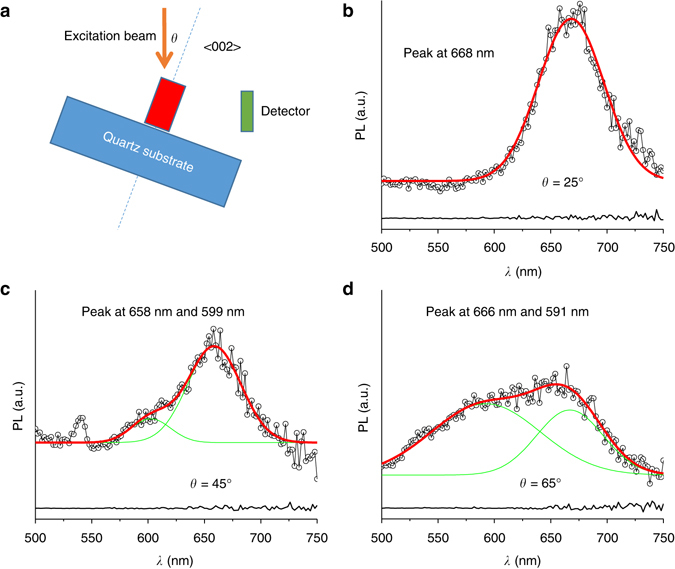
Photoluminescence (PL) anisotropy of (CH3NH3)3Bi2I9 coating. a Experimental set-up and coating orientation. The detector and incident angle are positioned at right angles and the substrate is rotated to control the angle. The sample is positioned vertically and the wavelength of incident beam is 350 nm. bd show the respective PL spectra at 25°, 45° and 65°. The black lines at the bottom of bd are the PL measurement on the bare fused silica substrate at the respective angles
Fig. 4
Fig. 4
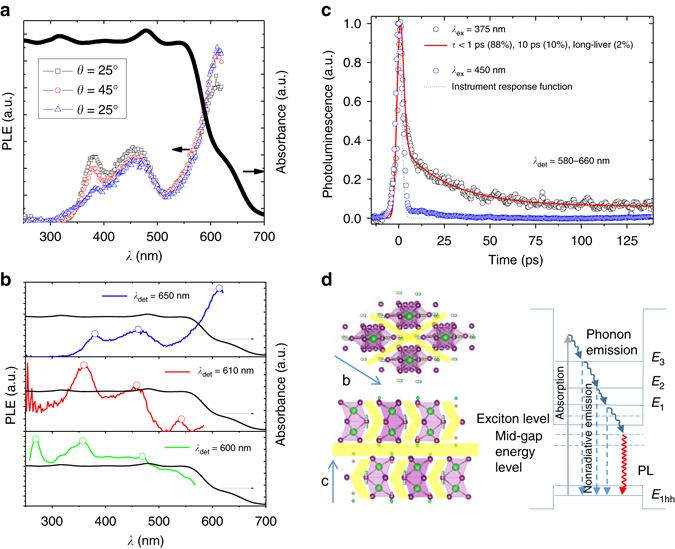
Excitation property of the charge carriers. a Ultraviolet–visible absorption derived from diffuse reflectance spectra of (CH3NH3)3Bi2I9 and the angular dependence of photoluminescence excitation (PLE) of 650 nm emission (λ det = 650 nm) at 25°, 45° and 65°. b PLE spectra for emission at λ det = 650, 610 and 600 nm while keeping incident angle, θ, at 45°. The open circles show the major PLE peaks. c Time-resolved photoluminescence of the coating placed at θ = 0° under a excitation beam of 375 nm (λ ex = 375 nm) and 450 nm (λ ex = 450 nm). d Schematics of quantum-well structure and multiphonon relaxation. The mid-gap energy level is from the organic termination. E hh represents the energy level of heavy hole state, while E 1, E 2 and E 3 show the discrete energy levels in the conduction band
Fig. 5
Fig. 5
Photoluminescence (PL) at difference excitation energies. a PL spectra of the powdered (CH3NH3)3Bi2I9 under different excitation energies. The blue and red arrows show the Stokes shift of 0.13 eV. The dashed line at the bottom is the PL measured on the substrate excited at 400 nm. b Energy diagram for the band gap of orientated film and the peak energy of PL at different angles. c Integration of PL intensities at different excitation energies. d Relative PL quantum yield (PLQY) for the (CH3NH3)3Bi2I9 powder and coating on quartz, respectively

References

    1. Tsai H, et al. High-efficiency two-dimensional Ruddlesden–Popper perovskite solar cells. Nature. 2016;536:312–316. doi: 10.1038/nature18306. - DOI - PubMed
    1. Smith IC, Hoke ET, Solis-Ibarra D, McGehee MD, Karunadasa HI. A layered hybrid perovskite solar-cell absorber with enhanced moisture stability. Angew. Chem. 2014;126:11414–11417. doi: 10.1002/ange.201406466. - DOI - PubMed
    1. Nie W, et al. High-efficiency solution-processed perovskite solar cells with millimeter-scale grains. Science. 2015;347:522–525. doi: 10.1126/science.aaa0472. - DOI - PubMed
    1. Kagan CR, Mitzi DB, Dimitrakopoulos CD. Organic-inorganic hybrid materials as semiconducting channels in thin-film field-effect transistors. Science. 1999;286:945–947. doi: 10.1126/science.286.5441.945. - DOI - PubMed
    1. Cao DH, Stoumpos CC, Farha OK, Hupp JT, Kanatzidis MG. 2D homologous perovskites as light-absorbing materials for solar cell applications. J. Am. Chem. Soc. 2015;137:7843–7850. doi: 10.1021/jacs.5b03796. - DOI - PubMed

Publication types

LinkOut - more resources