. 2017 Jul 31;8(1):156.
doi: 10.1038/s41467-017-00185-4.

High-T c superconductivity in undoped ThFeAsN

Affiliations

High-T c superconductivity in undoped ThFeAsN

T Shiroka et al. Nat Commun. .

Abstract

Unlike the widely studied ReFeAsO series, the newly discovered iron-based superconductor ThFeAsN exhibits a remarkably high critical temperature of 30 K, without chemical doping or external pressure. Here we investigate in detail its magnetic and superconducting properties via muon-spin rotation/relaxation and nuclear magnetic resonance techniques and show that ThFeAsN exhibits strong magnetic fluctuations, suppressed below ~35 K, but no magnetic order. This contrasts strongly with the ReFeAsO series, where stoichiometric parent materials order antiferromagnetically and superconductivity appears only upon doping. The ThFeAsN case indicates that Fermi-surface modifications due to structural distortions and correlation effects are as important as doping in inducing superconductivity. The direct competition between antiferromagnetism and superconductivity, which in ThFeAsN (as in LiFeAs) occurs at already zero doping, may indicate a significant deviation of the s-wave superconducting gap in this compound from the standard s ± scenario.Exploring the interplay between the superconducting gap and the antiferromagnetic phase in Fe-based superconductors remains an open issue. Here, the authors show that Fermi-surface modifications by means of structural distortions and correlation effects are as important as doping in inducing superconductivity in undoped ThFeAsN.


Conflict of interest statement

The authors declare no competing financial interests.

Figures
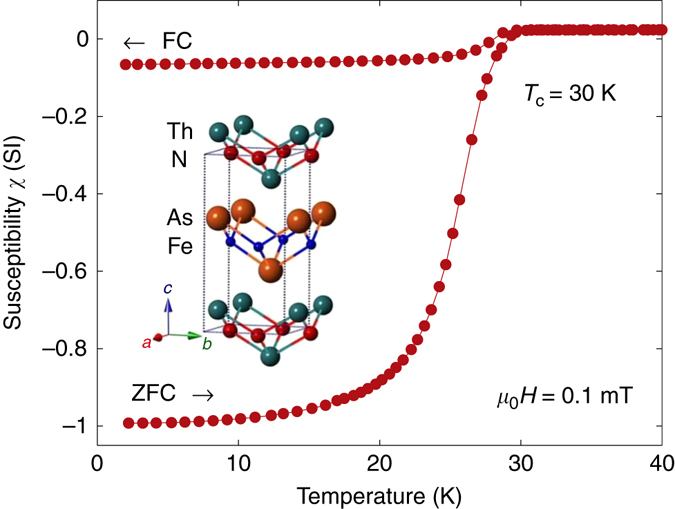
Fig. 1
Fig. 1
Magnetic susceptibility of ThFeAsN. Temperature dependence of the zero field-cooled (ZFC) and field-cooled (FC) dc susceptibility measured at μ 0 H = 0.1 mT. The sample shows a sizable diamagnetic response and T c = 30 K. Inset: structure of ThFeAsN showing the ThN and FeAs planes (adapted from Wang et al.)
Fig. 2
Fig. 2
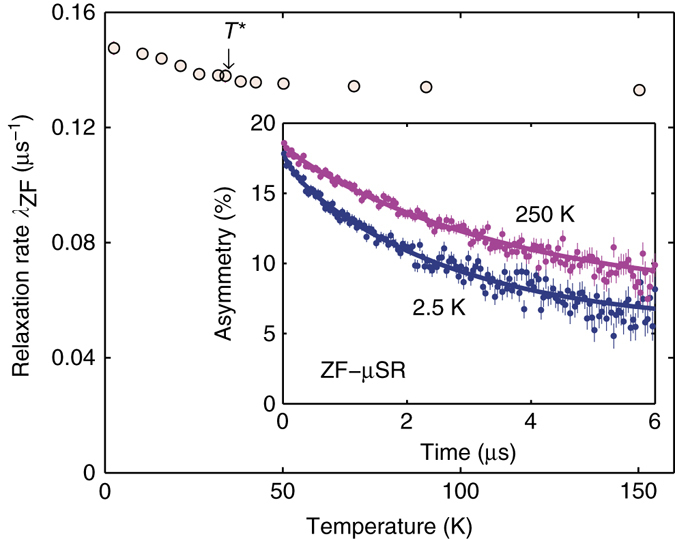
ZF-μSR time spectra and relaxation rates. The zero-field relaxation rate λ ZF is small and practically constant with temperature, with only a tiny increase below T *. Inset: representative ZF-μSR spectra at selected temperatures
Fig. 3
Fig. 3
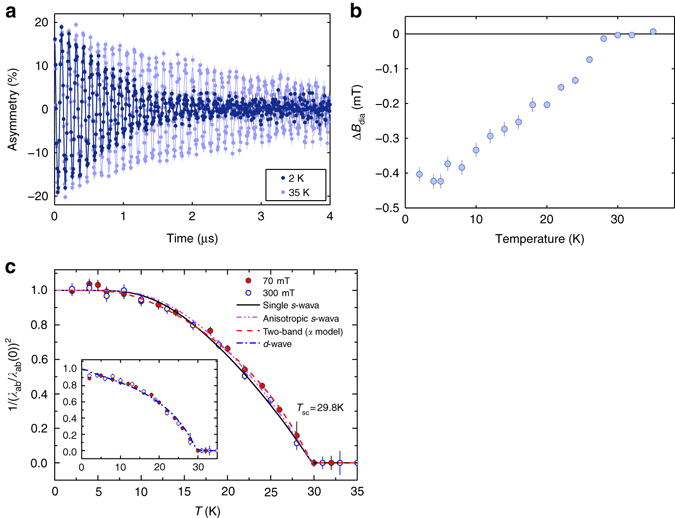
TF-μSR spectra, diamagnetic shift, and relaxation rate. a Representative TF-μSR spectra above and below T c measured in 70 mT and relevant fits. b Diamagnetic field-shifts in the superconducting phase. c Temperature dependence of λ −2, as calculated from the measured TF relaxation rate σ sc(T) at 70 mT (red) and 300 mT (yellow). Lines represent fits using a single-gap (solid) and two-gap or anisotropic s-wave model (dashed), the latter two showing a better χr2. The inset shows a fit using a d-wave model
Fig. 4
Fig. 4
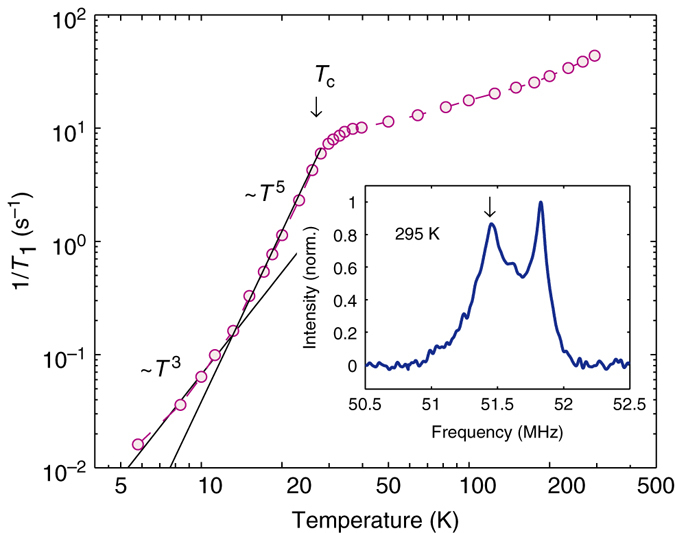
NMR relaxation rate and lineshape. Temperature dependence of 1/T 1 relaxation rate measured at 7 T at the left peak of the 75As NMR lineshape (arrow in the inset). A similar 1/T 1 behavior is found also for the right peak. The steep decrease of 1/T 1 below T c is compatible with a fully gapped superconductor. Lines indicate different power-law dependences, at different temperature regimes (see text for details)
Fig. 5
Fig. 5
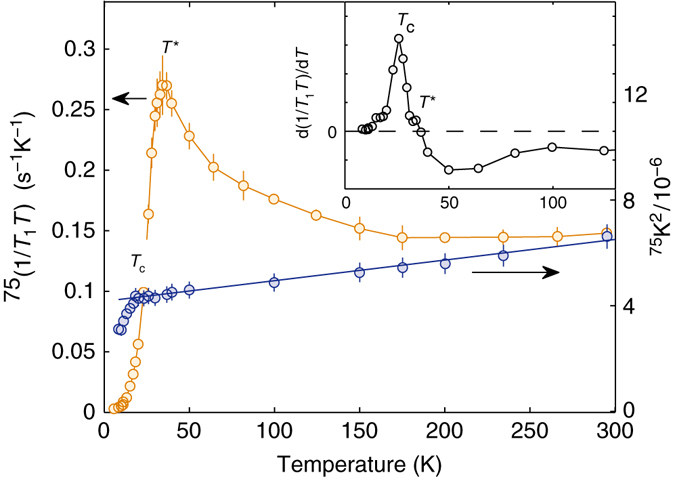
Different temperature behavior of 1/(T 1 T) and K 2. Temperature dependence of 1/(T 1 T) (left scale) and 75 K 2 shift (right scale) measured at 7 T. The peak in the former and the drop in the latter indicate T * and T c, respectively, which differ by ca. 5 K. The clearly different functional form of the two curves below ca. 150 K indicates the development of strong AF fluctuations. The strong low-temperature drop of 1/(T 1 T) confirms the bulk character of SC, whereas the peak in the derivative (inset) indicates its sharp onset

References

    1. Kamihara Y, et al. Iron-based layered superconductor: LaOFeP. J. Am. Chem. Soc. 2006;128:10012–10013. doi: 10.1021/ja063355c. - DOI - PubMed
    1. Tapp JH, et al. LiFeAs: an intrinsic FeAs-based superconductor with Tc = 18 K. Phys. Rev. B. 2008;78:060505(R). doi: 10.1103/PhysRevB.78.060505. - DOI
    1. Hsu F-C, et al. Superconductivity in the PbO-type structure α-FeSe. Proc. Natl Acad. Sci. 2008;105:14262. doi: 10.1073/pnas.0807325105. - DOI - PMC - PubMed
    1. Kamihara Y, Watanabe T, Hirano M, Hosono H. Iron-based layered superconductor La[O1−xFx]FeAs (x = 0.05–0.12) with Tc = 26 K. J. Am. Chem. Soc. 2008;130:3296–3297. doi: 10.1021/ja800073m. - DOI - PubMed
    1. Wen H-H. Developments and perspectives of iron-based hightemperature superconductors. Adv. Mater. 2008;20:3764–3769. doi: 10.1002/adma.200801623. - DOI

Publication types

LinkOut - more resources