


The Impact of Methylphenidate on Motor Performance in Children with both Attention Deficit Hyperactivity Disorder and Developmental Coordination Disorder: A Randomized Double-Blind Crossover Clinical Trial
- PMID: 28761201
- PMCID: PMC5523042
The Impact of Methylphenidate on Motor Performance in Children with both Attention Deficit Hyperactivity Disorder and Developmental Coordination Disorder: A Randomized Double-Blind Crossover Clinical Trial
Abstract
Background: Children with attention deficit hyperactivity disorder/developmental coordination disorder (ADHD/DCD) suffer from problems associated with gross and fine motor skills. There is no effective pharmacological therapy for such patients. We aimed to assess the impact of methylphenidate (MPH) on motor performance of children with ADHD/DCD.
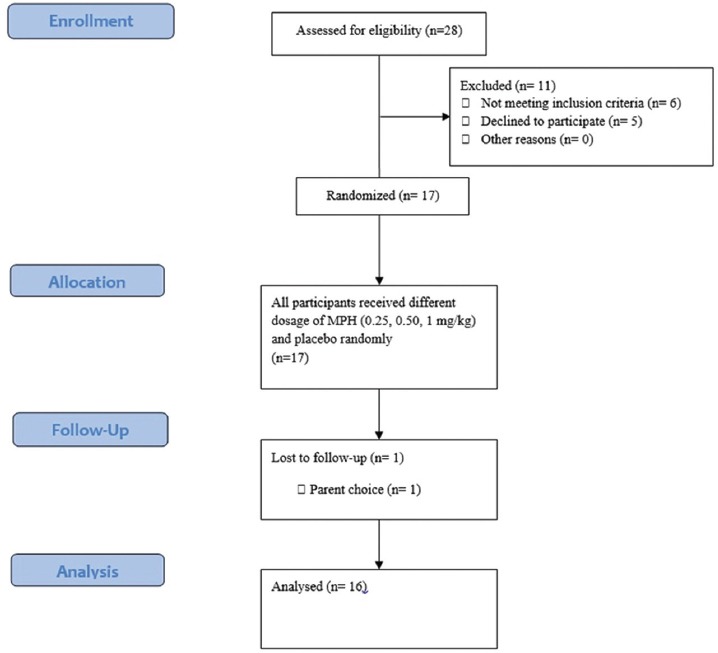
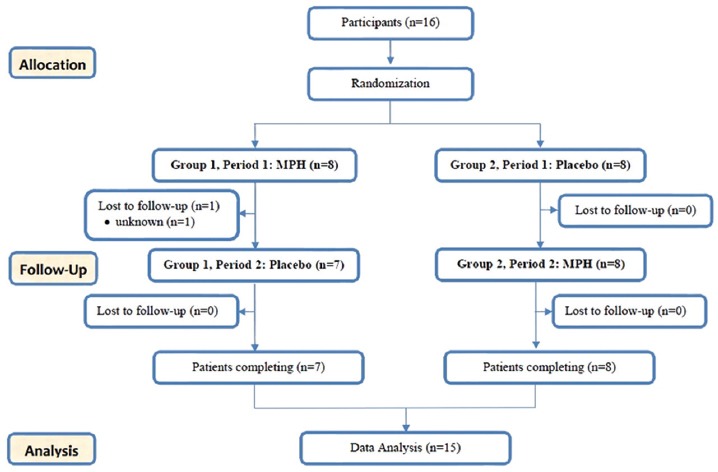
Methods: In this double-blind placebo-controlled, 17 children (12 boys) with ADHD/DCD with a mean age of 7 years 6 months were recruited in Shafa Hospital, Rasht, Iran. The response was defined as ≥25% reduction in the total score of ADHD rating scale-IV from the baseline. Sixteen boys entered phase 2 of the study in which the impact of MPH on motor function was determined through a crossover randomized clinical trial. Eligible individuals were scheduled for baseline and two assessment visits after a one-week period of intervention. We used the short form of Bruininks-Oseretsky test (BOT-2) to identify the disability of motor function. Children were randomly assigned to receive MPH or inert ingredients (placebo). In the second period, medication (MPH/placebo) was crossed over. The effects of MPH were analyzed using χ2 test for related samples to compare the performance during baseline, placebo, and MPH trials. The results were analyzed using the SPSS software version 16.0.
Results: The mean minimal effective dose of MPH per day was 17.3 mg (0.85 mg/kg). Children with higher ADHD rating scale had a significantly lower standard score in BOT-2 (P=0.03). Following MPH intake, 26.6% of the children showed clinically significant improvement in motor function. However, the improvement was not statistically different between the MPH and placebo.
Conclusion: Although MPH improved ADHD symptoms, problems with motor performance still remained. Further work is required to determine the probable effects of MPH in a higher dosage or in different subtypes of ADHD.
Trial registration number: IRCT201107071483N2.
Keywords: Attention deficit disorder with hyperactivity; Methylphenidate; Motor skills; Psychomotor performance.
Figures
References
-
- Qian Y, Lei G, Castellanos FX, Forssberg H, Heijtz RD. Deficits in fine motor skills in a genetic animal model of ADHD. Behav Brain Funct. 2010;6:51–8. doi: 10.1186/1744-9081-6-51. [ PMC Free Article] - DOI - PMC - PubMed
LinkOut - more resources
Full Text Sources