. 2017:2017:4397340.
doi: 10.1155/2017/4397340. Epub 2017 Jul 6.

Flavonoids as Putative Inducers of the Transcription Factors Nrf2, FoxO, and PPAR γ

Affiliations

Flavonoids as Putative Inducers of the Transcription Factors Nrf2, FoxO, and PPAR γ

Kathrin Pallauf et al. Oxid Med Cell Longev. 2017.

Abstract

Dietary flavonoids have been shown to extend the lifespan of some model organisms and may delay the onset of chronic ageing-related diseases. Mechanistically, the effects could be explained by the compounds scavenging free radicals or modulating signalling pathways. Transcription factors Nrf2, FoxO, and PPARγ possibly affect ageing by regulating stress response, adipogenesis, and insulin sensitivity. Using Hek-293 cells transfected with luciferase reporter constructs, we tested the potency of flavonoids from different subclasses (flavonols, flavones, flavanols, and isoflavones) to activate these transcription factors. Under cell-free conditions (ABTS and FRAP assays), we tested their free radical scavenging activities and used α-tocopherol and ascorbic acid as positive controls. Most of the tested flavonoids, but not the antioxidant vitamins, stimulated Nrf2-, FoxO-, and PPARγ-dependent promoter activities. Flavonoids activating Nrf2 also tended to induce a FoxO and PPARγ response. Interestingly, activation patterns of cellular stress response by flavonoids were not mirrored by their activities in ABTS and FRAP assays, which depended mostly on hydroxylation in the flavonoid B ring and, in some cases, extended that of the vitamins. In conclusion, the free radical scavenging properties of flavonoids do not predict whether these molecules can stimulate a cellular response linked to activation of longevity-associated transcription factors.


Figures
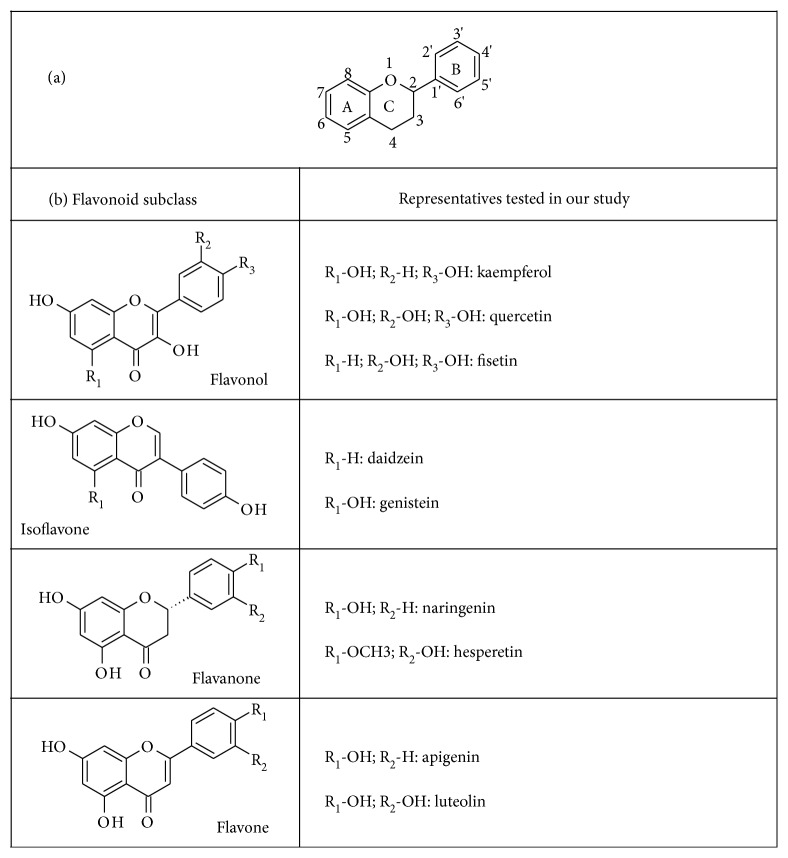
Figure 1
Figure 1
(a) Flavan structure (b) flavonoids used in this study.
Figure 2
Figure 2
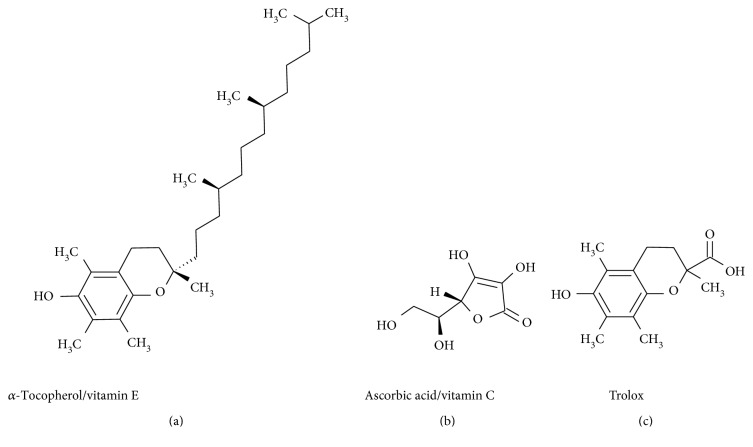
Chemical structure of ascorbic acid (b), α-tocopherol (a), and trolox (c).
Figure 3
Figure 3
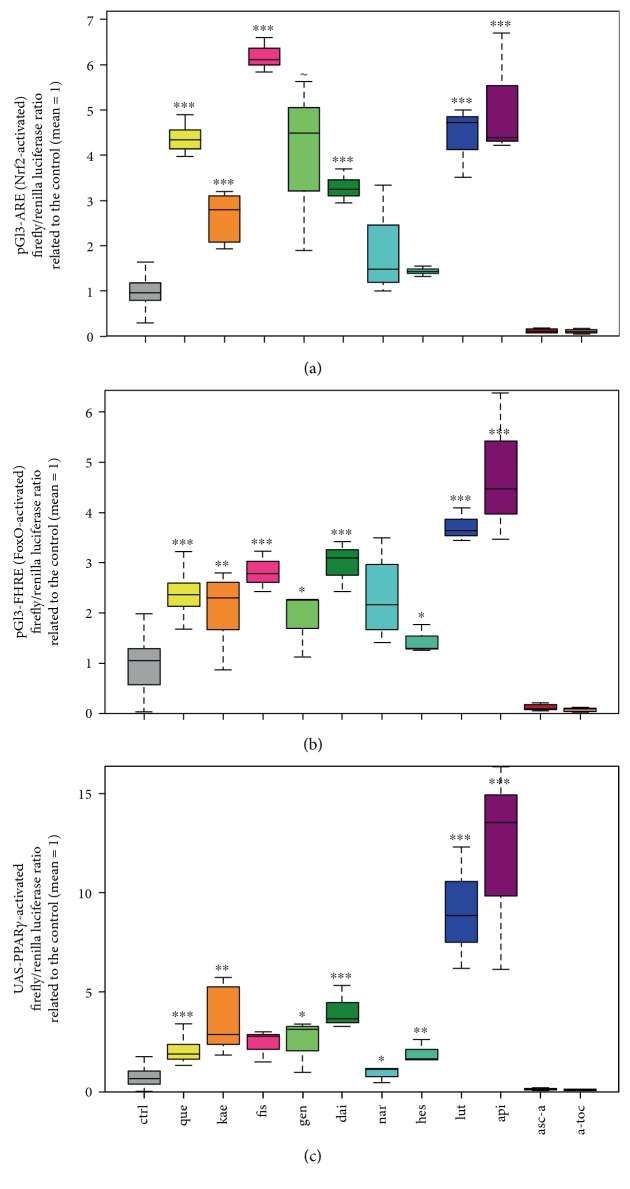
Hek-293 cells were transfected with firefly luciferase constructs controlled by elements responding to Nrf2 (a), FoxO (b), or PPARγ (c) activation. Constitutively expressed renilla luciferase was cotransfected to obtain firefly/renilla ratios. The vehicle for the tested flavonoid or vitamin and quercetin as a positive control were included in every experiment. In order to show all experiments in one plot, the firefly/renilla luciferase ratios were normalised to the difference between the control and quercetin and the mean of the control was set to be 1. Concentrations of flavonoids and vitamins were 20 μM and 100 μM, respectively. ctrl: vehicle control; que: quercetin; kae: kaempferol; fis: fisetin; gen: genistein; dai: daidzein; nar: naringenin; hes: hesperetin; lut: luteolin; api: apigenin; asc-a: ascorbic acid; a-toc: α-tocopherol; ARE: antioxidant response element; FHRE: forkhead responsive element; PPAR: peroxisome proliferator-activated receptor; UAS: upstream activating sequence. ~p < 0.1 compared to the control, p < 0.05 compared to the control, ∗∗p < 0.01 compared to the control, and ∗∗∗p < 0.005 compared to the control. For the statistics, the non-normalised firefly/renilla ratios were used. A minimum of three independent experiments was performed.
Figure 4
Figure 4
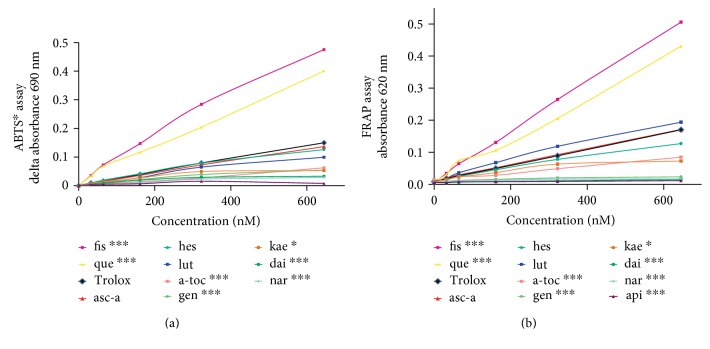
Graph showing the antioxidant capacity of the flavonoids and vitamins tested compared to trolox in assays using the 2,2′-azino-bis(3-ethylbenzothiazoline-6-sulfonic acid) (ABTS) radical (a) and the ferric-reducing ability of plasma (FRAP) (b). (a) The reduction of the coloured ABTS radical is plotted as the difference in absorbance to the vehicle control against the concentration of the compound that was added to the reaction. Absorbance was measured at 690 nm after 6 minutes. (b) The absorbance of a solution containing a known concentration of ferrous ions is plotted against the flavonoid or vitamin concentration. Absorbance was measured at 620 nm after 15 minutes incubation. The legends show the flavonoid with the steepest curve first and the shallowest last. que: quercetin; kae: kaempferol; fis: fisetin; gen: genistein; dai: daidzein; nar: naringenin; hes: hesperetin; lut: luteolin; api: apigenin; asc-a: ascorbic acid, a-toc: α-tocopherol. p < 0.05 compared to trolox, ∗∗∗p < 0.005 compared to trolox.

References

    1. Hertog M. G., Feskens E. J., Kromhout D. Antioxidant flavonols and coronary heart disease risk. Lancet. 1997;349:p. 699. doi: 10.1016/S0140-6736(05)60135-3. - DOI - PubMed
    1. Hertog M. G., Kromhout D., Aravanis C., et al. Flavonoid intake and long-term risk of coronary heart disease and cancer in the seven countries study. Archives of Internal Medicine. 1995;155:381–386. doi: 10.1001/archinte.1995.00430040053006. - DOI - PubMed
    1. Pallauf K., Duckstein N., Rimbach G. A literature review of flavonoids and lifespan in model organisms. The Proceedings of the Nutrition Society. 2016;76:1–18. - PubMed
    1. Williams R. J., Spencer J. P., Rice-Evans C. Flavonoids: antioxidants or signalling molecules? Free Radical Biology & Medicine. 2004;36:838–849. doi: 10.1016/j.freeradbiomed.2004.01.001. - DOI - PubMed
    1. Alam J., Stewart D., Touchard C., Boinapally S., Choi A. M., Cook J. L. Nrf2, a Cap'n'Collar transcription factor, regulates induction of the heme oxygenase-1 gene. The Journal of Biological Chemistry. 1999;274:26071–26078. doi: 10.1074/jbc.274.37.26071. - DOI - PubMed

MeSH terms

LinkOut - more resources