Review
. 2017 Jun 14;4(2):e000431.
doi: 10.1136/openhrt-2016-000431. eCollection 2017.

Evaluation of intermediate coronary stenoses in acute coronary syndromes using pressure guidewire

Affiliations
Review

Evaluation of intermediate coronary stenoses in acute coronary syndromes using pressure guidewire

Giampaolo Niccoli et al. Open Heart. .

Abstract

Fractional flow reserve (FFR) is increasingly used to guide myocardial revascularisation. However, supporting evidence regarding its use originates from studies that have enrolled mainly patients with stable angina, while patients with acute coronary syndromes (ACS) have not been included. Notably, multifactorial microvascular dysfunction and an increased sympathetic tone in patients with ACS may lead to blunted response to adenosine and false-negative results of FFR due to submaximal hyperaemia. This may raise the possibility of deferring treatment of stenosis that instead would have needed dilatation, thus leaving a residual risk of preventable cardiac events. In this literature review, we aim at summarising laboratory and clinical investigations concerning the use of FFR in culprit and non-culprit lesions in ACS. Furthermore, we will report recent data on instantaneous wave-free ratio, an adenosine-free index of functional stenosis severity, in stable coronary artery disease and in patients with ACS.

Keywords: Acute coronary syndromes; Fractional flow reserve; Instantaneous wave-free ratio.


Conflict of interest statement

Competing interests: None declared.

Figures
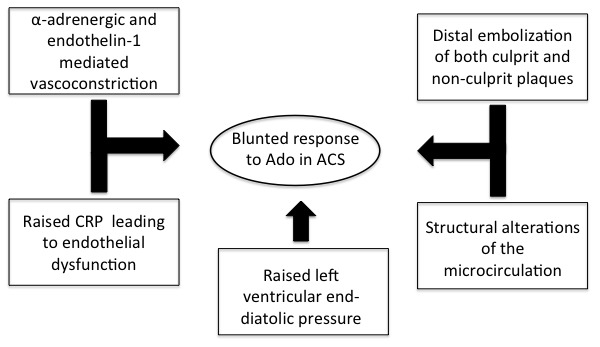
Figure 1
Figure 1
Mechanisms leading to blunted response to Ado and submaximal hyperaemia in patients with ACS. ACS, acute coronary syndrome; Ado, adenosine; CRP, C-reactive protein.
Figure 2
Figure 2
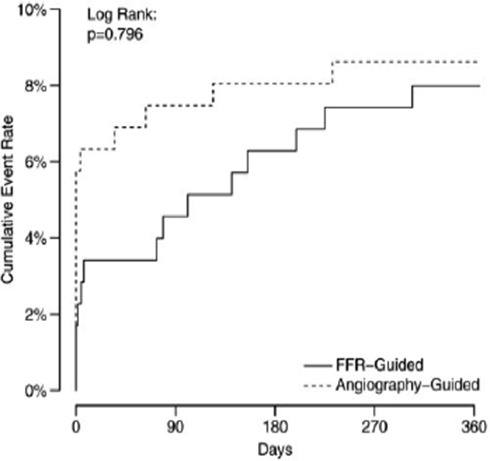
Kaplan-Meier plots of cumulative event rate in patients with acute coronary syndromes enrolled in the FAMOUS-NSTEMI study according to FFR or angio-guidance. FFR, fractional flow reserve. (Adapted from Tamita et al).
Figure 3
Figure 3
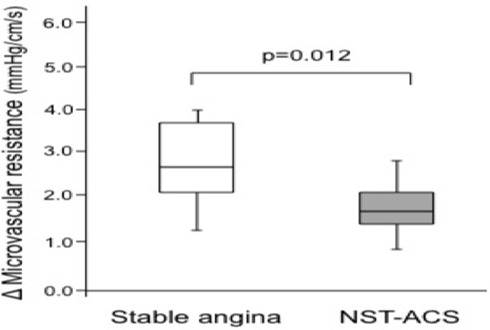
Variation of microvascular resistance in patients with stable angina or non-ST elevation acute coronary syndrome (NST-ACS). (Adapted from Sels et al).
Figure 4
Figure 4
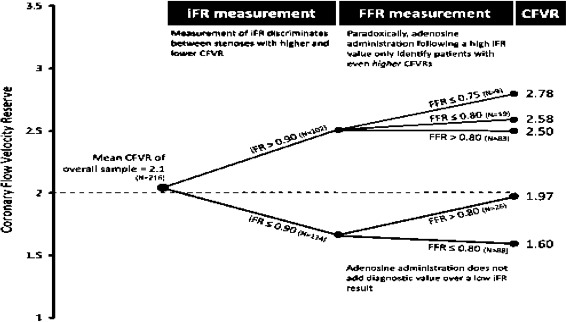
Agreement between CFR, FFR and iFR. When CFR is below 2, 23% of patients may have normal FFR (>0.80) and the agreement between CFR and iFR is much better than that of CFR and FFR. Such scenario may be common in acute coronary syndromes with low CFR. CFR, coronary flow reserve; CFVR, coronary flow velocity reserve; FFR, fractional flow reserve;  iFR, instantaneous wave-free ratio. (Adapted from Tomai et al).
Figure 5
Figure 5
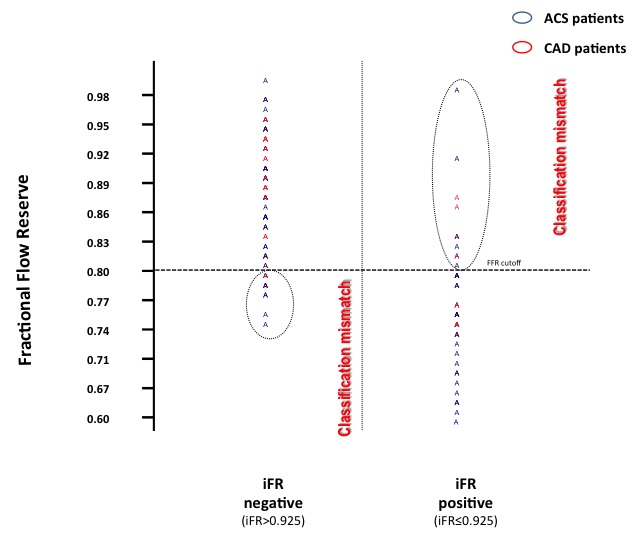
Assessment of classification mismatch between iFR and FFR. ACS, acute coronary syndrome; CAD, coronary artery disease; FFR, fractional flow reserve; iFR, instantaneous wave-free ratio. (Adapted from Echavarría-Pinto et al).

References

    1. Pijls NH, Sels JW. Functional measurement of coronary Stenosis. J Am Coll Cardiol 2012;59:1045–57.10.1016/j.jacc.2011.09.077 - DOI - PubMed
    1. Kolh P, Windecker S. ESC/EACTS myocardial revascularization guidelines 2014. Eur Heart J 2014;35:3235–6.10.1093/eurheartj/ehu422 - DOI - PubMed
    1. Pijls NH, van Schaardenburgh P, Manoharan G, et al. . Percutaneous coronary intervention of functionally nonsignificant Stenosis: 5-year follow-up of the DEFER Study. J Am Coll Cardiol 2007;49:2105–11.10.1016/j.jacc.2007.01.087 - DOI - PubMed
    1. Tonino PA, De Bruyne B, Pijls NH, et al. . Fractional flow reserve versus angiography for guiding percutaneous coronary intervention. N Engl J Med 2009;360:213–24.10.1056/NEJMoa0807611 - DOI - PubMed
    1. Echavarría-Pinto M, van de Hoef TP, Serruys PW, et al. . Facing the complexity of ischaemic heart disease with intracoronary pressure and flow measurements: beyond fractional flow reserve interrogation of the coronary circulation. Curr Opin Cardiol 2014;29:564–70.10.1097/HCO.0000000000000110 - DOI - PubMed