High-intensity flywheel exercise and recovery of atrophy after 90 days bed--rest
- PMID: 28761699
- PMCID: PMC5530106
- DOI: 10.1136/bmjsem-2016-000196
High-intensity flywheel exercise and recovery of atrophy after 90 days bed--rest
Abstract
Aims: To investigate differential muscle atrophy during bed-rest, the impact of a high-intensity concentric-eccentric (flywheel) resistance exercise countermeasure and muscle recovery after bed-rest.
Methods: Twenty-five healthy male subjects underwent 90 dayshead-down tilt bed-rest. Volume of individual lower-limb muscles was measured via MRI before, twice during and four times up to 1 year after bed-rest. Subjects were either inactive (n=16) or performed flywheel exercise every third day of bed-rest (n=9). Functional performance was assessed via countermovement jump.
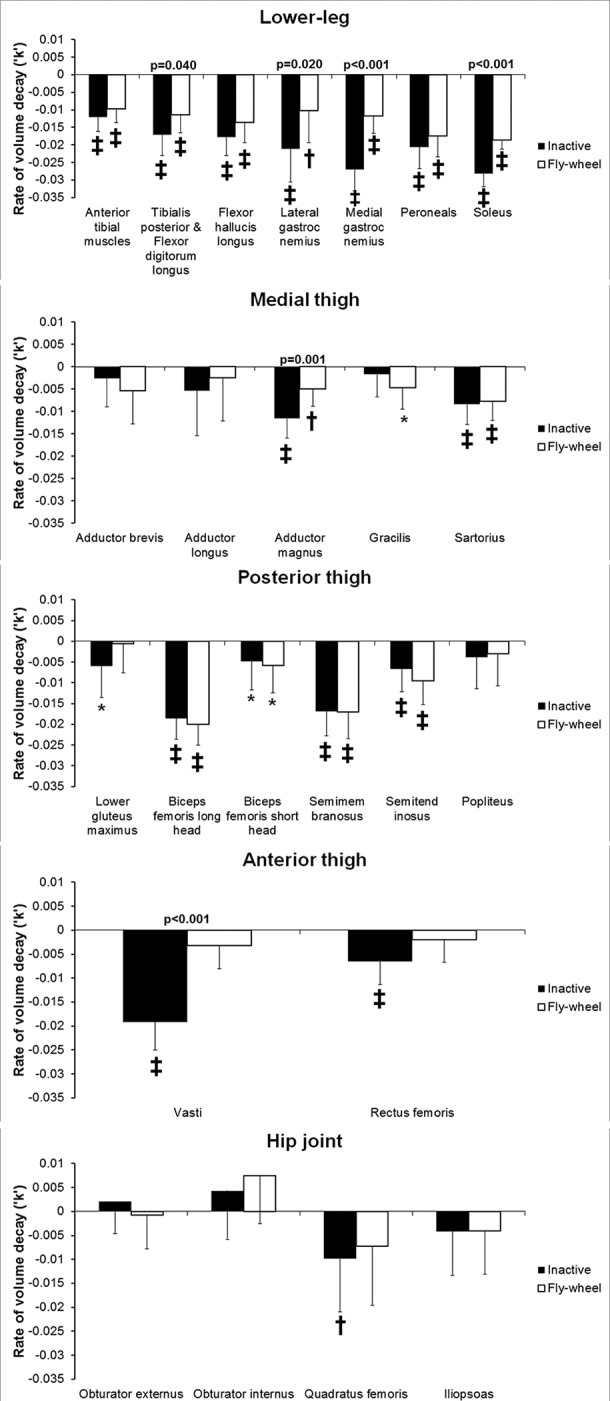
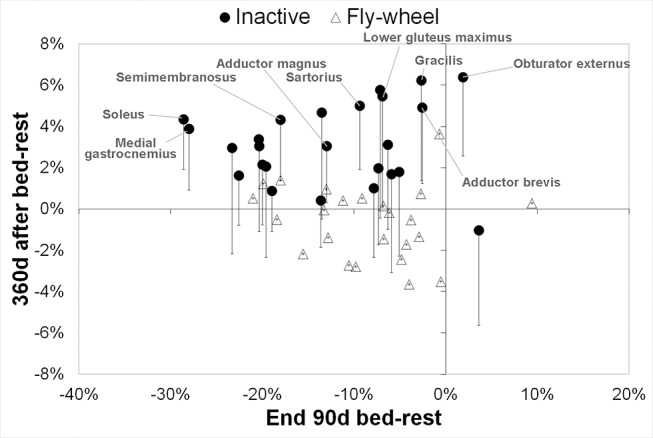
Results: On 'intent-to-treat' analysis, flywheel prevented atrophy in the vasti (p<0.001) and reduced atrophy in the hip adductor/extensor adductor magnus (p=0.001) and ankle dorsiflexors/toe flexors (soleus (p<0.001), gastrocnemius medialis (p<0.001), gastrocnemius lateralis (p=0.02), and tibialis posterior with flexor digitorum longus (p=0.04)). Flywheel exercise was not effective for the hamstrings, gracilis, sartorius, peroneals and anterior tibial muscles. Muscle atrophy in vasti, soleus, gastrocnemius medialis, gastrocnemius lateralis and adductor magnus correlated with losses in countermovement jump performance. Muscle volume recovered within 90 days after bed-rest, however long-term after bed-rest, the inactive subjects only showed significantly increased muscle volume versus prebed-rest in a number of muscles including soleus (+4.3%), gastrocnemius medialis (+3.9%) and semimembranosus (+4.3%). This was not associated with greater countermovement jump performance.
Conclusion: The exercise countermeasure was effective in preventing or reducing atrophy in the vasti, adductor magnus and ankle dorsiflexors/toe flexors but not the hamstrings, medial thigh muscles or peroneals and dorsiflexor muscles.
Trial registration number: NCT00311571; results.
Keywords: Exercise; Exercise rehabilitation; Muscle.
Conflict of interest statement
Competing interests: None declared.
Figures
References
-
- Nicogossian AE, Dietlein LF. Microgravity Simulation and Analogues Nicogossian AE, Space physiology and Medicine. Philadelphia: Lea & Febiger, 1982:240–8.
-
- Belavý DL, Miokovic T, Armbrecht G, et al. Resistive vibration exercise reduces lower limb muscle atrophy during 56-day bed-rest. J Musculoskelet Neuronal Interact 2009;9:225–35. - PubMed
-
- Berg HE, Tesch A. A gravity-independent ergometer to be used for resistance training in space. Aviat Space Environ Med 1994;65:752–6. - PubMed
Associated data
LinkOut - more resources
Full Text Sources
Other Literature Sources
Medical