


Discussing and prescribing expensive unfunded anticancer drugs in Australia
- PMID: 28761744
- PMCID: PMC5519793
- DOI: 10.1136/esmoopen-2017-000170
Discussing and prescribing expensive unfunded anticancer drugs in Australia
Abstract
Objective: Australia has a publicly funded universal healthcare system which heavily subsidises the cost of most registered anticancer drugs. The use of anticancer drugs that are unfunded, that is, not subsidised by the government, entails substantial out-of-pocket costs for patients. We sought to determine how frequently Australian medical oncologists discuss and prescribe unfunded anticancer drugs, and their attitudes and beliefs about their use.
Methods: Members of the Medical Oncology Group of Australia (MOGA) completed an online survey about their clinical practices over a recent 3-month period. A negative binomial regression model was used to examine the influence of respondent characteristics on the rate of discussions about, and prescription of, unfunded anticancer drugs.
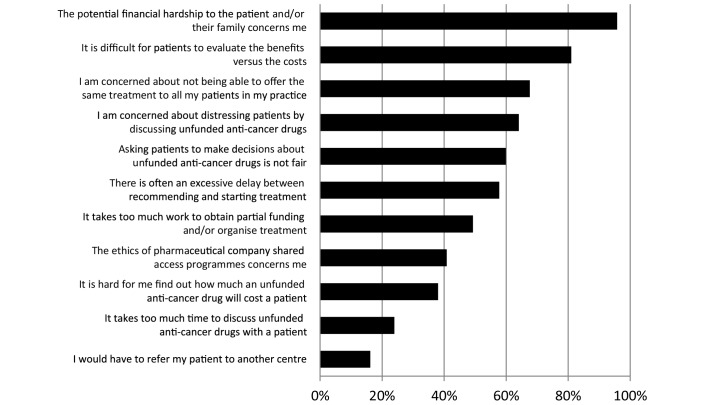
Results: Of the 154 respondents (27% of 575 MOGA members), 92% had discussed and 68% had prescribed at least one unfunded anticancer drug in the last 3 months. Respondents reported discussing unfunded anticancer drugs with an average of 2.5 patients per month (95% CI 2.1 to 2.9), and prescribed them to an average of 0.9 patients per month (95% CI 0.7 to 1.2). The rate of discussing unfunded anticancer drugs was associated with being fully qualified (p=0.01), and being in a metropolitan practice (p=0.009), the rate of prescription was associated only with being in metropolitan practice (p=0.006). The concerns about discussing and prescribing unfunded anticancer drugs rated most important were as follows: 'potential to cause financial hardship' and 'difficulty for patients to evaluate the benefits versus the costs'.
Conclusions: Australian medical oncologists frequently discuss and prescribe unfunded anticancer drugs, and are concerned about their patients having to face difficult decisions and financial hardship. Further research is needed to better understand the factors that affect how oncologists and patients value expensive, unfunded anticancer drugs.
Keywords: Anticancer drugs; Financial hardship; Out-of-pocket costs; Value.
Conflict of interest statement
Competing interests: None declared.
Figures
References
-
- Australian Government Department of Health. Therapeutic goods administration. TGA Basics. https://www.tga.gov.au/tga-basics (accessed February 25, 2017).
-
- Australian Government Department of Health: guidelines for preparing a submission to the pharmaceutical benefits advisory committee-version 5.0. https://pbac.pbs.gov.au/content/information/files/pbac-guidelines-versio... (accessed September 14, 2016).
LinkOut - more resources
Full Text Sources
Other Literature Sources
