


Understanding the complex relationships underlying hot flashes: a Bayesian network approach
- PMID: 28763402
- PMCID: PMC5771829
- DOI: 10.1097/GME.0000000000000959
Understanding the complex relationships underlying hot flashes: a Bayesian network approach
Abstract
Objective: The mechanism underlying hot flashes is not well-understood, primarily because of complex relationships between and among hot flashes and their risk factors.
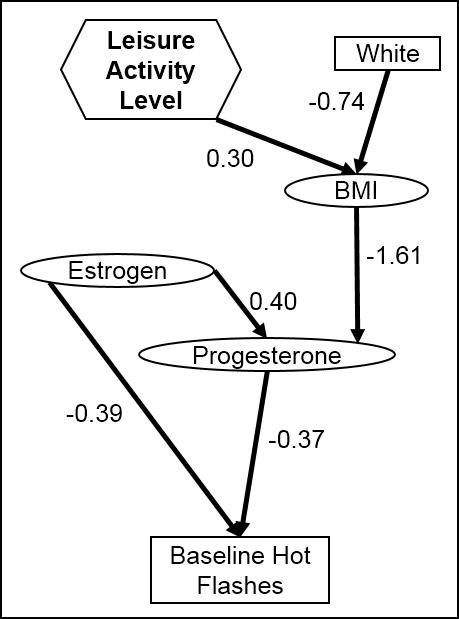
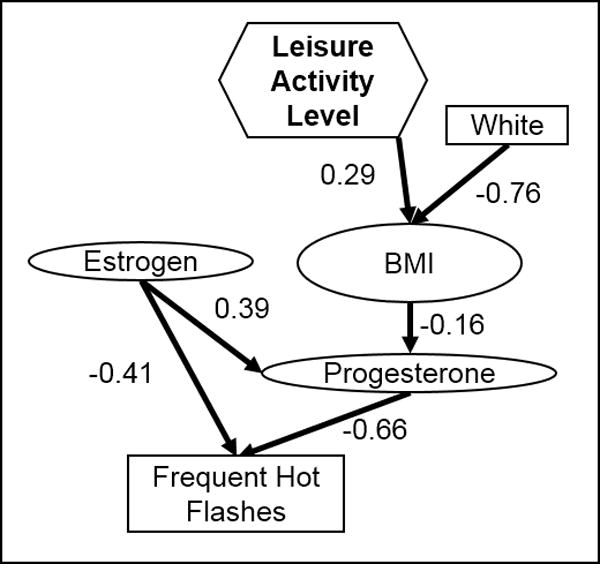
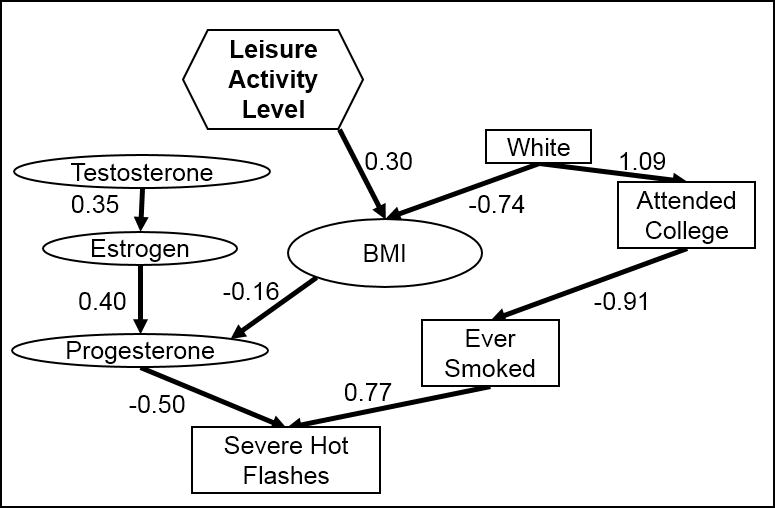
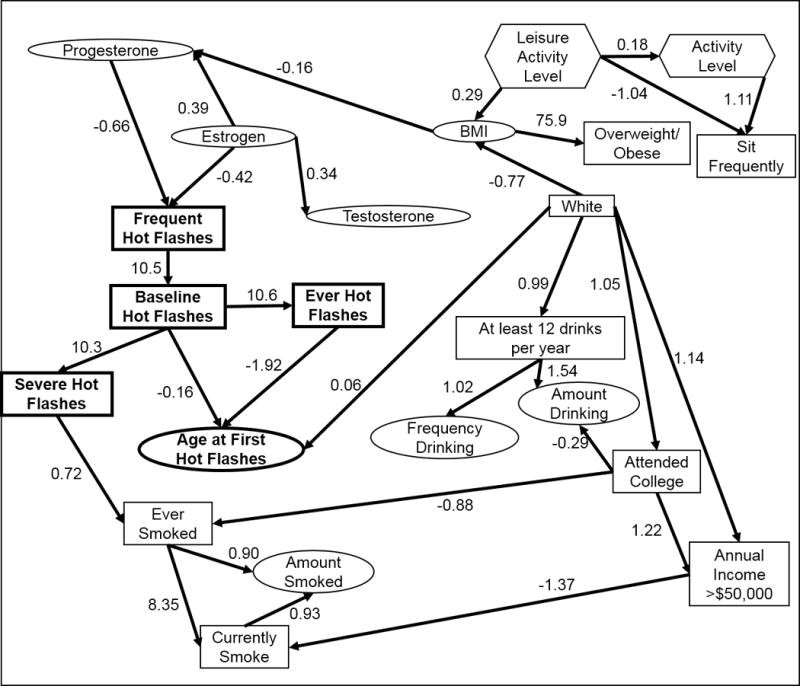
Methods: We explored those relationships using a Bayesian network approach based on a 2006 to 2015 cohort study of hot flashes among 776 female residents, 45 to 54 years old, in the Baltimore area. Bayesian networks were fit for each outcome (current hot flashes, hot flashes before the end of the study, hot flash severity, hot flash frequency, and age at first hot flashes) separately and together with a list of risk factors (estrogen, progesterone, testosterone, body mass index and obesity, race, income level, education level, smoking history, drinking history, and activity level). Each fitting was conducted separately on all women and only perimenopausal women, at enrollment and 4 years after enrollment.
Results: Hormone levels, almost always interrelated, were the most common variable linked to hot flashes; hormone levels were sometimes related to body mass index, but were not directly related to any other risk factors. Smoking was also frequently associated with increased likelihood of severe symptoms, but not through an antiestrogenic pathway. The age at first hot flashes was related only to race. All other factors were either not related to outcomes or were mediated entirely by race, hormone levels, or smoking.
Conclusions: These models can serve as a guide for design of studies into the causal network underlying hot flashes.
Conflict of interest statement
The authors have no conflicts to declare.
Figures
References
-
- Goodman NF, Cobin RH, Ginzburg SB, Katz IA, Woode DE. AACE Medical Guidelines for Clinical Practice for the Diagnosis and Treatment of Menopause. Endocr Pract. 2011;17:1–25. - PubMed
-
- Smith RL, Gallicchio LM, Miller SR, Zacur HA, Flaws JA. Risk Factors for Extended Duration and Timing of Peak Severity of Hot Flashes. PLoS One [Internet] 2016;11(5):e0155079. Available from: http://dx.plos.org/10.1371/journal.pone.0155079. - DOI - PMC - PubMed
-
- Avis NE, Crawford SL, Greendale G, Bromberger JT, Everson-Rose Sa, Gold EB, et al. Duration of Menopausal Vasomotor Symptoms Over the Menopause Transition. JAMA Intern Med [Internet] 2015;27157(4):531–9. Available from: http://archinte.jamanetwork.com/article.aspx?doi=10.1001/jamainternmed.2.... - PMC - PubMed
-
- Fisher TE, Chervenak JL. Lifestyle alterations for the amelioration of hot flashes. Maturitas [Internet] 2012;71(3):217–20. Available from: http://dx.doi.org/10.1016/j.maturitas.2011.12.006. - DOI - PubMed
Publication types
MeSH terms
Substances
Grants and funding
LinkOut - more resources
Full Text Sources
Other Literature Sources
