Effect of Endovascular Contact Aspiration vs Stent Retriever on Revascularization in Patients With Acute Ischemic Stroke and Large Vessel Occlusion: The ASTER Randomized Clinical Trial
- PMID: 28763550
- PMCID: PMC5817613
- DOI: 10.1001/jama.2017.9644
Effect of Endovascular Contact Aspiration vs Stent Retriever on Revascularization in Patients With Acute Ischemic Stroke and Large Vessel Occlusion: The ASTER Randomized Clinical Trial
Abstract
Importance: The benefits of endovascular revascularization using the contact aspiration technique vs the stent retriever technique in patients with acute ischemic stroke remain uncertain because of lack of evidence from randomized trials.
Objective: To compare efficacy and adverse events using the contact aspiration technique vs the standard stent retriever technique as a first-line endovascular treatment for successful revascularization among patients with acute ischemic stroke and large vessel occlusion.
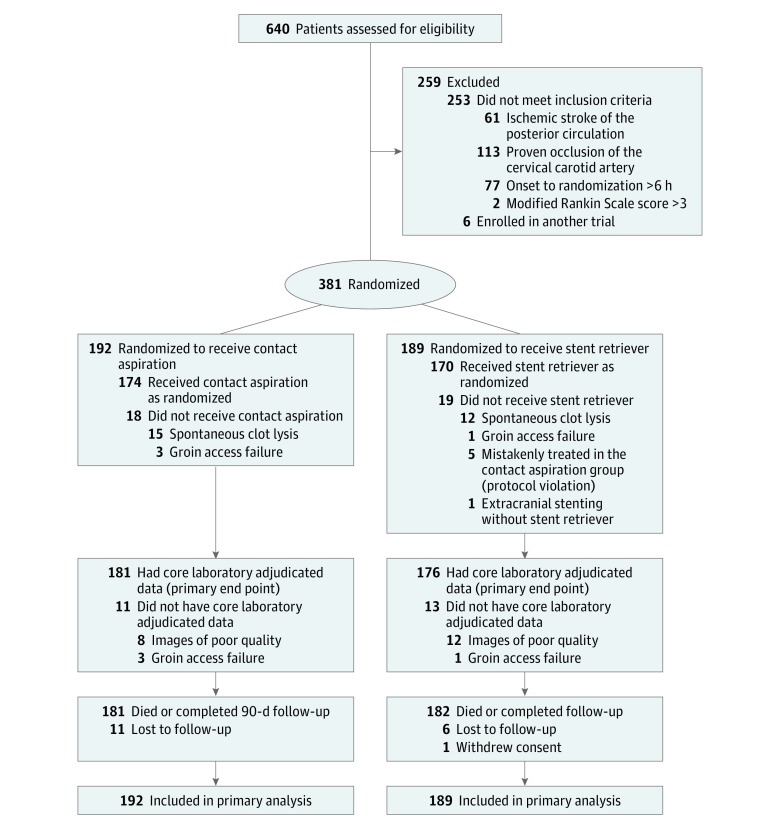
Design, setting, and participants: The Contact Aspiration vs Stent Retriever for Successful Revascularization (ASTER) study was a randomized, open-label, blinded end-point clinical trial conducted in 8 comprehensive stroke centers in France (October 2015-October 2016). Patients who presented with acute ischemic stroke and a large vessel occlusion in the anterior circulation within 6 hours of symptom onset were included.
Interventions: Patients were randomly assigned to first-line contact aspiration (n = 192) or first-line stent retriever (n = 189) immediately prior to mechanical thrombectomy.
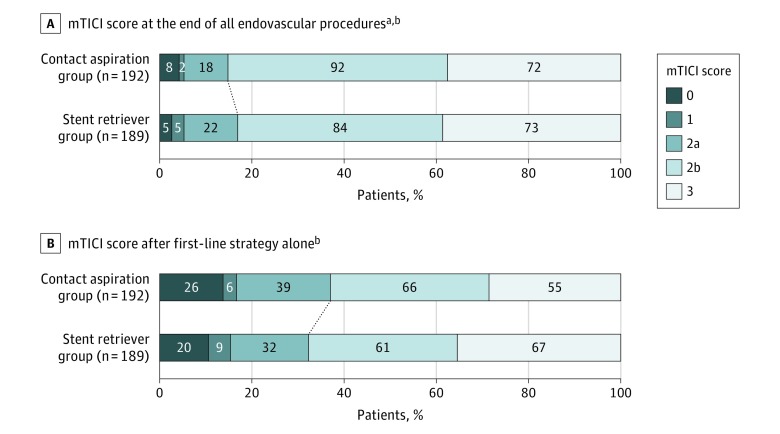
Main outcomes and measures: The primary outcome was the proportion of patients with successful revascularization defined as a modified Thrombolysis in Cerebral Infarction score of 2b or 3 at the end of all endovascular procedures. Secondary outcomes included degree of disability assessed by overall distribution of the modified Rankin Scale (mRS) score at 90 days, change in National Institutes of Health Stroke Scale (NIHSS) score at 24 hours, all-cause mortality at 90 days, and procedure-related serious adverse events.
Results: Among 381 patients randomized (mean age, 69.9 years; 174 women [45.7%]), 363 (95.3%) completed the trial. Median time from symptom onset to arterial puncture was 227 minutes (interquartile range, 180-280 minutes). For the primary outcome, the proportion of patients with successful revascularization was 85.4% (n = 164) in the contact aspiration group vs 83.1% (n = 157) in the stent retriever group (odds ratio, 1.20 [95% CI, 0.68-2.10]; P = .53; difference, 2.4% [95% CI, -5.4% to 9.7%]). For the clinical efficacy outcomes (change in NIHSS score at 24 hours, mRS score at 90 days) and adverse events, there were no significant differences between groups.
Conclusions and relevance: Among patients with ischemic stroke in the anterior circulation undergoing thrombectomy, first-line thrombectomy with contact aspiration compared with stent retriever did not result in an increased successful revascularization rate at the end of the procedure.
Trial registration: clinicaltrials.gov Identifier: NCT02523261.
Conflict of interest statement
Figures
References
-
- European Stroke Organisation; European Society for Minimally Invasive Neurological Therapy; European Society of Neuroradiology Consensus statement on mechanical thrombectomy in acute ischemic stroke. 2014. http://2014.strokeupdate.org/sites/default/files/Consensus_thrombectomy_.... Accessed July 13, 2016.
-
- Goyal M, Menon BK, van Zwam WH, et al. ; HERMES Collaborators . Endovascular thrombectomy after large-vessel ischaemic stroke: a meta-analysis of individual patient data from 5 randomised trials. Lancet. 2016;387(10029):1723-1731. - PubMed
-
- Powers WJ, Derdeyn CP, Biller J, et al. ; American Heart Association Stroke Council . 2015 American Heart Association/American Stroke Association focused update of the 2013 guidelines for the early management of patients with acute ischemic stroke regarding endovascular treatment: a guideline for healthcare professionals from the American Heart Association/American Stroke Association. Stroke. 2015;46(10):3020-3035. - PubMed
-
- Blanc R, Fahed R, Redjem H, Bartolini B, Pistocchi S, Piotin M. Single center experience with the ADAPT technique for acute ischemic stroke [abstract P-031]. J Neurointerv Surg. 2014;6(suppl 1):A37.
Publication types
MeSH terms
Associated data
LinkOut - more resources
Full Text Sources
Other Literature Sources
Medical