


A brief, trauma-informed intervention increases safety behavior and reduces HIV risk for drug-involved women who trade sex
- PMID: 28764681
- PMCID: PMC5540183
- DOI: 10.1186/s12889-017-4624-x
A brief, trauma-informed intervention increases safety behavior and reduces HIV risk for drug-involved women who trade sex
Erratum in
-
Erratum to: BMC Public Health, Vol. 18.BMC Public Health. 2017 Sep 22;17(1):736. doi: 10.1186/s12889-017-4709-6. BMC Public Health. 2017. PMID: 28938882 Free PMC article. No abstract available.
Abstract
Background: Female sex workers (FSWs) are an important population for HIV acquisition and transmission. Their risks are shaped by behavioral, sexual network, and structural level factors. Violence is pervasive and associated with HIV risk behavior and infection, yet interventions to address the dual epidemics of violence and HIV among FSWs are limited.
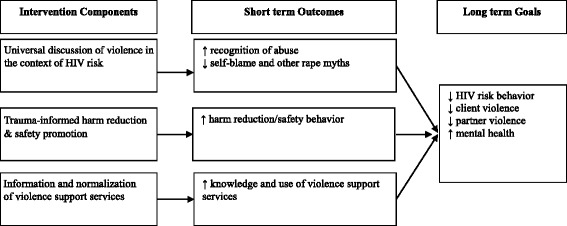
Methods: We used participatory methods to develop a brief, trauma-informed intervention, INSPIRE (Integrating Safety Promotion with HIV Risk Reduction), to improve safety and reduce HIV risk for FSWs. A quasi-experimental, single group pretest-posttest study evaluated intervention feasibility, acceptability and efficacy among FSWs in Baltimore, MD, most of whom were drug-involved (baseline n = 60; follow-up n = 39 [65%]; non-differential by demographics or outcomes). Qualitative data collected at follow-up contextualizes findings.
Results: Based on community partnership and FSW input, emergent goals included violence-related support, connection with services, and buffering against structural forces that blame FSWs for violence. Qualitative and quantitative results demonstrate feasibility and acceptability. At follow-up, improvements were seen in avoidance of client condom negotiation (p = 0.04), and frequency of sex trade under the influence of drugs or alcohol (p = 0.04). Women's safety behavior increased (p < 0.001). Participants improved knowledge and use of sexual violence support (p < 0.01) and use of intimate partner violence support (p < 0.01). By follow-up, most respondents (68.4%) knew at least one program to obtain assistance reporting violence to police. Over the short follow-up period, client violence increased. In reflecting on intervention acceptability, participants emphasized the value of a safe and supportive space to discuss violence.
Discussion: This brief, trauma-informed intervention was feasible and highly acceptable to FSWs. It prompted safety behavior, mitigated sex trade under the influence, and bolstered confidence in condom negotiation. INSPIRE influenced endpoints deemed valuable by community partners, specifically improving connection to support services and building confidence in the face of myths that falsely blame sex workers for violence. Violence persisted; prevention also requires targeting perpetrators, and longer follow-up durations as women acquire safety skills. This pilot study informs scalable interventions that address trauma and its impact on HIV acquisition and care trajectories for FSWs.
Conclusion: Addressing violence in the context of HIV prevention is feasible, acceptable to FSWs, and can improve safety and reduce HIV risk, thus supporting FSW health and human rights.
Conflict of interest statement
Ethics approval and consent to participate
Procedures were approved by the Johns Hopkins Bloomberg School of Public Health Institutional Review Board (FWA#0000287). All participants provided verbal consent.
Consent for publication
N/a
Competing interests
The authors declare that they have no competing interests.
Publisher’s Note
Springer Nature remains neutral with regard to jurisdictional claims in published maps and institutional affiliations.
References
-
- Baral S, Beyrer C, Muessig K, et al. Burden of HIV among female sex workers in low-income and middle-income countries: a systematic review and meta-analysis. Lancet Infect Dis. 2012;12(7):538–49. - PubMed
MeSH terms
Grants and funding
LinkOut - more resources
Full Text Sources
Other Literature Sources
Medical
Research Materials
