


Informing tobacco control policy in Jordan: assessing the effectiveness of pictorial warning labels on cigarette packs
- PMID: 28764682
- PMCID: PMC5540564
- DOI: 10.1186/s12889-017-4642-8
Informing tobacco control policy in Jordan: assessing the effectiveness of pictorial warning labels on cigarette packs
Erratum in
-
Erratum to: BMC Public Health, Vol. 18.BMC Public Health. 2017 Sep 22;17(1):736. doi: 10.1186/s12889-017-4709-6. BMC Public Health. 2017. PMID: 28938882 Free PMC article. No abstract available.
Abstract
Background: Pictorial warning labels (PWLs) deter initiation and motivate quitting. Assessing PWLs is important to track effectiveness and wear out. Jordan introduced an updated set of PWLs in 2013. This study assessed the effectiveness of the set after 2.5 years on the market.
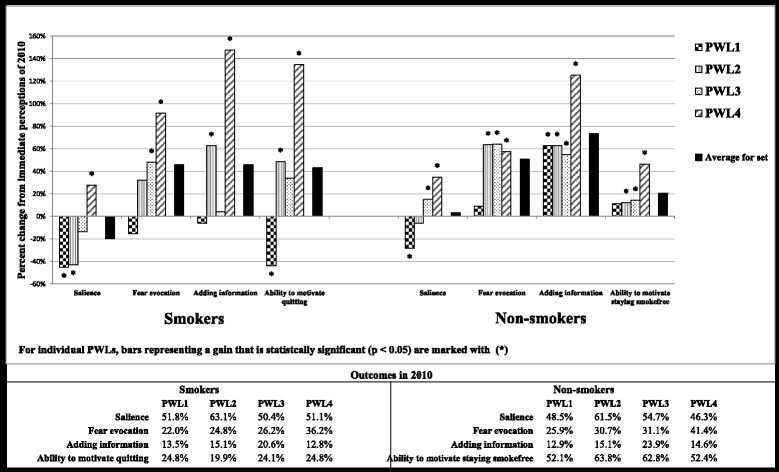
Methods: We administered a survey in a cross-sectional sample of young adults aged 17-26 years. For convenience, respondents were recruited on university campuses. For heterogeneity, respondents were solicited from the different schools in four geographically diverse university campuses. The study compared perceptions of effectiveness surveyed in 2015 to perceptions gauged in 2010 during a pre-launch evaluation exercise. Outcomes of interest were: salience, fear evocation, adding information, and ability to motivate quitting smoking (for smokers) or deterring starting (for non-smokers).
Results: Results indicate awareness of the set among smokers and non-smokers, and their recall of at least one PWL message. Results also indicate effectiveness of the set: (1) 1/3 smokers who frequently saw them reported PWLs to trigger considering quitting, (2) and among both smokers and non-smokers the set in 2015 sustained ability to motivate quitting and staying smoke-free. However, results uncover erosion of salience, suggesting that the set has reached its end of life. Finally, results reveal variability in performance among PWLs; the one PWL that depicts human suffering significantly outperformed the others, and its ability to motivate was most strongly associated with its ability to evoke fear.
Conclusion: Based on the early signs of wear-out (i.e. erosion of salience), and understanding the importance of sustaining upstream outcomes (especially fear evocation) to sustain motivation, we recommend retiring this set of PWLs and replacing it with a stronger set in line with proven standards.
Keywords: Assessment of effectiveness; Pictorial warning labels; Tobacco control policy.
Conflict of interest statement
Ethics approval and consent to participate
The survey instrument and methods (including that for informed consent) were reviewed and approved by the Institutional Review Board (IRB) at King Hussein Cancer Center. Since no identifying information were being collected and the IRB classified the project as imposing no more than minimal risk, only verbal consent was obtained from respondents.
Consent for publication
Not applicable.
Competing interests
The authors declare that they have no competing interests.
Publisher’s Note
Springer Nature remains neutral with regard to jurisdictional claims in published maps and institutional affiliations.
References
-
- World Health Organization. WHO report on the global tobacco epidemic 2013. Tobacco Free Initiative (TFI). http://www.who.int/tobacco/global_report/2013/en/. Published 2013. Accessed 20 Mar 2017.
-
- WHO Framework Convention on Tobacco Control. 2003. http://www.who.int/fctc/text_download/en/. Accessed 20 Mar 2017.
-
- Guidelines for implementation of Article 11. Guidelines on packaging and labelling of tobacco products. WHO. 2008. http://www.who.int/fctc/guidelines/adopted/article_11/en/. Accessed 20 Mar 2017.
MeSH terms
LinkOut - more resources
Full Text Sources
Other Literature Sources
Medical
