


Household preferences for reducing greenhouse gas emissions in four European high-income countries: Does health information matter? A mixed-methods study protocol
- PMID: 28764686
- PMCID: PMC5540303
- DOI: 10.1186/s12889-017-4604-1
Household preferences for reducing greenhouse gas emissions in four European high-income countries: Does health information matter? A mixed-methods study protocol
Erratum in
-
Erratum to: Household preferences for reducing greenhouse gas emissions in four European high-income countries: Does health information matter? A mixed-methods study protocol.BMC Public Health. 2017 Aug 29;17(1):679. doi: 10.1186/s12889-017-4676-y. BMC Public Health. 2017. PMID: 28851347 Free PMC article. No abstract available.
-
Erratum to: BMC Public Health, Vol. 18.BMC Public Health. 2017 Sep 22;17(1):736. doi: 10.1186/s12889-017-4709-6. BMC Public Health. 2017. PMID: 28938882 Free PMC article. No abstract available.
-
Correction to: household preferences for reducing greenhouse gas emissions in four European high-income countries: does health information matter? A mixed-methods study protocol.BMC Public Health. 2017 Oct 25;17(1):846. doi: 10.1186/s12889-017-4861-z. BMC Public Health. 2017. PMID: 29070015 Free PMC article. No abstract available.
Abstract
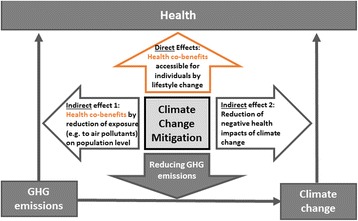
Background: It is now universally acknowledged that climate change constitutes a major threat to human health. At the same time, some of the measures to reduce greenhouse gas emissions, so-called climate change mitigation measures, have significant health co-benefits (e.g., walking or cycling more; eating less meat). The goal of limiting global warming to 1,5° Celsius set by the Conference of the Parties to the United Nations Framework Convention on Climate Change in Paris in 2015 can only be reached if all stakeholders, including households, take actions to mitigate climate change. Results on whether framing mitigation measures in terms of their health co-benefits increases the likelihood of their implementation are inconsistent. The present study protocol describes the transdisciplinary project HOPE (HOuseholds' Preferences for reducing greenhouse gas emissions in four European high-income countries) that investigates the role of health co-benefits in households' decision making on climate change mitigation measures in urban households in France, Germany, Norway and Sweden.
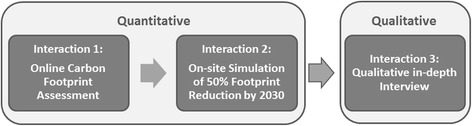
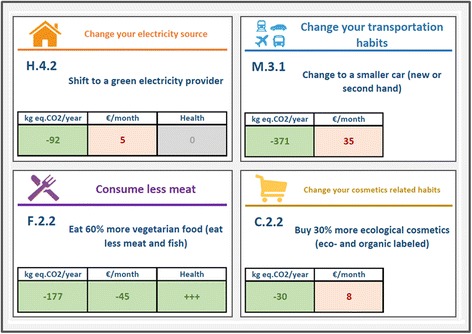
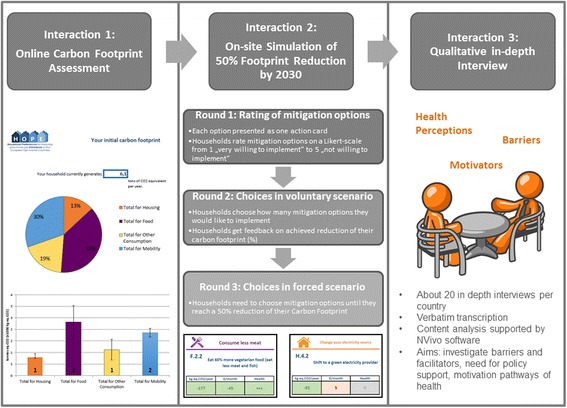
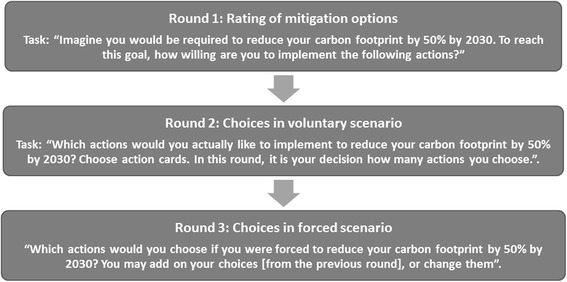
Methods: HOPE employs a mixed-methods approach combining status-quo carbon footprint assessments, simulations of the reduction of households' carbon footprints, and qualitative in-depth interviews with a subgroup of households. Furthermore, a policy analysis of current household oriented climate policies is conducted. In the simulation of the reduction of households' carbon footprints, half of the households are provided with information on health co-benefits of climate change mitigation measures, the other half is not. Households' willingness to implement the measures is assessed and compared in between-group analyses of variance.
Discussion: This is one of the first comprehensive mixed-methods approaches to investigate which mitigation measures households are most willing to implement in order to reach the 1,5° target set by the Paris Agreement, and whether health co-benefits can serve as a motivator for households to implement these measures. The comparison of the empirical data with current climate policies will provide knowledge for tailoring effective climate change mitigation and health policies.
Keywords: Climate change; Health co-benefits; Mitigation; Mixed-methods; Policy; household preferences.
Conflict of interest statement
Ethics approval and consent to participate
All participants were given written information about the study objectives and modalities (points of assessment, length of questionnaires), data preparation and pseudonymized data storage, the expected amount of commitment, the voluntary nature of participation, and their right to withdraw at any time. Furthermore, participants were informed verbally about the study purpose and procedures and were given the chance to ask questions. All participants provided written informed consent. All countries assure that data processing and storage is done in line with European and national data protection rules. Where necessary the study procedures were approved by an ethical committee. In Norway the Norwegian Center for Research Data approved of the study (44003). In Germany the Institutional Review Board of the Medical Faculty by the University of Heidelberg approved of the study (S-611/2015). In Sweden the study was approved by the Regional Ethical Review Board in Umeå (2015/357-31Ö). In France the project needed to fullfill the obligations of the CNIL (Commission nationale informatique et libertés), no specific ethical approval was necessary.
Consent for publication
Not applicable.
Competing interests
The authors declare that they have no competing interests.
Publisher’s Note
Springer Nature remains neutral with regard to jurisdictional claims in published maps and institutional affiliations.
Figures
References
-
- IPCC. Climate change 2014: impacts, adaptation, and vulnerability. Contribution of working group II to the fifth assessment report of the intergovernmental panel on climate change. In: IPCC assessment reports. In: Field CB, Barros VR, Dokken DJ, Mach KJ, Mastrandrea MD, Bilir TE, Chatterjee M, Ebi KL, Estrada YO, Genova RC, Girma B, Kissel ES, Levy AN, MacCracken S, Mastrandrea PR, White LL, editors. Assessment Report. vol. 5th. Cambridge and New York: IPCC; 2014.
MeSH terms
LinkOut - more resources
Full Text Sources
Other Literature Sources
Medical
