


A metagenomic survey of forest soil microbial communities more than a decade after timber harvesting
- PMID: 28765786
- PMCID: PMC5525643
- DOI: 10.1038/sdata.2017.92
A metagenomic survey of forest soil microbial communities more than a decade after timber harvesting
Abstract
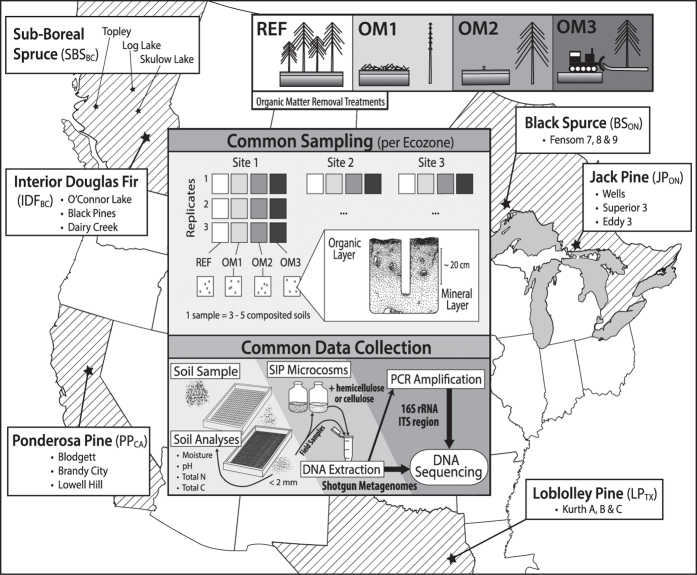
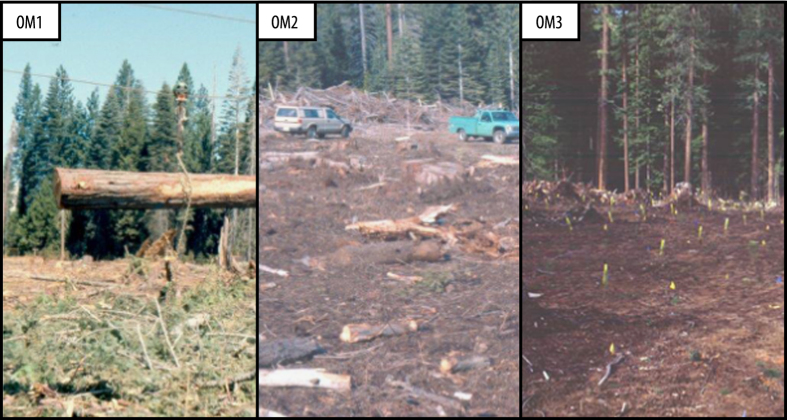
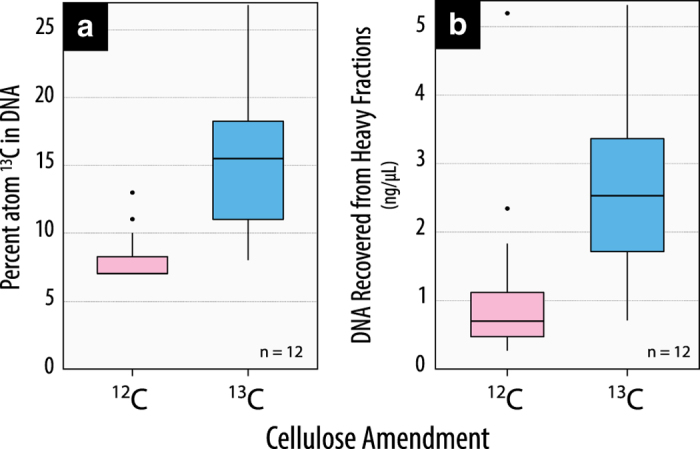
The scarcity of long-term data on soil microbial communities in the decades following timber harvesting limits current understanding of the ecological problems associated with maintaining the productivity of managed forests. The high complexity of soil communities and the heterogeneity of forest and soil necessitates a comprehensive approach to understand the role of microbial processes in managed forest ecosystems. Here, we describe a curated collection of well replicated, multi-faceted data from eighteen reforested sites in six different North American ecozones within the Long-term Soil Productivity (LTSP) Study, without detailed analysis of results or discussion. The experiments were designed to contrast microbial community composition and function among forest soils from harvested treatment plots with varying intensities of organic matter removal. The collection includes 724 bacterial (16S) and 658 fungal (ITS2) amplicon libraries, 133 shotgun metagenomic libraries as well as stable isotope probing amplicon libraries capturing the effects of harvesting on hemicellulolytic and cellulolytic populations. This collection serves as a foundation for the LTSP Study and other studies of the ecology of forest soil and forest disturbance.
Keywords: Forest ecology; Metagenomics; Molecular ecology; Soil microbiology.
Conflict of interest statement
The authors declare no competing financial interests.
Figures
Dataset use reported in
- doi: 10.1038/ismej.2015.57
- doi: 10.1038/ismej.2012.84
- doi: 10.1038/ismej.2015.118
- doi: 10.3389/fmicb.2017.00537
References
Data Citations
-
- 2015. European Nucleotide Archive. https://www.ebi.ac.uk/ena/data/search?query=PRJEB8599
-
- 2016. European Nucleotide Archive. https://www.ebi.ac.uk/ena/data/search?query=PRJEB12501
-
- 2015. European Nucleotide Archive. https://www.ebi.ac.uk/ena/data/search?query=PRJEB8420
-
- 2015. European Nucleotide Archive. https://www.ebi.ac.uk/ena/data/search?query=PRJEB9181
-
- 2015. European Nucleotide Archive. https://www.ebi.ac.uk/ena/data/search?query=PRJEB9182
References
-
- Powers R. F. et al. The North American long-term soil productivity experiment: Findings from the first decade of research. Forest Ecol. Manag. 220, 31–50 (2005).
-
- Thiffault E. et al. Effects of forest biomass harvesting on soil productivity in boreal and temperate forests—A review. Environ. Rev. 19, 278–309 (2011).
-
- Ponder F. et al. Effects of organic matter removal, soil compaction and vegetation control on 10th year biomass and foliar nutrition: LTSP continent-wide comparisons. Forest. Ecol. Manag. 278, 35–54 (2012).
-
- Holub S. M., Terry T. A., Harrington C. A., Harrison R. B. & Meade R. Tree growth ten years after residual biomass removal, soil compaction, tillage, and competing vegetation control in a highly-productive Douglas-fir plantation. Forest Ecol. Manag. 305, 60–66 (2013).
Publication types
MeSH terms
LinkOut - more resources
Full Text Sources
Other Literature Sources
