


Lactate dehydrogenase and creatine kinase as poor prognostic factors in lung cancer: A retrospective observational study
- PMID: 28767733
- PMCID: PMC5540491
- DOI: 10.1371/journal.pone.0182168
Lactate dehydrogenase and creatine kinase as poor prognostic factors in lung cancer: A retrospective observational study
Abstract
Purpose: Circulating molecules play important roles in lung cancer diagnosis. In addition, plasma lactate dehydrogenase (LDH) and creatine kinase (CK) have been shown to be closely related to tumor progression in breast cancer, prostate cancer, and colonel cancer. However, the relationships between LDH and CK levels with metastasis occurrence and the survival status of lung cancer patients remain unclear.
Experimental design: A total of 1142 lung cancer patients were enrolled in this study and were separated into negative or positive groups, according to the plasma levels of CK or LDH. Patients in both groups were assessed for clinical characteristics, metastasis occurrence, and survival status. The Cox regression model was then introduced to confirm whether CK and LDH could act as independent factors for predicting a poor prognosis.
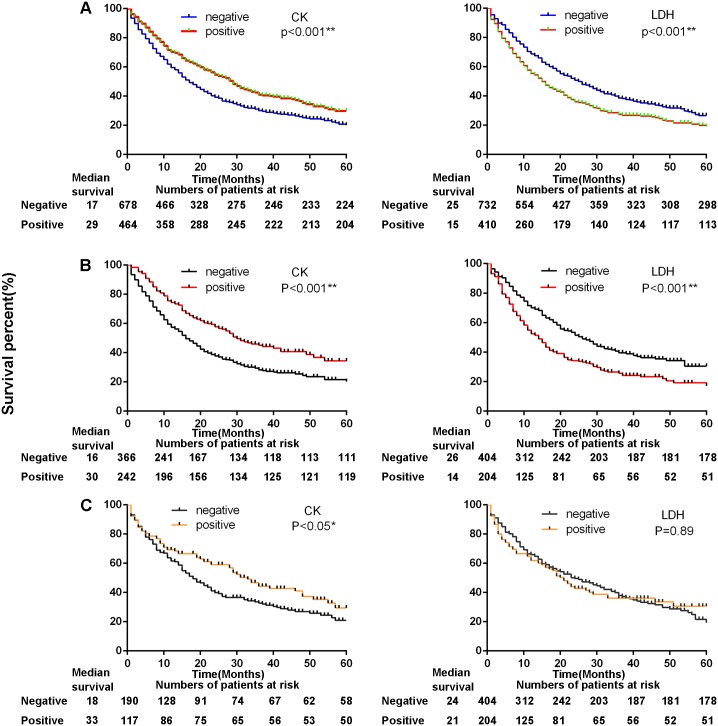
Results: The results indicated that CK had a close relationship with bone (p < 0.05) and lymph node (p < 0.05) metastases. In addition, LDH was strongly related with bone (p < 0.05), adrenal gland (p < 0.05), and lymph node (p < 0.05) metastases. CK and LDH were also correlated with the survival status of the lung cancer patients (all p < 0.001). According to specific histological classification analysis, it was found that CK was closely related to the survival status of adenocarcinoma (ADC) and squamous cell carcinoma (SCC) patients, while LDH was only correlated with that of ADC patients. Cox regression analysis confirmed that CK and LDH could act as independent factors for predicting a poor prognosis in ADC but not SCC patients.
Conclusions: For the first time, our study confirmed the role of CK in metastasis occurrence and the survival status of lung cancer patients. In addition, it also demonstrated that CK and LDH could be used as independent factors to predict a poor prognosis in ADC patients. The identification of CK and LDH will play important roles in lung cancer diagnosis and poor outcome prediction in the future.
Conflict of interest statement
Figures
References
-
- Siegel RL, Miller KD, Jemal A. Cancer statistics, 2015. CA Cancer J Clin. 2015; 65: 5–29. doi: 10.3322/caac.21254 - DOI - PubMed
-
- Chen WC, Zheng RS, Baade PD, Zhang SW, Zeng HM, Bray F et al. Cancer statistics in China, 2015. CA Cancer J Clin. 2016; 66: 115–132. doi: 10.3322/caac.21338 - DOI - PubMed
-
- Henschke CI, Yankelevitz DF, Libby DM, Pasmantier MW, Smith JP, Miettinen OS. Survival of patients with stage I lung cancer detected on CT screening. N Eng J Med. 2006; 355: 1763–1771. - PubMed
-
- Sun N, Chen ZL, Tan FW, Zhang BH, Yao R, Zhou CC et al. Isocitrate dehydrogenase 1 is a novel plasma biomarker for the diagnosis of non-small cell lung cancer. Clin. Can Res. 2013; 19:5136–5145. - PubMed
-
- Alberle DR, Adams AM, Berg CD, Black WC, Clapp JD. Reduced lung-cancer mortality with low-dose computed tomographic screening. N Engl J Med. 2011; 365: 395–409. doi: 10.1056/NEJMoa1102873 - DOI - PMC - PubMed
Publication types
MeSH terms
Substances
LinkOut - more resources
Full Text Sources
Other Literature Sources
Medical
Research Materials
