


Randomized controlled pilot trial of supportive text messages for patients with depression
- PMID: 28768493
- PMCID: PMC5541655
- DOI: 10.1186/s12888-017-1448-2
Randomized controlled pilot trial of supportive text messages for patients with depression
Abstract
Background: Depression is projected to be the primary cause of disability worldwide by 2030. In a recent survey, the most commonly cited unmet need among 42.4% of depressed Albertans was the lack of sufficient, accessible, and affordable counselling. Our aim was to test the efficacy of a supportive text messaging mobile health intervention in improving treatment outcomes in depressed patients.
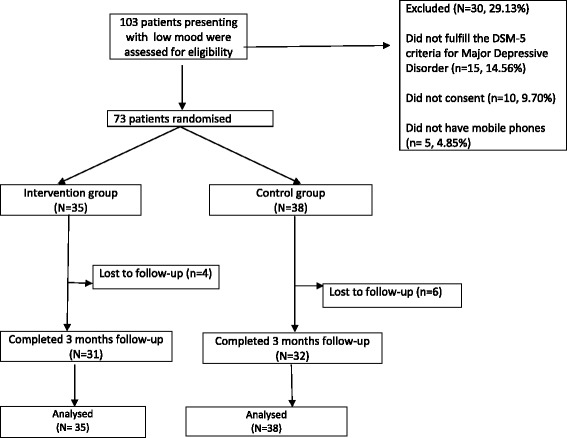
Methods: We performed a single-rater-blinded randomized trial involving 73 patients with Major Depressive Disorder. Patients in the intervention group (n = 35) received twice-daily supportive text messages for 3 months while those in the control group (n = 38) received a single text message every fortnight thanking them for participating in the study. The primary outcome of this study was: "Mean changes in the BDI scores from baseline".
Results: After adjusting for baseline BDI scores, a significant difference remained in the 3 month mean BDI scores between the intervention and control groups: (20.8 (SD = 11.7) vs. 24.9 (SD = 11.5), F (1, 60) = 4.83, p = 0.03, ηp2 = 0.07). The mean difference in the BDI scores change was significant with an effect size (Cohen's d) of 0.67. Furthermore, after adjusting for baseline scores, a significant difference remained in the 3 month mean self-rated VAS scores (EQ-5D-5 L scale) between the intervention and control groups, 65.7 (SD = 15.3) vs. 57.4 (SD = 22.9), F (1, 60) =4.16, p = 0.05, ηp2 = 0.065. The mean difference in change mean self-rated VAS scores was also statistically significant with an effect size (Cohen's d) of 0.51.
Conclusions: Our findings suggest that supportive text messages are a potentially useful psychological intervention for depression, especially in underserved populations. Further studies are needed to explore the implications of our findings in larger clinical samples.
Trial registration: ClinicalTrials.gov NCT02327858 . Registered 24 December 2014.
Keywords: Depression; Mobile health; Randomised controlled trial; Supportive text messages; eHealth; mHealth.
Conflict of interest statement
Authors’ information
Vincent I.O. Agyapong is a Clinical Associate Professor of Psychiatry at the Faculty of Health Sciences, Department of Psychiatry, University of Alberta and the Edmonton Zone Clinical Section Chief of Community Mental Health, Alberta Health Services, Edmonton, AB, Canada.
Michal Juhás is a PhD Candidate at the Faculty of Health Sciences, Department of Psychiatry, University of Alberta, Edmonton, AB, Canada.
Arto Ohinmaa is a Professor of Health Economics at Institute of Health Economics and School of Public Health, University of Alberta, Edmonton, AB, Canada.
Joy Omeje is staff member at the Department of Public Health, Alberta Health Services, Fort Mc Murray, AB, Canada.
Kelly Mrklas is a Knowledge Translation and Implementation Scientist at Research Priorities and Implementation, Research Innovation and Analytics, Alberta Health Services, Calgary, AB, Canada.
Victoria Y.M Suen is the Manager of the Addiction and Mental Health Strategic Clinical Network, Alberta Health Services, Edmonton, AB, Canada.
Serdar M. Dursun is a Professor of Psychiatry at the Faculty of Health Sciences, Department of Psychiatry, University of Alberta, Edmonton, AB, Canada.
Andrew J. Greenshaw is Professor of Psychiatry at the Faculty of Health Sciences, Department of Psychiatry, University of Alberta, Edmonton, AB, Canada.
Ethics approval and consent to participate
The study protocol was reviewed and approved by the Review and Ethics Board of the University of Alberta and written informed consent was obtained from all study participants.
Consent for publication
Not applicable.
Competing interests
All authors declare that they have no competing interests.
Publisher’s Note
Springer Nature remains neutral with regard to jurisdictional claims in published maps and institutional affiliations.
References
-
- Gap analysis of public mental health and addictions programs (GAP-MAP) final report http://www.deslibris.ca/ID/241268. Accessed 1 July 2016.
-
- Caxaj CS. A review of mental health approaches for rural communities: complexities and opportunities in the Canadian context. Can J Commun Mental Health. 2016;35(1):29–45. doi: 10.7870/cjcmh-2015-023. - DOI
Publication types
MeSH terms
Associated data
LinkOut - more resources
Full Text Sources
Other Literature Sources
Medical
