Review
. 2017 Aug 2;12(1):56.
doi: 10.1186/s13024-017-0197-5.

TREM2 in Neurodegenerative Diseases

Affiliations
Review

TREM2 in Neurodegenerative Diseases

Taylor R Jay et al. Mol Neurodegener. .

Abstract

TREM2 variants have been identified as risk factors for Alzheimer's disease (AD) and other neurodegenerative diseases (NDDs). Because TREM2 encodes a receptor exclusively expressed on immune cells, identification of these variants conclusively demonstrates that the immune response can play an active role in the pathogenesis of NDDs. These TREM2 variants also confer the highest risk for developing Alzheimer's disease of any risk factor identified in nearly two decades, suggesting that understanding more about TREM2 function could provide key insights into NDD pathology and provide avenues for novel immune-related NDD biomarkers and therapeutics. The expression, signaling and function of TREM2 in NDDs have been extensively investigated in an effort to understand the role of immune function in disease pathogenesis and progression. We provide a comprehensive review of our current understanding of TREM2 biology, including new insights into the regulation of TREM2 expression, and TREM2 signaling and function across NDDs. While many open questions remain, the current body of literature provides clarity on several issues. While it is still often cited that TREM2 expression is decreased by pro-inflammatory stimuli, it is now clear that this is true in vitro, but inflammatory stimuli in vivo almost universally increase TREM2 expression. Likewise, while TREM2 function is classically described as promoting an anti-inflammatory phenotype, more than half of published studies demonstrate a pro-inflammatory role for TREM2, suggesting that its role in inflammation is much more complex. Finally, these components of TREM2 biology are applied to a discussion of how TREM2 impacts NDD pathologies and the latest assessment of how these findings might be applied to immune-directed clinical biomarkers and therapeutics.

Keywords: Alzheimer’s disease; Frontotemporal dementia; Genetic risk factors; Genetics; Inflammation; Microglia; Neurodegeneration; Parkinson’s disease; Triggering receptor expressed on myeloid cells 2.


Conflict of interest statement

Ethics approval and consent to participate

Not applicable.

Consent for publication

Not applicable.

Competing interests

The authors declare that they have no competing interests.

Publisher’s Note

Springer Nature remains neutral with regard to jurisdictional claims in published maps and institutional affiliations.

Figures
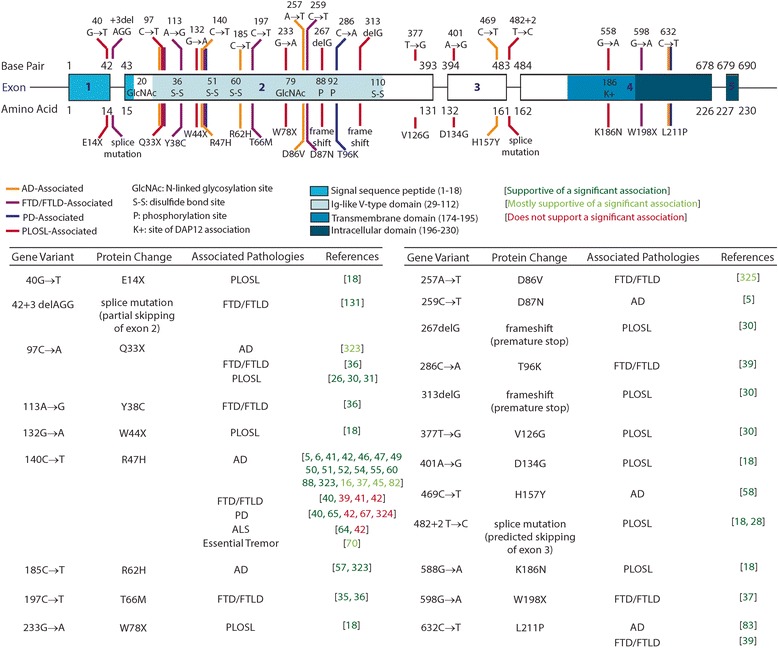
Fig. 1
Fig. 1
Diverse TREM2 variants are associated with NDDs. Genetic variants in the TREM2 gene (shown above) result in diverse changes in the protein structure (shown below). These variants occur in almost every exon (black boxes) and impact known protein motifs (sequences highlighted in blue) and flank many sites of known protein modifications (amino acid number and type of modification detailed inside black boxes). TREM2 variants have been found to be significantly associated with many NDDs, including AD (variants shown in yellow), FTD or FTLD (pink), PD (purple) and PLOSL (red). The table shows genetic variants that have been found to be significantly associated with disease risk, with supporting references shown in dark green and references that provide strong counterevidence shown in red. References shown in light green did find a significant association between the TREM2 variant and disease risk, but only in one or multiple populations they examined or only after inclusion of previously published literature into metastudy analyses. While these variants have been significantly associated with disease risk, many more studies find suggestive but not significant associations between additional TREM2 variants and NDD risk which are not represented here [, , , , , , , , –, –, –, –, , , , , , , , , , , , , , –325]
Fig. 2
Fig. 2
TREM2 can be present as a full-length protein (shown at top) or as a soluble product. This can occur through proteolytic cleavage by ADAM10 followed by γ-secretase to produce soluble TREM2 (sTREM2), a C-terminal fragment (CTF) and an intracellular domain (ICD). TREM2 can also be alternatively spliced to produce soluble isoforms. One alternative transcript has been validated in mice, while two have been validated in humans and four others are predicted to occur [51, 132, 133, 161, 225, 228, 230, 232]
Fig. 3
Fig. 3
TREM2 is expressed in many immune cells, and is localized to microglia in the CNS. TREM2 expression has been assessed in a variety of human and mouse cell types. These data represent TREM2 expression in these cells under homeostatic conditions, though, as discussed in the next section, TREM2 expression can change in the contexts of inflammation or pathology. References shown in green are supportive of TREM2 expression in the cell type listed while those in red did not detect TREM2 expression using the listed method of detection. References in yellow provide evidence of expression, but at low levels or in a small percentage of cells assayed. The graph represents the cell types in which TREM2 expression has been examined at a size relative to the number of studies and methods used to detect TREM2 expression in that cell type. They are graphed along the y-axis according to the percentage of these findings which support TREM2 expression on these cells [, , , , , , , , , , –, –, , –160, 162, 164, 165, 216, 219, 200]
Fig. 4
Fig. 4
TREM2 signaling and function. TREM2 has been proposed to bind to a variety of different ligands, categorized here by lipids, lipoproteins and ligands associated with damage- or pathogen-related molecular patterns. These ligands bind to the TREM2 receptor. Following ligand binding, TREM2 can associate with DAP12 homodimers or DAP12/DAP10 heterodimers to mediate downstream signaling. This signaling requires phosphorylation of the adaptor, following which activating (shown on left in green) or inhibitory (shown on right in red) signaling components can bind. These activating components have been shown to initiate different downstream pathways that lead to cell proliferation and differentiation, survival, phagocytosis, chemotaxis and inflammation. While many other signaling components are thought to play a role downstream of TREM2 activation, only those validated as part of the signaling pathway responsible for the listed functions have been included here. Association with inhibitory components is thought to prevent activation of these downstream pathways. Lipids: PE [254, 96], PS [96, 144, 196, 222, 254], PA [96, 222, 254], PG [254, 222, 96], PC [144, 196, 222, 96, 254], PI [196, 222, 96], CL [96, 254, 222], SM [196, 222, 96, 254], LA [254, 222], SA [144, 196, 222, 96], Apo-/lipoproteins: ApoE [95, 96, 94], ApoJ [94], ApoA-1 [94, 96], ApoA-II [94, 96], LDL, HDL [94, 144, 93], PAMP/DAMPs: [244, 245], (−) bacterial products (LPS, LTA) [244], Nucleic Acids [160], Heat Shock protien 60 [249], Apoptotic cells [95, 153, 160, 96, 222], Macropahages [252], Astrocytoma cells [244]

References

    1. Guerreiro R, Hardy J. Genetics of Alzheimer’s Disease. Neurotherapeutics. 2014;11:732–737. doi: 10.1007/s13311-014-0295-9. - DOI - PMC - PubMed
    1. Grupe A, Abraham R, Li Y, Rowland C, Hollingworth P, Morgan A, Jehu L, Segurado R, Stone D, Schadt E, et al. Evidence for novel susceptibility genes for late-onset Alzheimer’s disease from a genome-wide association study of putative functional variants. Hum Mol Genet. 2007;16:865–873. doi: 10.1093/hmg/ddm031. - DOI - PubMed
    1. Karch CM, Goate AM. Alzheimer’s Disease Risk Genes and Mechanisms of Disease Pathogenesis. Biol Psychiatry. 2015;77:43–51. doi: 10.1016/j.biopsych.2014.05.006. - DOI - PMC - PubMed
    1. Wes PD, Sayed FA, Bard F, Gan L. Targeting Microglia for the Treatment of Alzheimer’s Disease. Glia. 2016;64:1710–1732. doi: 10.1002/glia.22988. - DOI - PubMed
    1. Guerreiro R, Wojtas A, Bras J, Carrasquillo M, Rogaeva E, Majounie E, Cruchaga C, Sassi C, Kauwe JSK, Lupton MK, et al. TREM2 Variants in Alzheimer’s Disease. N Engl J Med. 2013;368:117–127. doi: 10.1056/NEJMoa1211851. - DOI - PMC - PubMed

MeSH terms
