


Intake of niacin, folate, vitamin B-6, and vitamin B-12 through young adulthood and cognitive function in midlife: the Coronary Artery Risk Development in Young Adults (CARDIA) study
- PMID: 28768650
- PMCID: PMC5611785
- DOI: 10.3945/ajcn.117.157834
Intake of niacin, folate, vitamin B-6, and vitamin B-12 through young adulthood and cognitive function in midlife: the Coronary Artery Risk Development in Young Adults (CARDIA) study
Abstract
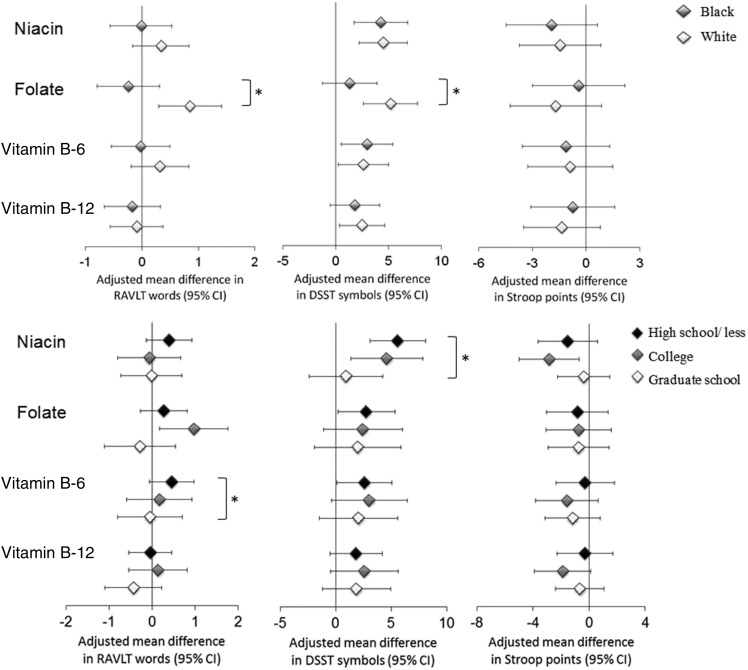
Background: Epidemiologic evidence regarding niacin, folate, vitamin B-6, and vitamin B-12 intake in relation to cognitive function is limited, especially in midlife.Objective: We hypothesize that higher intake of these B vitamins in young adulthood is associated with better cognition later in life.Design: This study comprised a community-based multicenter cohort of black and white men and women aged 18-30 y in 1985-1986 (year 0, i.e., baseline) from the Coronary Artery Risk Development in Young Adults (CARDIA) study (n = 3136). We examined participants' CARDIA diet history at years 0, 7, and 20 to assess nutrient intake, including dietary and supplemental B vitamins. We measured cognitive function at year 25 (mean ± SD age: 50 ± 4 y) through the use of the Rey Auditory Verbal Learning Test (RAVLT) for verbal memory, the Digit Symbol Substitution Test (DSST) for psychomotor speed, and a modified Stroop interference test for executive function. Higher RAVLT and DSST scores and a lower Stroop score indicated better cognitive function. We used multivariable-adjusted linear regressions to estimate mean differences in cognitive scores and 95% CIs.Results: Comparing the highest quintile with the lowest (quintile 5 compared with quintile 1), cumulative total intake of niacin was significantly associated with 3.92 more digits on the DSST (95% CI: 2.28, 5.55; P-trend < 0.01) and 1.89 points lower interference score on the Stroop test (95% CI: -3.10, -0.68; P-trend = 0.05). Total folate was associated with 2.56 more digits on the DSST (95% CI: 0.82, 4.31; P-trend = 0.01). We also found that higher intakes of vitamin B-6 (quartile 5 compared with quartile 1: 2.62; 95% CI: 0.97, 4.28; P-trend = 0.02) and vitamin B-12 (quartile 5 compared with quartile 1: 2.08; 95% CI: 0.52, 3.65; P-trend = 0.02) resulted in better psychomotor speed measured by DSST scores.Conclusion: Higher intake of B vitamins throughout young adulthood was associated with better cognitive function in midlife.
Keywords: cognitive function; epidemiology; folate; middle age; niacin; vitamin B-12; vitamin B-6.
© 2017 American Society for Nutrition.
Figures
References
-
- Brookmeyer R, Johnson E, Ziegler-Graham K, Arrighi HM. Forecasting the global burden of Alzheimer’s disease. Alzheimers Dement 2007;3:186–91. - PubMed
-
- McCaddon A. Homocysteine and cognition—a historical perspective. J Alzheimers Dis 2006;9:361–80. - PubMed
-
- Smith AD, Refsum H. Homocysteine, B vitamins, and cognitive impairment. Annu Rev Nutr 2016;36:211–39. - PubMed
-
- La Rue A, Koehler KM, Wayne SJ, Chiulli SJ, Haaland KY, Garry PJ. Nutritional status and cognitive functioning in a normally aging sample: a 6-y reassessment. Am J Clin Nutr 1997;65:20–9. - PubMed
-
- Lee L, Kang SA, Lee HO, Lee BH, Park JS, Kim JH, Jung IK, Park YJ, Lee JE. Relationships between dietary intake and cognitive function level in Korean elderly people. Public Health 2001;115:133–8. - PubMed
Publication types
MeSH terms
Substances
LinkOut - more resources
Full Text Sources
Other Literature Sources
Medical
