. 2017 Aug 2;7(1):7118.
doi: 10.1038/s41598-017-07216-6.

Sex Specific Placental Accumulation and Behavioral Effects of Developmental Firemaster 550 Exposure in Wistar Rats

Affiliations

Sex Specific Placental Accumulation and Behavioral Effects of Developmental Firemaster 550 Exposure in Wistar Rats

Kylie R Baldwin et al. Sci Rep. .

Abstract

Firemaster® 550 (FM 550) is a commercial flame retardant mixture of brominated and organophosphate compounds applied to polyurethane foam used in furniture and baby products. Due to widespread human exposure, and structural similarities with known endocrine disruptors, concerns have been raised regarding possible toxicity. We previously reported evidence of sex specific behavioral effects in rats resulting from developmental exposure. The present study expands upon this prior finding by testing for a greater range of behavioral effects, and measuring the accumulation of FM 550 compounds in placental tissue. Wistar rat dams were orally exposed to FM 550 during gestation (0, 300 or 1000 µg/day; GD 9 - 18) for placental measurements or perinatally (0, 100, 300 or 1000 µg/day; GD 9 - PND 21) to assess activity and anxiety-like behaviors. Placental accumulation was dose dependent, and in some cases sex specific, with the brominated components reaching the highest levels. Behavioral changes were predominantly associated with a loss or reversal of sex differences in activity and anxiety-like behaviors. These findings demonstrate that environmental chemicals may sex-dependently accumulate in the placenta. That sex-biased exposure might translate to sex-specific adverse outcomes such as behavioral deficits is a possibility that merits further investigation.


Conflict of interest statement

The authors declare that they have no competing interests.

Figures
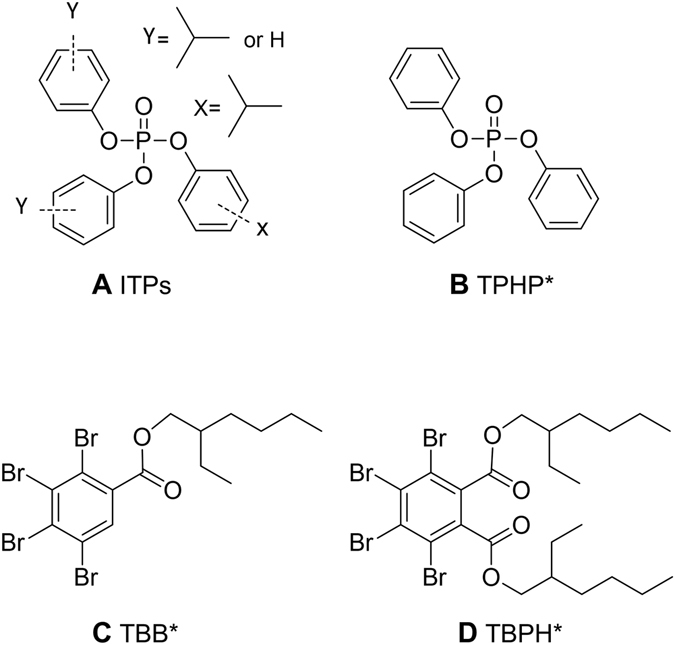
Figure 1
Figure 1
Chemical structure of the four FM 550 components. * = also known as TPP, EH-TBB, and BEH-TEBP respectively. This figure is adapted from.
Figure 2
Figure 2
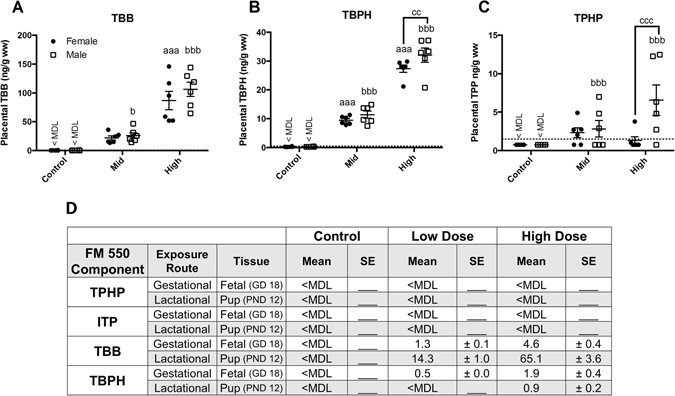
Accumulation of TBB, TBPH, and TPHP in placental tissue following gestational exposure to FM 550. Dose dependent accumulation of TBB, TBPH and TPHP (ng/g wet weight) was observed (AC). Sex specific accumulation was statistically significant at the highest dose for TPHP and TBPH, with males having higher levels than females (B and C). The table (D) summarizes previously published data from our prior, related study, showing the degree to which each component was able to accumulate in fetal and pup tissues following gestational or lactation exposure, respectively (adapted from). Closed circles represent females and open squares represent males. The method detection limit for TBB (0.6 ng/g wet weight), TBPH (0.5 ng/g wet weight), and TPHP (1.5 ng/g wet weight) are depicted by a dotted line. For each dose n = 6, a and b denotes statistically significant exposure effects, within each sex, while c denotes significant sex differences (aaa and bbbp ≤ 0.0001; bp ≤ 0.05; ccp ≤ 0.01; cccp ≤ 0.001). Graphs depict mean +/− SEM.
Figure 3
Figure 3
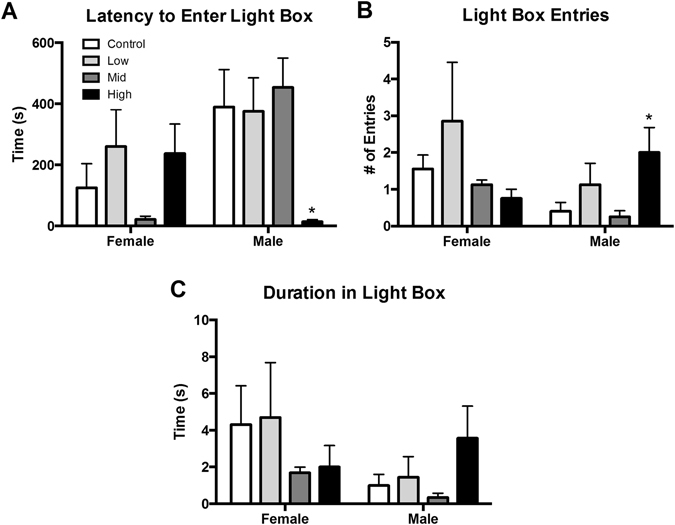
Effects of perinatal FM 550 exposure on juvenile behavior in the light dark box (L/D). No significant effect of sex was observed between control males and females for any of the L/D box measurements. In females, there was no significant effect of exposure for any of the observed endpoints. In males, latency to enter the light box was significantly reduced and light box entries were significantly increased at the highest dose (A and B), while no significant effect of exposure was observed for duration in the light box (C). White bars indicate control groups, light gray low dose, dark grey mid dose, and black high dose. Graphs depict mean ± SEM (*p ≤ 0.05).
Figure 4
Figure 4
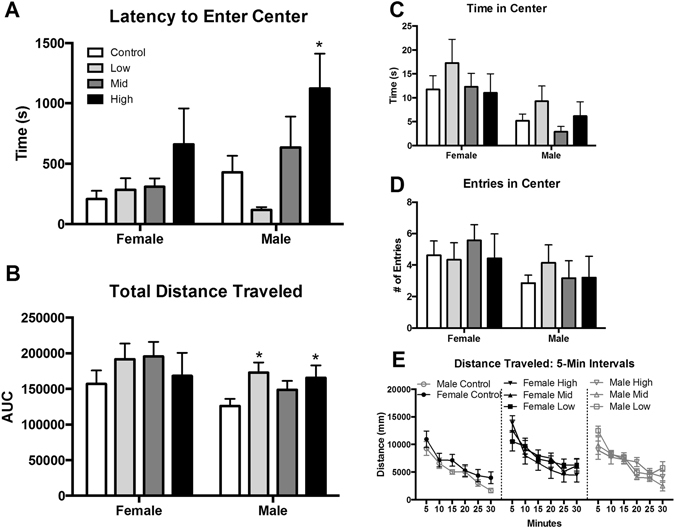
Effects of perinatal FM 550 exposure on juvenile behavior in the open field (OF). No significant effect of sex was observed between control males and females for any of the OF measurements. In females, there was no significant effect of exposure for any of the observed endpoints. In males, latency to enter the center was significantly increased for high dose males and distance traveled was significantly elevated for both low dose and high dose males (A and B). No significant effect of exposure for time in center or center entries (C and D). Distance traveled was binned into 5 minute intervals to evaluate the pattern of locomotor activity over the 30 minute test (E). No exposure-related effects were detected. White bars indicate control groups, light gray low dose, dark grey mid dose, and black high dose. Graphs depict mean ± SEM (*p ≤ 0.05).
Figure 5
Figure 5
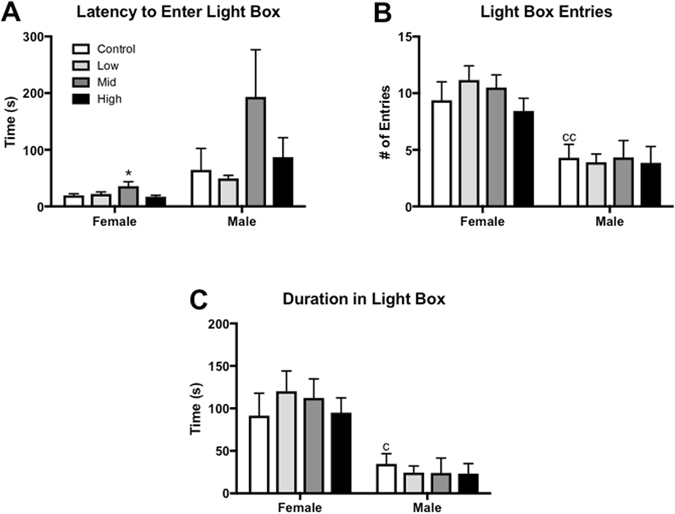
Effects of perinatal FM 550 exposure on adult behavior in the light dark box (L/D). In females, latency to enter the light box was significantly increased at the middle dose (A). As expected, a significant difference between male and female controls was observed for both number of entries in the light box and time spent in the light box (B and C; ccp ≤ 0.01 and cp ≤ 0.05). In males, no significant effect of exposure was observed for any of the L/D box measurements. White bars indicate control groups, light gray low dose, dark grey mid dose, and black high dose. Graphs depict mean ± SEM (*p ≤ 0.05).
Figure 6
Figure 6
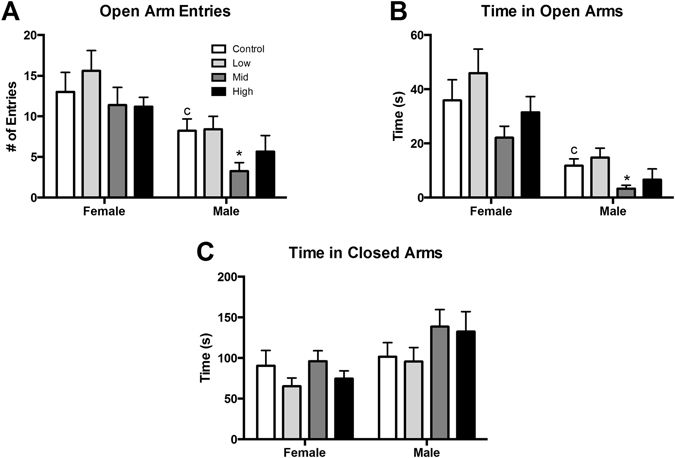
Effects of perinatal FM 550 exposure on adult behavior in the elevated plus maze (EPM). A significant difference between male and female controls was observed in both open arm entries and time in open arms (A and B; cp ≤ 0.05). In females, there was no significant effect of exposure for any of the observed endpoints. In males, open arm entries and time spent in the open arms was significantly reduced at the mid dose (A and B). No significant effect of exposure was observed for time in the closed arms (C). White bars indicate control groups, light gray low dose, dark grey mid dose, and black high dose. Graphs depict mean ± SEM (*p ≤ 0.05).
Figure 7
Figure 7
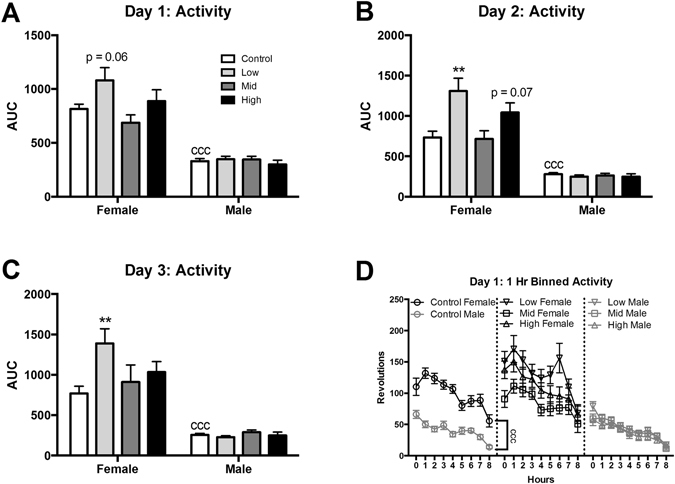
Effects of perinatal FM 550 exposure on adult behavior in activity wheels. A significant difference between male and female controls was observed for all three days of activity wheels (AC; cccp ≤ 0.0001). In females, activity levels were significantly increased on the second and third day of activity wheels at the lowest dose (C and B). In males, there was no significant effect of exposure on any of the three days. White bars indicate control groups, light gray low dose, dark grey mid dose, and black high dose. Graphs depict mean ± SEM (**p ≤ 0.01).

References

    1. Stapleton HM, et al. Detection of organophosphate flame retardants in furniture foam and U.S. house dust. Environ Sci Technol. 2009;43:7490–7495. doi: 10.1021/es9014019. - DOI - PMC - PubMed
    1. Grandjean P, Landrigan PJ. Neurobehavioural effects of developmental toxicity. Lancet Neurol. 2014;13:330–338. doi: 10.1016/S1474-4422(13)70278-3. - DOI - PMC - PubMed
    1. Kalkbrenner AE, Schmidt RJ, Penlesky AC. Environmental chemical exposures and autism spectrum disorders: a review of the epidemiological evidence. Current problems in pediatric and adolescent health care. 2014;44:277–318. doi: 10.1016/j.cppeds.2014.06.001. - DOI - PMC - PubMed
    1. Landrigan PJ, Lambertini L, Birnbaum LS. A research strategy to discover the environmental causes of autism and neurodevelopmental disabilities. Environ. Health Perspect. 2012;120:a258–260. doi: 10.1289/ehp.1104285. - DOI - PMC - PubMed
    1. Masuo Y, Ishido M. Neurotoxicity of endocrine disruptors: possible involvement in brain development and neurodegeneration. J Toxicol Environ Health B Crit Rev. 2011;14:346–369. doi: 10.1080/10937404.2011.578557. - DOI - PubMed

Publication types

Substances

LinkOut - more resources