. 2017 Aug 2;7(1):7137.
doi: 10.1038/s41598-017-07222-8.

Mechanism of biofilm-mediated stress resistance and lifespan extension in C. elegans

Affiliations

Mechanism of biofilm-mediated stress resistance and lifespan extension in C. elegans

Olga Smolentseva et al. Sci Rep. .

Abstract

Bacteria naturally form communities of cells known as biofilms. However the physiological roles of biofilms produced by non-pathogenic microbiota remain largely unknown. To assess the impact of a biofilm on host physiology we explored the effect of several non-pathogenic biofilm-forming bacteria on Caenorhabditis elegans. We show that biofilm formation by Bacillus subtilis, Lactobacillus rhamnosus and Pseudomonas fluorescens induces C. elegans stress resistance. Biofilm also protects against pathogenic infection and prolongs lifespan. Total mRNA analysis identified a set of host genes that are upregulated in response to biofilm formation by B. subtilis. We further demonstrate that mtl-1 is responsible for the biofilm-mediated increase in oxidative stress resistance and lifespan extension. Induction of mtl-1 and hsp-70 promotes biofilm-mediated thermotolerance. ilys-2 activity accounts for biofilm-mediated resistance to Pseudomonas aeruginosa killing. These results reveal the importance of non-pathogenic biofilms for host physiology and provide a framework to study commensal biofilms in higher organisms.


Conflict of interest statement

The authors declare that they have no competing interests.

Figures
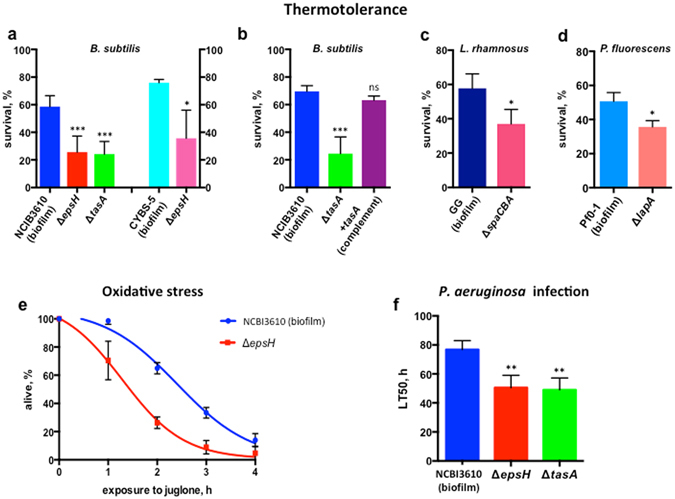
Figure 1
Figure 1
Biofilm enhances C. elegans stress resistance. Each graph represents mean values ± SD from at least free independent biological replicates. Each biological replicate was performed with at least 60 worms per condition. (a) B. subtilis biofilm increases C. elegans thermotolerance. left panel, Day-five-adult worms grown on B. subtilis NCBI3610 (biofilm) or its biofilm-deficient mutants, ΔepsH and ΔtasA, were subjected to heat shock at 33 °C for 3 hours. Surviving animals were scored after 20 hours of recovery at 20 °C. Mean values ± SD are plotted, n = 5. right panel, C. elegans were grown on B. subtilis CYBS-5 (biofilm) or its biofilm-deficient derivative (ΔepsH) until day 5 of adulthood and subjected to heat shock at 33 °C for 3 hours. Surviving animals were scored after 20 hours of recovery at 20 °C. T-test p-value = 0.0270, n = 3. (b) Complementation of B. subtilis tasA deficiency restores biofilm-mediated enhancement of C. elegans thermotolerance. Worms were grown on either biofilm-forming NCBI3610 B. subtilis (biofilm), its biofilm-deficient derivative (ΔtasA), or ∆tasA complimented with a copy of tasA inserted at a distal locus (+tasA (complement)). Five-day old adult worms were heat shocked and scored as described in (a), n = 3. (c) The Lactobacillus rhamnosus biofilm enhances worms resistance to elevated temperatures. C. elegans were grown on Lactobacillus rhamnosus GG (biofilm) or its biofilm-deficient derivative (ΔspaCBA) until day 5 of adulthood and subjected to heat shock at 36 °C for 3 hours. After 20 hours of recovery at 20 °C it was unclear if animals were dead due to residual movement, thus surviving animals were scored after 40 hours of recovery at 20 °C. T-test p-value = 0.0389, n = 3. (d) The Pseudomonas fluorescens biofilm promotes worm heat shock-resistance. C. elegans were grown on Pseudomonas fluorescens Pf0-1(biofilm) or its biofilm-deficient derivative (ΔlapA) until day 5 of adulthood and subjected to heat shock at 35 °C for 4 hours. Surviving animals were scored after 20 hours of recovery at 20 °C. T-test p-value = 0.0144, n = 3. (e) The biofilm renders C. elegans more resistant to oxidative stress. Five-day old C. elegans, grown on NCBI3610 (biofilm) or its biofilm-deficient derivative (ΔepsH) were transferred to plates supplemented with juglone (90 μM) and scored for survival every hour. For statistical data see Supplementary Table S1, n = 4. (f) B. subtilis biofilm protects against pathogenic bacteria. Five-day old worms fed NCBI3610 (biofilm) or its biofilm-deficient derivatives, ΔepsH and ΔtasA, were transferred to P. aeruginosa PA14 seeded plates and scored for survival every 6 hours. LT50, the time at which 50% of animals were scored as dead, was taken from Kaplan-Meier survival curves (median survival data). For the log-rank test p-values see Supplementary Table S2, n = 6.
Figure 2
Figure 2
B. subtilis biofilm extends C. elegans lifespan independently of caloric restriction. (a) C. elegans N2 were fed either biofilm-forming B. subtilis NCBI3610 (biofilm) or its biofilm-deficient derivatives (ΔepsH or ΔtasA). The graph is representative of three independent biological replicates. Median lifespan, days: biofilm–19; ΔepsH–16; ΔtasA–16. The log-rank test p-value for each experiment is ≤0.05. Also see Supplementary Table S3. (b) Worms fed on biofilm-producing B. subtilis exhibit slower age-associated decline in motility. The graph represents linear regression of the median motility values of day-2 and day-8-adults grown of biofilm-forming (biofilm) or biofilm-deficient (ΔepsH, ΔtasA) B. subtilis. The median values were calculated as described in Supplemental Fig. S3d and mean values ± SD from 3 independent experiments are plotted. (c) The biofilm prolongs lifespan of dietary restricted worms DA1116 (eat-2). Median lifespan, days: biofilm–34; ΔepsH–29; ΔtasA–28. The graph is representative of three independent biological replicates. The log-rank test p-value is ≤0.05, Supplementary Table S3. (d) pha-4 is induced in response to dietary restriction, but not by the B. subtilis biofilm. RT-PCR analysis of pha-4 expression in C. elegans eat-2 (dashed bars) and N2 (empty bars) fed biofilm-forming (biofilm) and biofilm deficient (ΔepsH, ΔtasA) B. subtilis strains. Mean ± SD from three independent experiments are plotted, n = 100 per experiment per condition. One-way ANOVA: p-value = 0.6696 for N2 worms; p-value = 0.1945 for eat-2 worms.
Figure 3
Figure 3
Beneficial effects likely require intestinal biofilm production. (a) Induction of biofilm matrix gene expression in the C. elegans intestine. Representative image of worms grown on the indicated B. subtilis strains were visualized at day 5 of adulthood. The red fluorescent signal indicates tasA expression in B. subtilis cells. (b) Fluorescence quantification of five-day old adults (n = 15) grown on corresponding bacterial strain. (c) Biofilm matrix exopolysaccharides are present in the C. elegans intestinal lumen. Representative image of FITC-conjugated wheat germ agglutinin (WGA-FITC) stained C. elegans grown on the indicated B. subtilis strains at day 5 of adulthood. Green fluorescence indicates biofilm matrix. (d) Fluorescence quantification of adult worms (n = 15) grown on corresponding bacterial strains until day 5 of adulthood and stained with WGA-FITC. Error bars show means ± SD from three independent experiments. (e) The anti-aging effect of biofilm requires live metabolizing bacteria. B. subtilis strains were grown on NGM plates overnight at 20 °C and then treated with a mixture of antibiotics (100 μg/ml kanamycin and 500 μg/ml carbenicillin). The graph is representative of three independent biological replicates. Median lifespan, days: biofilm–21; ΔepsH–21; ΔtasA–21. The log-rank test p-value for each experiment is >0.05. Supplementary Table S3. (f) Biofilm-induced thermotolerance requires live bacteria. B. subtilis lawns were treated with a mixture of antibiotics (100 μg/ml kanamycin and 500 μg/ml carbenicillin) prior to transferring C. elegans to them. Five-day old adult worms were heat shocked as in (a) for the indicated period of time. Each experiment includes at least 60 worms per condition per experiment. Mean values ± SD are plotted, n = 5. One-way ANOVA: p-value = 0.8759 (3 h), p-value = 0.9310 (4 h).
Figure 4
Figure 4
Biofilm acts via induction of metallothionein in C. elegans. In each case the average values ± SD from at least three independent experiments are plotted. Each experiment includes at least 60 worms per condition. (a) MTL-1 is required for biofilm-dependent lifespan extension. C. elegans mtl-1 (tm1770) were fed either biofilm-forming B. subtilis (biofilm, blue) or its biofilm-deficient derivatives (ΔepsH and ΔtasA, red and green, respectively). The graph is representative of three independent biological replicates. Median lifespan, days: biofilm–15; ΔepsH–15; ΔtasA–15. The log-rank test p-value for each experiment is >0.05, Supplementary Table S3. (b) MTL-1 is required for biofilm-mediated thermotolerance. Wild-type (N2) and mtl-1 (tm1770) C. elegans were grown in parallel on indicated bacterial strains until day 5 of adulthood and then subjected to heat shock at 33 °C for 3 hours. Surviving animals were scored after 20 hours of recovery at 20 °C. The graph represents mean values ± SD from free independent biological replicates. One-way ANOVA p-value = 0.4800. (c) MTL-1 is required for biofilm-mediated resistance to oxidative stress. Five-day old wild-type (N2) and mtl-1 (tm1770) C. elegans were grown on indicated bacterial strains, transferred to plates supplemented with juglone (90 μM) and scored for survival every hour. The graph represents mean values ± SD from free independent biological replicates. Also see Supplemental Table S1.
Figure 5
Figure 5
mtl-1 overexpression abrogates biofilm-mediated effects. In each case the average values ± SD from at least three independent experiments are plotted. Each experiment includes at least 60 worms per condition. (a) Relative levels of mtl-1 expression. The relative level of mtl-1 mRNA was calculated as the fold change from the expression level in C. elegans N2 fed on wild-type B. subtilis (biofilm) using RT-PCR. (b) The B. subtilis biofilm fails to increase the thermotolerance of C. elegans overexpressing mtl-1. Five-day old mtl-1 OE (WU1394) grown on B. subtilis NCIB3610 (biofilm) or its biofilm-deficient derivative (ΔepsH) were heat shocked at 33 °C for 5 hours. The duration of heat shock was increased from 3 to 5 hours because 100% of mtl-1 OE worms survived a 3 hour heat-shock treatment regardless of the bacterial strain. Surviving animals were scored after 20 hours of recovery at 20 °C. One-way ANOVA p-value = 0.2877. (c) The B. subtilis biofilm fails to promote resistance to oxidative stress in worms overexpressing mtl-1. Five-day old mtl-1 OE (WU1394) grown on B. subtilis NCBI3610 (biofilm) or its biofilm-deficient derivative (ΔepsH) were transferred to plates supplemented with juglone (90 μM) and scored for survival every hour. See Supplementary Table S1.
Figure 6
Figure 6
HSP70 and lysozyme contribute to biofilm-mediated resistance to heat and infection. (a) C. elegans hsp-70 (F44E5.4 and F44E5.5) are required for biofilm-induced thermotolerance. Wild-type (N2) and hsp70-deficient C. elegans were grown in parallel on biofilm-forming (biofilm) and biofilm-deficient (ΔepsH, ΔtasA) B. subtilis. Five-day old worms were subjected to heat shock as in Fig. 1a. Mean values ± SD from three independent biological replicates are plotted. Each biological replicate includes at least 60 worms per condition. One-way ANOVA p-value = 0.1210. (b) ILYS-2 is dispensable for the biofilm-mediated increase in C. elegans thermotolerance. N2 and ilys-2 worms were grown in parallel on indicated bacterial strains until day 5 of adulthood and then subjected to heat shock at 33 °C for 3 hours. Surviving animals were scored after 20 hours of recovery at 20 °C. (c) Biofilm-dependent induction of ilys-2 is essential for resistance to P. aeruginosa infection. Five-day old wild-type (N2) and ilys2 worms grown in parallel on indicated B. subtilis strains were transferred to P. aeruginosa PA14 seeded plates and survival was scored every 6 hours. LT50 was taken from Kaplan-Meier survival curves (median survival data). For the log-rank test p-values see Supplementary Table S2. (d) MTL-1 and HSP70 are not required for biofilm-dependent resistance to P. aeruginosa infection. Five-day old wild-type (N2), mtl-1 (tm1770) and hsp70 knockout worms grown in parallel on indicated B. subtilis strains were transferred to P. aeruginosa PA14 seeded plates and survival was scored every 6 hours. LT50 was taken from Kaplan-Meier survival curves (median survival data). For the log-rank test p-values see Supplementary Table S2. (e) Biofilm-induced signaling in C. elegans. Feeding C. elegans biofilm-forming B. subtilis induces expression of MTL-1, Hsp70 (F44E5.4 and F44E5.5) and ILYS-2, partly via HSF-1 and DAF-16 activation (blue and red arrows). Pentagons indicate transcription factors. Upregulation of these biofilm responsive genes in host organism results in enhanced lifespan, thermotolerance, and resistance to oxidative stress and pathogenic infection.

References

    1. Lopez D, Vlamakis H, Kolter R. Biofilms. Cold Spring Harbor perspectives in biology. 2010;2:a000398. doi: 10.1101/cshperspect.a000398. - DOI - PMC - PubMed
    1. Hall-Stoodley L, Costerton JW, Stoodley P. Bacterial biofilms: from the natural environment to infectious diseases. Nature reviews. Microbiology. 2004;2:95–108. doi: 10.1038/nrmicro821. - DOI - PubMed
    1. Branda SS, Vik S, Friedman L, Kolter R. Biofilms: the matrix revisited. Trends in microbiology. 2005;13:20–26. doi: 10.1016/j.tim.2004.11.006. - DOI - PubMed
    1. Hobley L, Harkins C, MacPhee CE, Stanley-Wall NR. Giving structure to the biofilm matrix: an overview of individual strategies and emerging common themes. FEMS microbiology reviews. 2015;39:649–669. doi: 10.1093/femsre/fuv015. - DOI - PMC - PubMed
    1. Hall-Stoodley L, Stoodley P. Evolving concepts in biofilm infections. Cellular microbiology. 2009;11:1034–1043. doi: 10.1111/j.1462-5822.2009.01323.x. - DOI - PubMed

Publication types
