Review
. 2017:2017:4049098.
doi: 10.1155/2017/4049098. Epub 2017 Jul 9.

Osteopontin at the Crossroads of Inflammation and Tumor Progression

Affiliations
Review

Osteopontin at the Crossroads of Inflammation and Tumor Progression

Luigi Mario Castello et al. Mediators Inflamm. 2017.

Abstract

Complex interactions between tumor and host cells regulate systemic tumor dissemination, a process that begins early at the primary tumor site and goes on until tumor cells detach themselves from the tumor mass and start migrating into the blood or lymphatic vessels. Metastatic cells colonize the target organs and are capable of surviving and growing at distant sites. In this context, osteopontin (OPN) appears to be a key determinant of the crosstalk between cancer cells and the host microenvironment, which in turn modulates immune evasion. OPN is overexpressed in several human carcinomas and has been implicated in inflammation, tumor progression, and metastasis. Thus, it represents one of the most attracting targets for cancer therapy. Within the tumor mass, OPN is secreted in various forms either by the tumor itself or by stroma cells, and it can exert either pro- or antitumorigenic effects according to the cell type and tumor microenvironment. Thus, targeting OPN for therapeutic purposes needs to take into account the heterogeneous functions of the multiple OPN forms with regard to cancer formation and progression. In this review, we will describe the role of systemic, tumor-derived, and stroma-derived OPN, highlighting its pivotal role at the crossroads of inflammation and tumor progression.


Figures
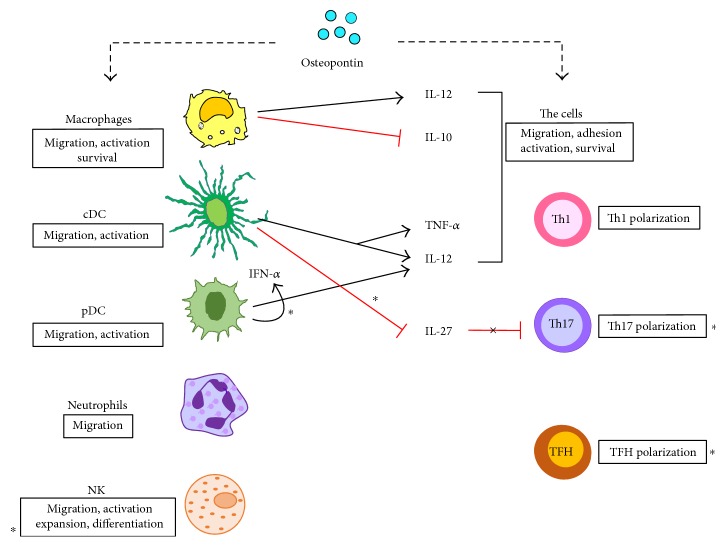
Figure 1
Figure 1
Effect of OPN on several leukocytes. sOPN triggers myeloid and lymphoid cells eliciting a functional response (boxes) that in turn induces cytokine secretion which drives the inflammatory/immune response. Asterisks mark the effects mediated by iOPN.
Figure 2
Figure 2
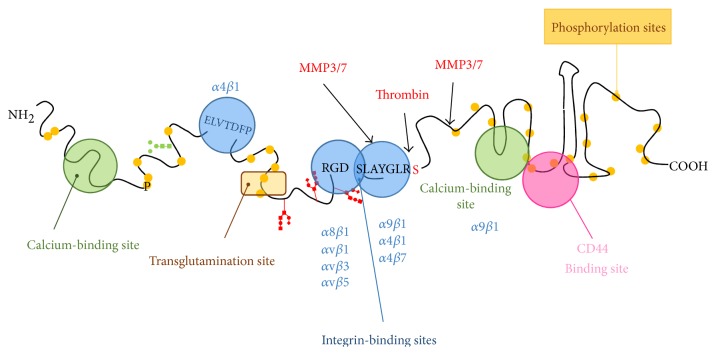
Main domains of OPN. The cartoon depicts the functional parts of OPN. OPN binds two different classes of receptors, integrins (in blue) and CD44 (in pink). It can also interact with calcium (green). The SVVYGLR sequence is usually masked in the full-length molecule, but it becomes available upon thrombin cleavage of OPN. OPN undergoes several posttranslational modifications including glycosylation (red and green sugars), phosphorylation (yellow dots), crosslinking mediated by transglutaminase and protease cleavage (thrombin and MMPs). Each of these modifications can alter OPN functions.
Figure 3
Figure 3
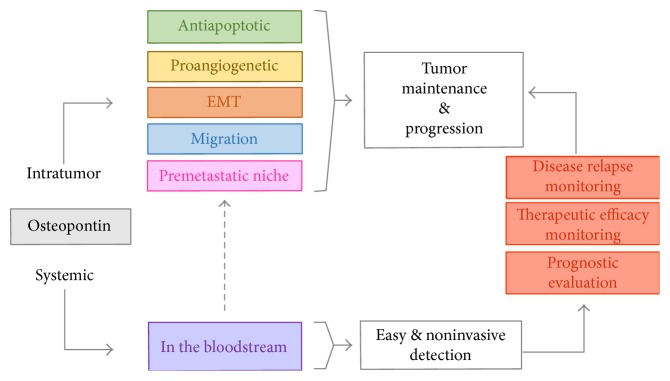
Schematic representation of the role of OPN in tumor patients. OPN is involved in many different biological functions as well as in tumor maintenance and progression. Besides its local effect, OPN is also secreted in the blood stream, and its levels are increased in patients with different tumor types. Since measurement of OPN from plasma or serum is readily accessible and noninvasive, it is likely that OPN might become a useful marker for the diagnosis, treatment, and tumor relapse monitoring of a number of carcinomas.
Figure 4
Figure 4
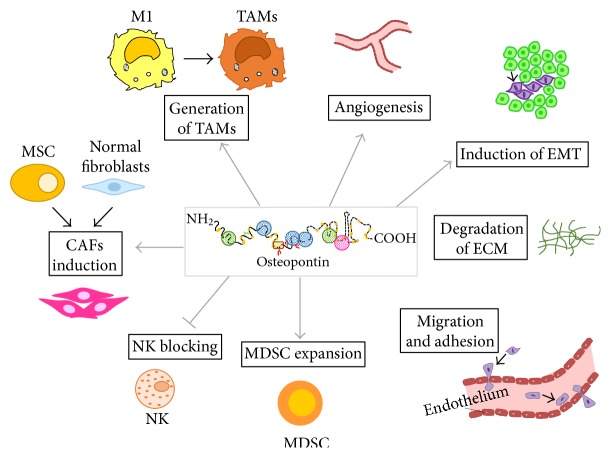
OPN functions in the tumor microenvironment. In the tumor microenvironment, OPN has different functions ranging from the recruitment of leucocytes, endothelial cells, and mesenchymal stem cells (MSCs) from the periphery or bone marrow, to the reprogramming of local fibroblast to cancer-associated fibroblasts and transformation of M1 antitumorigenic macrophages to tumor-associated macrophages. These changes in the stroma favor tumor progression through angiogenesis, degradation of the extracellular matrix, epithelial to mesenchymal transition (EMT), and migration of metastatic cells.
Figure 5
Figure 5
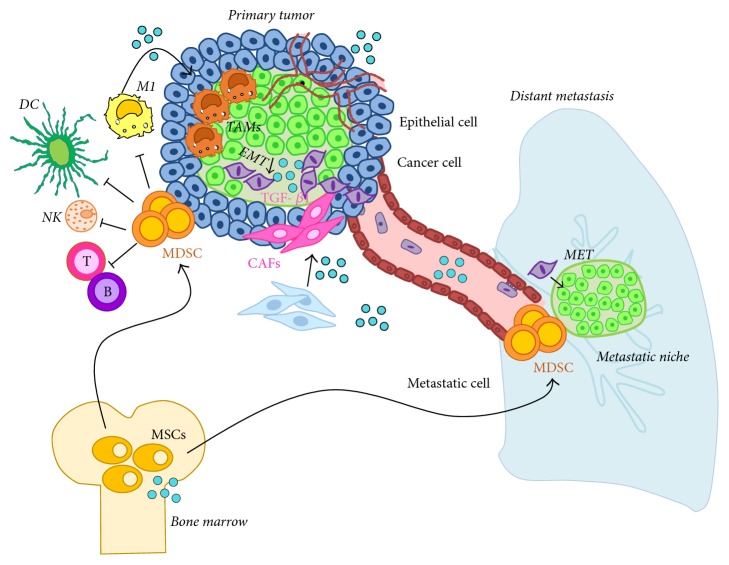
Tumor-promoting functions of OPN. OPN (blue sphere) induces increased proliferation and survival of tumor cells; it is also associated with the recruitment of myeloid-derived suppressor cells (MDSC), from bone marrow stem cells. MDSC create an immunosuppressive niche both in the primary tumor and in the metastatic tissue, thereby creating a favorable place for tumor growth. OPN favors dissemination and angiogenesis to counteract hypoxia, and concomitantly reprograms tissue fibroblasts to cancer-associated fibroblasts (CAFs), which by secreting TGF-β1, promote epithelial to mesenchymal transition (EMT) allowing tumor cells to detach from the primary mass and disseminate to the premetastatic niche. Here, OPN promotes mesenchymal to epithelial transition (MET) favoring the metastatic processes.

References

    1. Taniguchi K., Wu L. W., Grivennikov S. I., et al. A gp130-Src-YAP module links inflammation to epithelial regeneration. Nature. 2015;519:57–62. doi: 10.1038/nature14228. - DOI - PMC - PubMed
    1. Galdiero M. R., Bonavita E., Barajon I., Garlanda C., Mantovani A., Jaillon S. Tumor associated macrophages and neutrophils in cancer. Immunobiology. 2013;218:1402–1410. doi: 10.1016/j.imbio.2013.06.003. - DOI - PubMed
    1. Ruffel B., Coussens L. M. Macrophages and therapeutic resistance in cancer. Cancer Cell. 2015;27:462–472. doi: 10.1016/j.ccell.2015.02.015. - DOI - PMC - PubMed
    1. Shalapour S., Karin M. Immunity, inflammation, and cancer: an eternal fight between good and evil. The Journal of Clinical Investigation. 2015;125:3347–3355. doi: 10.1172/JCI80007. - DOI - PMC - PubMed
    1. Grivennikov S. I., Greten F. R., Karin M. Immunity, inflammation, and cancer. Cell. 2010;140:883–899. doi: 10.1016/j.cell.2010.01.025. - DOI - PMC - PubMed

LinkOut - more resources