


Efficacy and Tolerability of Gabapentin in Adults with Sleep Disturbance in Medical Illness: A Systematic Review and Meta-analysis
- PMID: 28769860
- PMCID: PMC5510619
- DOI: 10.3389/fneur.2017.00316
Efficacy and Tolerability of Gabapentin in Adults with Sleep Disturbance in Medical Illness: A Systematic Review and Meta-analysis
Abstract
Background and purpose: The aim of this study was to systematically review the efficacy and tolerability of gabapentin in the treatment of sleep disturbance in patients with medical illness.
Methods: PubMed was searched for randomized, double-blinded, placebo-controlled trials that reported sleep changes during gabapentin treatment up to November 2015.
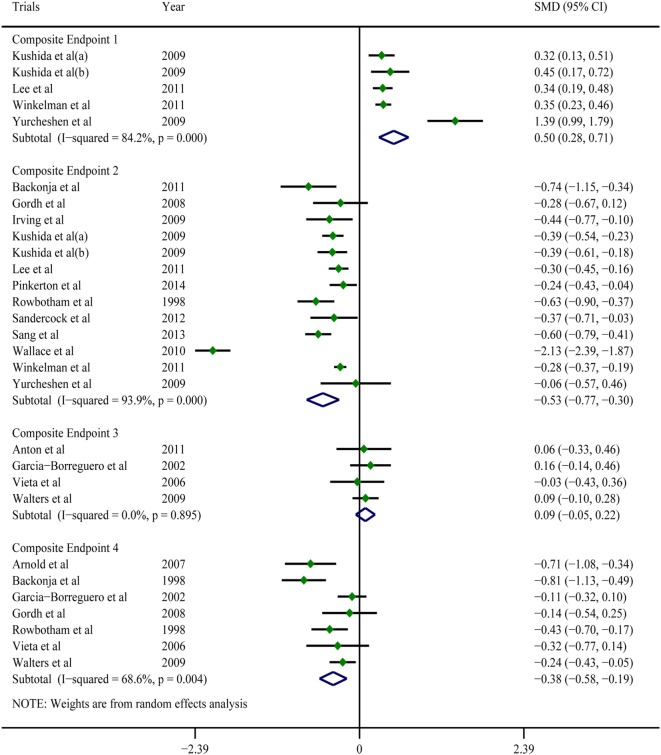
Findings: This review included 26 studies involving 4,684 participants. Except for Composite Endpoint 3 [standardized mean difference (SMD) = 0.09, 95% confidence interval (CI): -0.05-0.22] compared with the placebo group, the gabapentin group showed superior outcomes on our endpoints: Composite Endpoint 1 (SMD = 0.50, 95% CI: 0.28-0.71), Composite Endpoint 2 (SMD = -0.53, 95% CI: -0.77 to -0.30), Composite Endpoint 4 (SMD = -0.38, 95% CI: -0.58 to -0.19), Composite Endpoint 5 [risk ratio (RR) = 1.79, 95% CI: 1.24-2.58], and Composite Endpoint 6 (RR = 0.48, 95% CI: 0.32-0.72). However, the patients in the gabapentin group showed worse tolerance than those in the placebo group (RR = 1.38, 95% CI: 1.08-1.76).
Implications: This study is the first to systematically assess the clinical value of gabapentin for the treatment of sleep disorders. We found that regardless the type of sleep outcomes, gabapentin displayed stable treatment efficacy for sleep disturbance in patients with medical illness. However, when an average dose of approximately 1,800 mg/day was used, the risk of treatment discontinuation or drug withdrawal was relatively high. We recommend that further studies confirm these findings in patients with primary sleep disorders.
Keywords: efficacy; gabapentin; meta-analysis; sleep disturbance; tolerability.
Figures


References
LinkOut - more resources
Full Text Sources
Other Literature Sources
Medical
