Review
. 2017 Jul 18:8:329.
doi: 10.3389/fneur.2017.00329. eCollection 2017.

Eyelid Dysfunction in Neurodegenerative, Neurogenetic, and Neurometabolic Disease

Affiliations
Review

Eyelid Dysfunction in Neurodegenerative, Neurogenetic, and Neurometabolic Disease

Ali G Hamedani et al. Front Neurol. .

Abstract

Eye movement abnormalities are among the earliest clinical manifestations of inherited and acquired neurodegenerative diseases and play an integral role in their diagnosis. Eyelid movement is neuroanatomically linked to eye movement, and thus eyelid dysfunction can also be a distinguishing feature of neurodegenerative disease and complements eye movement abnormalities in helping us to understand their pathophysiology. In this review, we summarize the various eyelid abnormalities that can occur in neurodegenerative, neurogenetic, and neurometabolic diseases. We discuss eyelid disorders, such as ptosis, eyelid retraction, abnormal spontaneous and reflexive blinking, blepharospasm, and eyelid apraxia in the context of the neuroanatomic pathways that are affected. We also review the literature regarding the prevalence of eyelid abnormalities in different neurologic diseases as well as treatment strategies (Table 1).

Keywords: Parkinson; blepharospasm; blinking; eyelid; movement disorders; neurodegenerative diseases; neurogenetic.


Figures
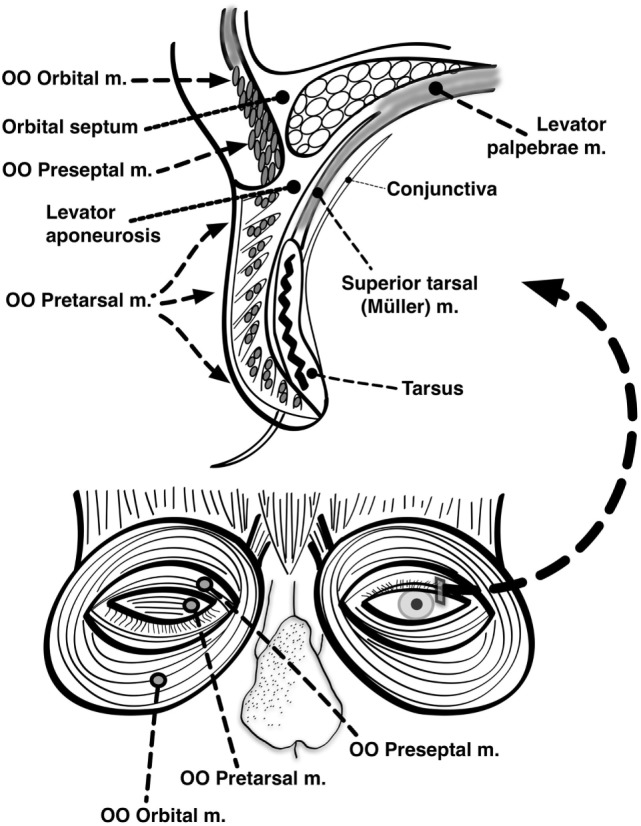
Figure 1
Figure 1
Anatomy of the eyelids. Seen here are the major muscles of eyelid opening and closure. The levator palpebrae, which is innervated by the oculomotor nerve, inserts on the tarsus via the levator aponeurosis and directly on the skin of the upper eyelid. The superior tarsal muscle (also known as Muller’s muscle, which is innervated by oculosympathetic fibers) originates from the levator aponeurosis and inserts on the tarsus. The orbicularis oculi (OO) is innervated by the facial nerve. It is made up of two portions: one contained within the eyelid itself (palpebral portion) and one located outside the eyelid surrounding the orbit (orbital portion). The palpebral portion of the OO can be further subdivided into preseptal and pretarsal components based on its anatomic location relative to the tarsus (Modified with permission from (154), Figure 24.5).
Figure 2
Figure 2
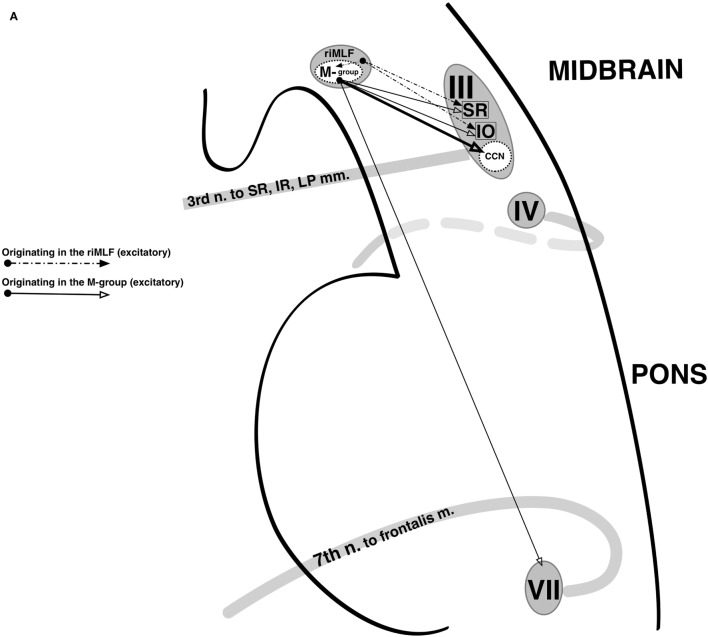
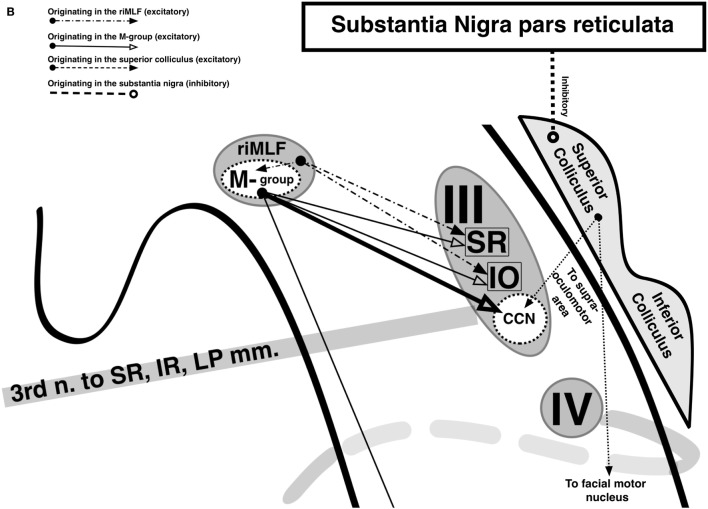
Supranuclear control of eyelid movement. (A) The central caudal nucleus (CCN) of the midbrain contributes fibers to both oculomotor nerves and innervates both levator palpebrae superioris (LPS). It maintains a tonic level of activity during eye opening that transiently increased with upward eye movements and decreases with downward eye movements. During a vertical saccade, the rostral interstitial nucleus of the median longitudinal fasciculus (riMLF) is activated, and it provides excitatory input into the superior rectus (SR) and inferior oblique (IO) subnuclei of the oculomotor nerve in order to elevate the eyes. In addition, the riMLF activates the nearby M-group. The M-group provides a small amount of reinforcing excitation to the SR and IO subnuclei, but its primary excitatory output is to the CCN, resulting in an increase in firing rate which produces eyelid elevation. The M-group also synapses on the facial nucleus, presumably to provide assistance from the frontalis in eyelid elevation when needed. The opposite occurs during downgaze. Eyelid retraction in midbrain dysfunction occurs due to M-group overstimulation (in an attempt to overcome an upgaze palsy) or underinhibition (from injury to the nearby interstitial nucleus of Cajal and nucleus of the posterior commissure). (B) During a blink, the LPS abruptly ceases firing and the orbicularis oculi (OO), which is innervated by the facial nerve, briefly contracts. This coordination of LPS and OO activity is thought to be mediated by the superior colliculus (SC). The SC projects to the supraoculomotor area directly overlying the CCN as well as to the facial nuclei and is inhibited by the pars reticulata of the substantia nigra (SNr). In parkinsonism, there is increased activity in the SNr, which results in greater inhibition of the SC and reduced spontaneous blinking. Not shown are afferents from the trigeminal nucleus and pretectum to the SC, which mediate reflexive blinking to corneal stimulation and bright light, respectively.
Figure 2
Figure 2
Supranuclear control of eyelid movement. (A) The central caudal nucleus (CCN) of the midbrain contributes fibers to both oculomotor nerves and innervates both levator palpebrae superioris (LPS). It maintains a tonic level of activity during eye opening that transiently increased with upward eye movements and decreases with downward eye movements. During a vertical saccade, the rostral interstitial nucleus of the median longitudinal fasciculus (riMLF) is activated, and it provides excitatory input into the superior rectus (SR) and inferior oblique (IO) subnuclei of the oculomotor nerve in order to elevate the eyes. In addition, the riMLF activates the nearby M-group. The M-group provides a small amount of reinforcing excitation to the SR and IO subnuclei, but its primary excitatory output is to the CCN, resulting in an increase in firing rate which produces eyelid elevation. The M-group also synapses on the facial nucleus, presumably to provide assistance from the frontalis in eyelid elevation when needed. The opposite occurs during downgaze. Eyelid retraction in midbrain dysfunction occurs due to M-group overstimulation (in an attempt to overcome an upgaze palsy) or underinhibition (from injury to the nearby interstitial nucleus of Cajal and nucleus of the posterior commissure). (B) During a blink, the LPS abruptly ceases firing and the orbicularis oculi (OO), which is innervated by the facial nerve, briefly contracts. This coordination of LPS and OO activity is thought to be mediated by the superior colliculus (SC). The SC projects to the supraoculomotor area directly overlying the CCN as well as to the facial nuclei and is inhibited by the pars reticulata of the substantia nigra (SNr). In parkinsonism, there is increased activity in the SNr, which results in greater inhibition of the SC and reduced spontaneous blinking. Not shown are afferents from the trigeminal nucleus and pretectum to the SC, which mediate reflexive blinking to corneal stimulation and bright light, respectively.

References

    1. Liu GT, Volpe NJ, Galetta SL. Neuro-Ophthalmology: Diagnosis and Management. 2nd ed Philadelphia, PA: Elsevier; (2010).
    1. Porter JD, Burns LA, May PJ. Morphological substrate for eyelid movements: innervation and structure of primary levator palpebrae superioris and orbicularis oculi muscles. J Comp Neurol (1989) 287(1):64–81. 10.1002/cne.902870106 - DOI - PubMed
    1. McClelland C, Manousakis G, Lee MS. Progressive external ophthalmoplegia. Curr Neurol Neurosci Rep (2016) 16(6):53. 10.1007/s11910-016-0652-7 - DOI - PubMed
    1. Milone M, Wong LJ. Diagnosis of mitochondrial myopathies. Mol Genet Metab (2013) 110(1–2):35–41. 10.1016/j.ymgme.2013.07.007 - DOI - PubMed
    1. Taylor RW, Turnbull DM. Mitochondrial DNA mutations in human disease. Nat Rev Genet (2005) 6(5):389–402. 10.1038/nrg1606 - DOI - PMC - PubMed

LinkOut - more resources