The Association between Food Group Consumption Patterns and Early Metabolic Syndrome Risk in Non-Diabetic Healthy People
- PMID: 28770180
- PMCID: PMC5539211
- DOI: 10.7762/cnr.2017.6.3.172
The Association between Food Group Consumption Patterns and Early Metabolic Syndrome Risk in Non-Diabetic Healthy People
Abstract
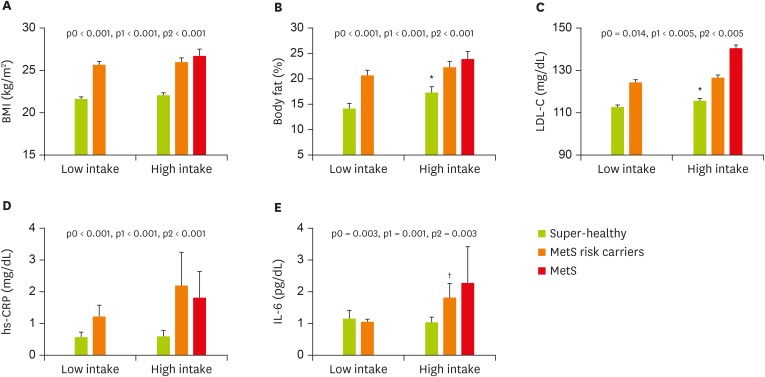
We investigated the association between dietary habits/food group consumption patterns and early risk of metabolic syndrome (MetS), a main cause for metabolic disease. Study participants were recruited from the health promotion center in Dong-A University Hospital and public advertisement. Study subjects (n = 243, 21-80 years) were categorized into three groups: Super-healthy (MetS risk factor [MetS RF] = 0, n = 111), MetS-risk carriers (MetS RF = 1-2, n = 96), and MetS (MetS RF ≥ 3, n = 27). Higher regularity in dietary habits (breakfast-everyday, regular eating time, non-frequent overeating, and non-frequent eating-out) was observed in the Super-healthy group than in the MetS-risk carriers, and particularly in the MetS subjects. The relationship between food group consumption patterns and MetS-risk related parameters were investigated with adjustment for confounding factors. Fruit consumption was positively associated with HDL-cholesterol, and tended to be negatively associated with waist circumference, triglyceride, LDL-cholesterol, and insulin resistance (IR). The consumption of low-fat meats and fish, and vegetables was negatively associated with hs-CRP. Specifically, the consumption of sea-foods belonging to the low-fat fish was negatively associated with fasting glucose, hs-CRP, and interleukin (IL)-6. Anchovy/dried white baits consumption was negatively associated with fasting insulin and IR. Green-yellow vegetables consumption was negatively associated with fasting insulin, IR, and hs-CRP. On the other hand, sugars and fast-foods were positively associated with LDL-cholesterol. Additionally, fast-foods consumption was positively associated with hs-CRP and IL-6 levels. In conclusion, dietary habits/food group consumption patterns are closely associated with MetS-risk related parameters in Koreans. It may suggest useful information to educate people to properly select healthy foods for early prevention of MetS.
Keywords: Dietary habit; Food group consumption pattern; Inflammation; Metabolic syndrome.
Conflict of interest statement
Conflict of Interest: The authors declare that they have no competing interests.
Figures
References
-
- Alberti KG, Eckel RH, Grundy SM, Zimmet PZ, Cleeman JI, Donato KA, Fruchart JC, James WP, Loria CM, Smith SC., Jr International Diabetes Federation Task Force on Epidemiology and Prevention; Hational Heart, Lung, and Blood Institute; American Heart Association; World Heart Federation; International Atherosclerosis Society; International Association for the Study of Obesity. Harmonizing the metabolic syndrome: a joint interim statement of the International Diabetes Federation Task Force on Epidemiology and Prevention; National Heart, Lung, and Blood Institute; American Heart Association; World Heart Federation; International Atherosclerosis Society; and International Association for the Study of Obesity. Circulation. 2009;120:1640–1645. - PubMed
-
- Klein BE, Klein R, Lee KE. Components of the metabolic syndrome and risk of cardiovascular disease and diabetes in Beaver Dam. Diabetes Care. 2002;25:1790–1794. - PubMed
-
- Ford ES. Risks for all-cause mortality, cardiovascular disease, and diabetes associated with the metabolic syndrome: a summary of the evidence. Diabetes Care. 2005;28:1769–1778. - PubMed
-
- Ng TP, Feng L, Nyunt MS, Feng L, Gao Q, Lim ML, Collinson SL, Chong MS, Lim WS, Lee TS, Yap P, Yap KB. Metabolic syndrome and the risk of mild cognitive impairment and progression to dementia: follow-up of the Singapore longitudinal ageing study cohort. JAMA Neurol. 2016;73:456–463. - PubMed
LinkOut - more resources
Full Text Sources
Other Literature Sources
Research Materials
Miscellaneous