


Measurement Challenges at Low Blood Lead Levels
- PMID: 28771411
- PMCID: PMC5709716
- DOI: 10.1542/peds.2017-0272
Measurement Challenges at Low Blood Lead Levels
Abstract
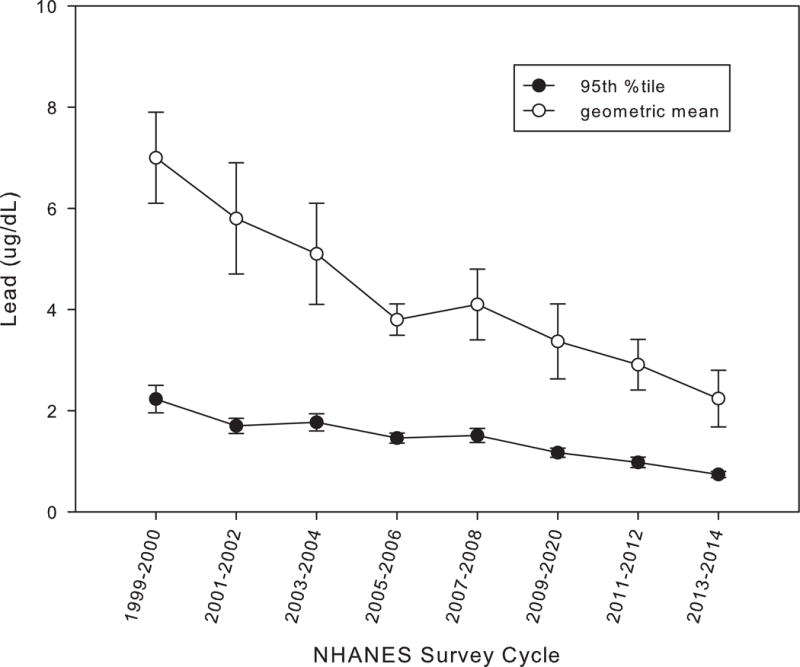
In 2012, the Centers for Disease Control and Prevention (CDC) adopted its Advisory Committee on Childhood Lead Poisoning Prevention recommendation to use a population-based reference value to identify children and environments associated with lead hazards. The current reference value of 5 μg/dL is calculated as the 97.5th percentile of the distribution of blood lead levels (BLLs) in children 1 to 5 years old from 2007 to 2010 NHANES data. We calculated and updated selected percentiles, including the 97.5th percentile, by using NHANES 2011 to 2014 blood lead data and examined demographic characteristics of children whose blood lead was ≥90th percentile value. The 97.5th percentile BLL of 3.48 µg/dL highlighted analytical laboratory and clinical interpretation challenges of blood lead measurements ≤5 μg/dL. Review of 5 years of results for target blood lead values <11 µg/dL for US clinical laboratories participating in the CDC's voluntary Lead and Multi-Element Proficiency quality assurance program showed 40% unable to quantify and reported a nondetectable result at a target blood lead value of 1.48 µg/dL, compared with 5.5% at a target BLL of 4.60 µg/dL. We describe actions taken at the CDC's Environmental Health Laboratory in the National Center for Environmental Health, which measures blood lead for NHANES, to improve analytical accuracy and precision and to reduce external lead contamination during blood collection and analysis.
Copyright © 2017 by the American Academy of Pediatrics.
Conflict of interest statement
POTENTIAL CONFLICT OF INTEREST: The authors have indicated they have no potential conflicts of interest to disclose.
Figures
References
-
- AAP Council on Environmental Health (AAP) Prevention of childhood lead toxicity. Pediatrics. 2016;138(1):e20161493. - PubMed
-
- Centers for Disease Control and Prevention. Low Level Lead Exposure Harms Children: A Renewed Call for Primary Prevention. Atlanta, GA: Centers for Disease Control and Prevention US Department of Health and Human Services; 2012. http://www.cdc.gov/nceh/lead/ACCLPP/Final_Document_030712.pdf. Accessed January 7, 2017.
-
- National Toxicology Program (NTP), Office of Health Assessment and Translation. NTP Monograph on Health Effects of Low-Level Lead. US Department of Health and Human Services, National Institutes of Health, National Institute for Environmental Health Sciences; Jun 13, 2012. Available at: https://ntp.niehs.nih.gov/ntp/ohat/lead/final/monographhealtheffectslowl... Accessed January 7, 2017.
-
- Centers for Disease Control and Prevention (CDC) CDC Response to Advisory Committee on Childhood Lead Poisoning Prevention Recommendations. Low Level Lead Exposure Harms Children: A Renewed Call of Primary Prevention. 2012 Jun 7; https://stacks.cdc.gov/view/cdc/37586 accessed January 6, 2017.
-
- Boone J, Hearn T, Lewis S. Comparison of interlaboratory results for blood lead with results from a definitive method. Clin Chem. 1979;25:389–393. - PubMed
MeSH terms
Substances
Grants and funding
LinkOut - more resources
Full Text Sources
Other Literature Sources
Medical
