Review
. 2017 Jul 25:40:231-250.
doi: 10.1146/annurev-neuro-072116-031312.

Identifying Cellular and Molecular Mechanisms for Magnetosensation

Affiliations
Review

Identifying Cellular and Molecular Mechanisms for Magnetosensation

Benjamin L Clites et al. Annu Rev Neurosci. .

Abstract

Diverse animals ranging from worms and insects to birds and turtles perform impressive journeys using the magnetic field of the earth as a cue. Although major cellular and molecular mechanisms for sensing mechanical and chemical cues have been elucidated over the past three decades, the mechanisms that animals use to sense magnetic fields remain largely mysterious. Here we survey progress on the search for magnetosensory neurons and magnetosensitive molecules important for animal behaviors. Emphasis is placed on magnetosensation in insects and birds, as well as on the magnetosensitive neuron pair AFD in the nematode Caenorhabditis elegans. We also review conventional criteria used to define animal magnetoreceptors and suggest how approaches used to identify receptors for other sensory modalities may be adapted for magnetoreceptors. Finally, we discuss prospects for underutilized and novel approaches to identify the elusive magnetoreceptors in animals.

Keywords: magnetic orientation; magnetoreception; magnetosensation; migration; orientation.


Figures
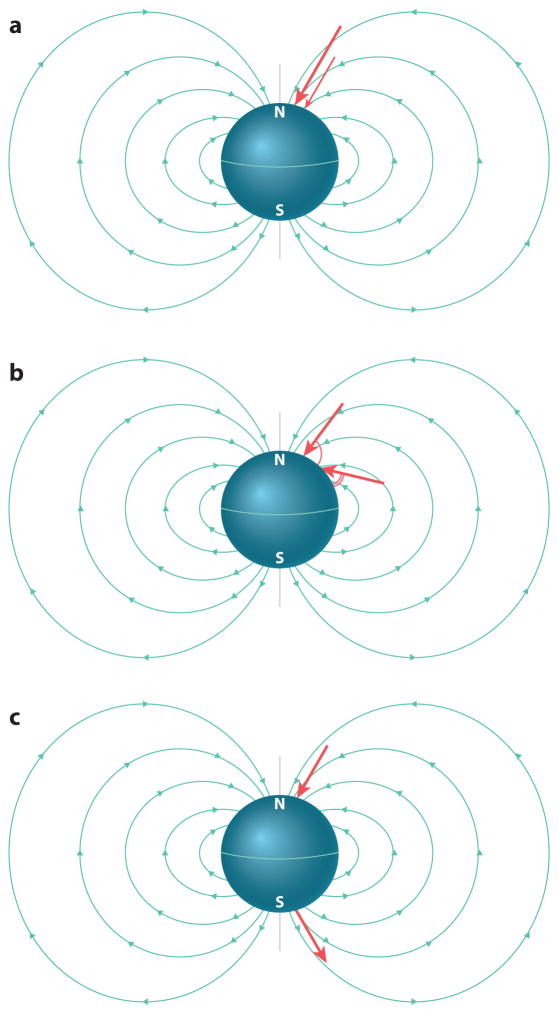
Figure 1
Figure 1
Different cues derived from the earth’s magnetic field. The magnetic field of the earth originates from the Southern Hemisphere, extends into the atmosphere and space, and then pierces into the Northern Hemisphere. Organisms may gain cues regarding their position and orientation on earth by detecting distinct aspects of the geomagnetic field in order to guide their behaviors. This includes sensing the intensity of the magnetic field (a), the inclination of the magnetic field (b), and the polarity of the magnetic field (c).
Figure 2
Figure 2
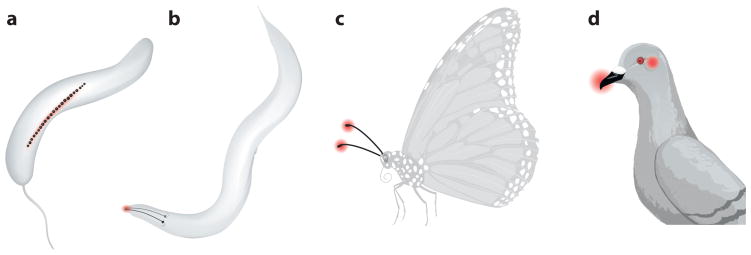
Magnetosensory loci across organisms. Many organisms have been found to orient to the earth’s magnetic field with different sensory structures. (a) Magnetotactic bacteria use a micron-scale compass needle composed of a string of iron beads. (b) The nematode Caenorhabditis elegans uses the left-right pair of AFD sensory neurons that project sensory structures to the tip of the worm’s head. (c) Insects including butterflies and flies may use a cryptochrome-based chemical magnetic sensor in their antennae. (d) Birds may sense magnetic fields using magnetosensory cells in the inner ear and beak with an iron-based mechanism, and in eyes with a cryptochrome-based mechanism.
Figure 3
Figure 3
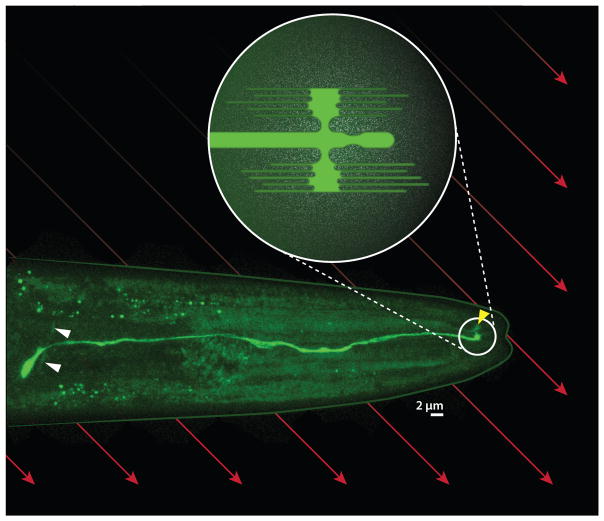
AFD magnetosensory neuron in Caenorhabditis elegans. Fluorescent micrograph shows the right AFD neuron expressing a green fluorophore. The cell body has a curved axon (white arrowheads) that synapses onto other neurons and a dendrite that extends toward the tip of the worm’s head, where it features a complex sensory structure (circled). Reconstructions by White et al. (1986) and Doroquez et al. (2014) at the level of electron microscopy suggest that this structure includes a single cilium and antenna-shaped arrays of anterioposterior-directed microvilli on the dorsal and ventral sides (schematized in inset) Although most of the bilaterally symmetric left AFD neuron is out of view, its sensory structure is visible (yellow arrowhead). If the microvilli are associated with iron, the earth’s magnetic field (red arrows) may impose a mechanical force on the microvilli that depends on the orientation of the worm.
Figure 4
Figure 4
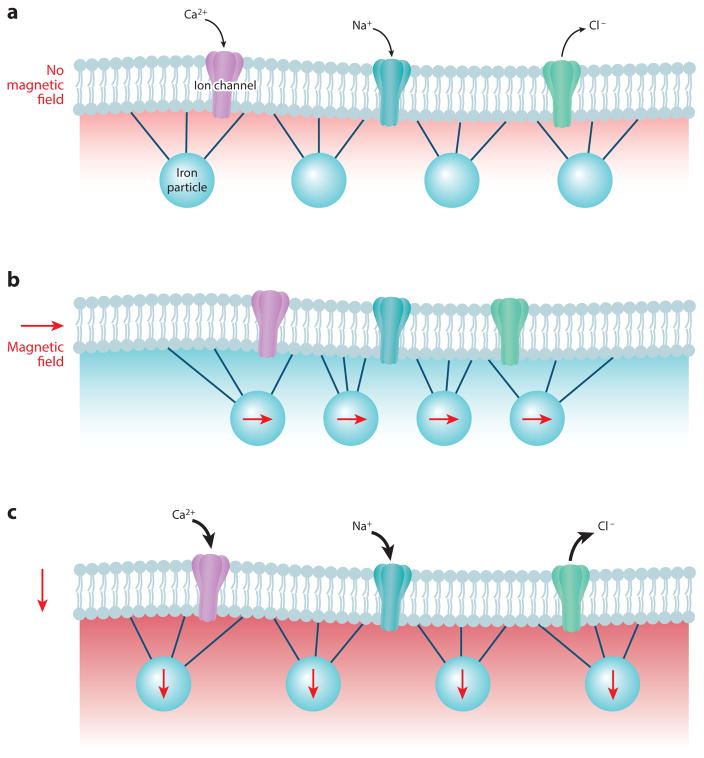
Biological magnetic particles associated with ion channels may provide an iron-dependent mechanism for magnetosensation. Iron-containing particles that are physically associated with ion channels may influence the activity of a hypothetical magnetosensory neuron. Iron particles may link directly with the ion channels or with nearby membrane proteins or lipids to alter channel activity. (a) When the magnetic field is in one orientation, the ion channels may conduct a baseline current. (b) When the magnetic field is oriented in a different orientation, the imposed movement on the iron particles may impede channel conductance and change the cell membrane potential. (c) When the magnetic field is in another orientation, the channels may increase conductance. Although progress is being made to engineer analogous magnetosensory ion channels, it remains to be determined whether animals possess similar ion channels associated with magnetic particles for magnetic dependent behaviors. Schematic modified with permission from Johnsen & Lohmann (2008).
Figure 5
Figure 5
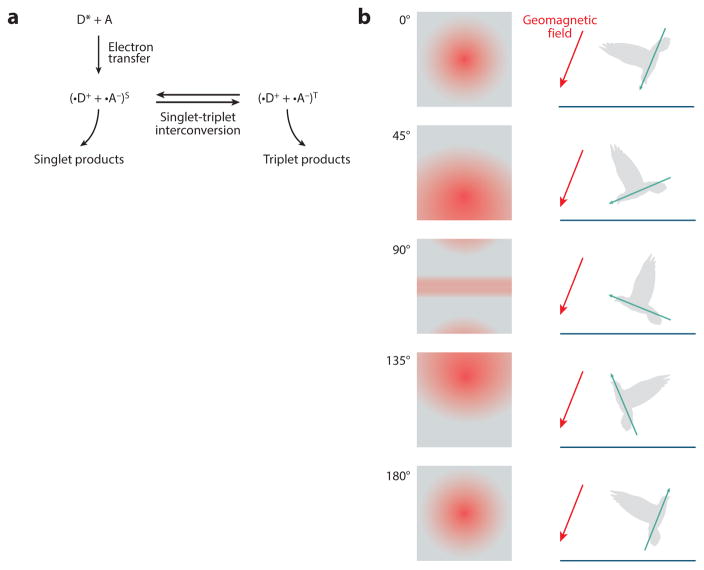
Cryptochrome provides a chemical-dependent mechanism for magnetosensation. The earth’s magnetic field may be detected by how it influences chemical reactions in sensory neurons. (a) The most promising model suggests that light may alter the propensity of doublet versus triplet reaction products when blue light interacts with the photoenzyme cryptochrome. (b) In this model, cryptochrome-expressing photoreceptors in the eye may visualize aspects of the geomagnetic field superimposed across their field of vision. Note that although this model allows the bird to distinguish its position with respect to the inclination angle of the geomagnetic field, it does not provide accurate information regarding the polarity of the geomagnetic field. Schematic modified with permission from Ritz et al. (2000).

References

    1. Baker RR. Human Navigation and Magnetoreception. Manchester, UK/New York: Manchester Univ. Press; 1989.
    1. Blakemore RP. Magnetotactic bacteria. Science. 1975;190(4212):377–79. - PubMed
    1. Blakemore RP, Frankel RB, Kalmijn AJ. South-seeking magnetotactic bacteria in the Southern Hemisphere. Nature. 1980;286:384–85.
    1. Block SM. Biophysical principles of sensory transduction. In: Corey DP, Roper SD, editors. Sensory Transduction. New York: Rockefeller Univ. Press; 1992. pp. 1–18. - PubMed
    1. Bretscher AJ, Kodama-Namba E, Busch KE, Murphy RJ, Soltesz Z, et al. Temperature, oxygen, and salt-sensing neurons in C. elegans are carbon dioxide sensors that control avoidance behavior. Neuron. 2011;69(6):1099–113. - PMC - PubMed

Publication types

LinkOut - more resources