Review
. 2017 Jul 25:40:349-372.
doi: 10.1146/annurev-neuro-072116-031508.

The Role of the Lateral Intraparietal Area in (the Study of) Decision Making

Affiliations
Review

The Role of the Lateral Intraparietal Area in (the Study of) Decision Making

Alexander C Huk et al. Annu Rev Neurosci. .

Abstract

Over the past two decades, neurophysiological responses in the lateral intraparietal area (LIP) have received extensive study for insight into decision making. In a parallel manner, inferred cognitive processes have enriched interpretations of LIP activity. Because of this bidirectional interplay between physiology and cognition, LIP has served as fertile ground for developing quantitative models that link neural activity with decision making. These models stand as some of the most important frameworks for linking brain and mind, and they are now mature enough to be evaluated in finer detail and integrated with other lines of investigation of LIP function. Here, we focus on the relationship between LIP responses and known sensory and motor events in perceptual decision-making tasks, as assessed by correlative and causal methods. The resulting sensorimotor-focused approach offers an account of LIP activity as a multiplexed amalgam of sensory, cognitive, and motor-related activity, with a complex and often indirect relationship to decision processes. Our data-driven focus on multiplexing (and de-multiplexing) of various response components can complement decision-focused models and provides more detailed insight into how neural signals might relate to cognitive processes such as decision making.

Keywords: decision making; lateral intraparietal cortex; parietal; visual motion; visual perception.


Figures
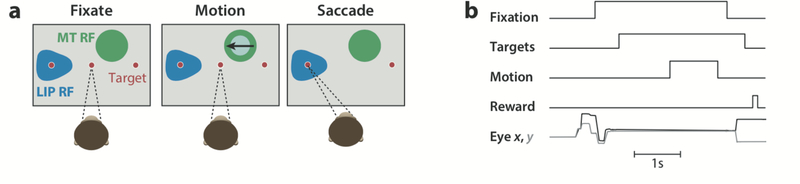
FIGURE 1
FIGURE 1
Generic direction discrimination task and neural recording geometry. (a) In a standard version of the direction discrimination task, monkeys are trained to discriminate the net direction of visual motion and communicate their decision with a saccadic eye movement to one of two diametrically opposite choice targets. When electrophysiological measurements are taken, task elements are positioned in reference to the receptive field (RF) of the neuron under study. For lateral intraparietal area (LIP) recordings, one of the saccade targets is typically placed in the LIP RF (blue patch). For middle temporal (MT) recordings, the motion stimulus is placed in the MT RF ( green patch). (b) Sequence of task events. In this example, the motion epoch is a fixed duration (FD) of approximately 1 s. Timings of individual events can be temporally jittered to decorrelate components. Other task permutations may include motion that has a variable duration (VD) between trials or with a duration determined by the animal’s response time (RT).
FIGURE 2
FIGURE 2
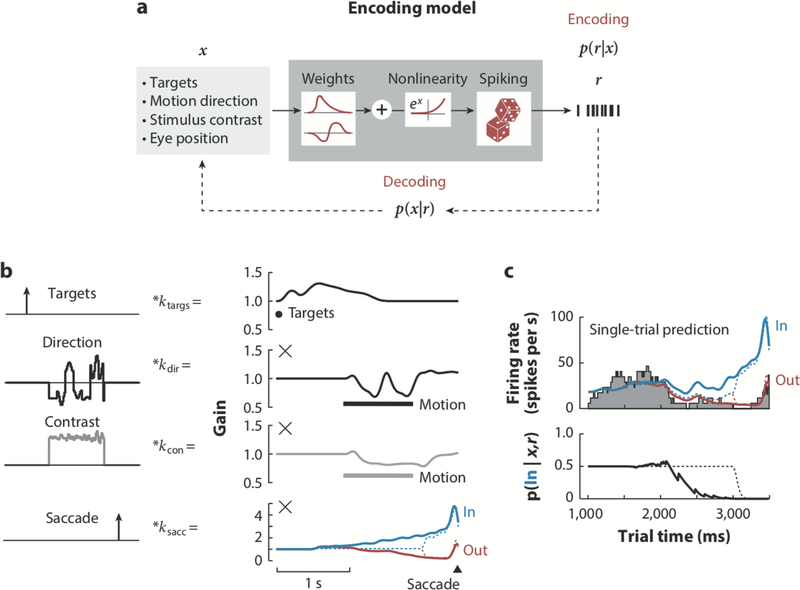
Generalized linear model (GLM) applied to lateral intraparietal area (LIP). (a) The GLM describes the probability of a spike train r given external variables x. This relationship, p(r|x), is given by a Poisson process with a rate that is generated by filtering the external variables linearly and then passing the summed output through a static nonlinearity. The conventional exponential nonlinearity implies that all linear terms interact multiplicatively. (b) The separate contribution of the targets, direction of motion, contrast of the stimulus, and saccade of the animal (left column) to spike rate are depicted as spike rate gains. The individual component gains (right column) are produced by convolving the stimulus covariates with their respective linear filters and exponentiating them. The × indicates that these gains are multiplied together to produce the spike rate for the neuron, a result of the exponential nonlinearity. The saccade kernel exerts a choicedependent effect on spike rate with rate increasing for choices in the response field (RF) (blue) and decreasing for choices out of the RF (red ). The dashed lines represent the effect the saccade would have if it affected spike rate only up to 500 ms before the saccade. (c) An example single-trial prediction for an LIP neuron (top). The predicted rates for a choice into the RF (blue) and out of the RF (red ) are overlaid with the binned spike count for this neuron ( gray). The probability of a choice into the RF is derived from the two predicted rates (black). Predicted responses using more punctate (truncated) saccade kernels are shown by the dashed lines, and clearly fail to account for the observed response. Figure modified with permission from Park et al. (2014) using data from Katz et al. (2016) and Yates et al. (2017).
FIGURE 3
FIGURE 3
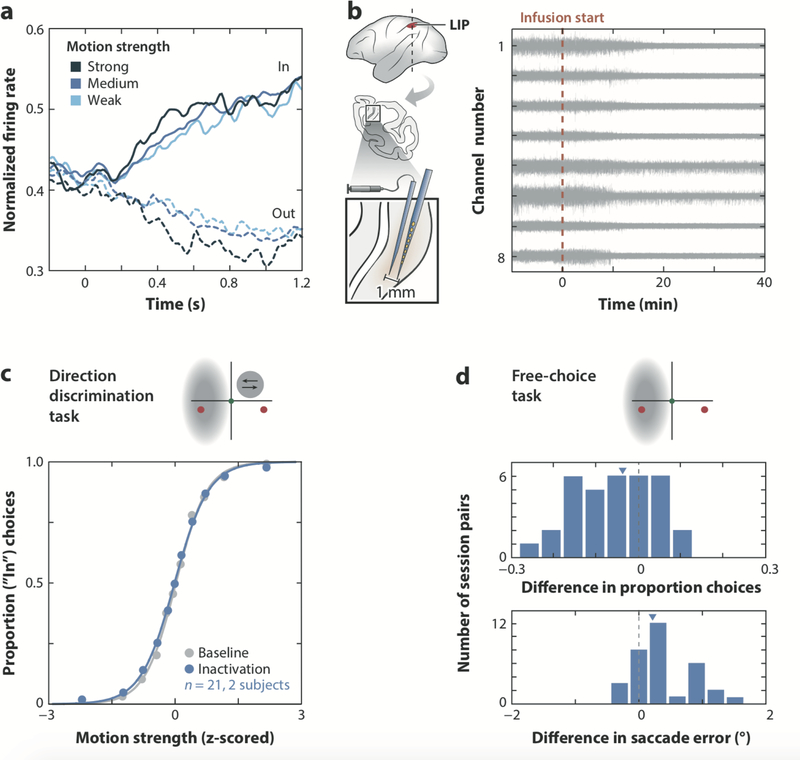
Inactivation of decision-correlated activity in lateral intraparietal area (LIP) does not have a significant effect on decision making. (a) Average response of 113 LIP neurons as a function of motion strength and direction (in versus out of the cell’s response field, solid and dashed lines, respectively), aligned to motion onset. (b) Schematic of the inactivation protocol (left). A multielectrode array was lowered alongside the infusion cannula to identify the targeted cortical location, verify neural selectivity before infusion, and confirm neural silencing after. On the right, continuous voltage traces are shown from an example inactivation session in which neural silencing is evident approximately 10 min after infusion start. (c) Psychophysical data for the direction discrimination task, averaged over pairs of baseline and muscimol treatment sessions in area LIP. Upper panel shows the experimental geometry along with the estimated inactivated field ( gray cloud ). (d ) Distribution of behavioral data in the free-choice task in which the animal chose between two targets that flashed in variable locations in the absence of a motion stimulus. Histograms show baseline and inactivation differences in proportion contralateral choices (top) and saccade error (bottom); positive numbers indicate an increase following inactivation. Figure modified with permission from Katz et al. (2016).

References

    1. Andersen RA, Asanuma C, Cowan WM. 1985. Callosal and prefrontal associational projecting cell populations in area 7A of the macaque monkey: a study using retrogradely transported fluorescent dyes. J. Comp. Neurol 232(4):443–55 - PubMed
    1. Andersen RA, Asanuma C, Essick G, Siegel RM. 1990. Corticocortical connections of anatomically and physiologically defined subdivisions within the inferior parietal lobule 296(1):65–113 - PubMed
    1. Balan PF, Gottlieb J. 2009. Functional Significance of Nonspatial Information in Monkey Lateral Intraparietal Area. Journal of Neuroscience 29(25):8166–76 - PMC - PubMed
    1. Basso MA, Wurtz RH. 1998. Modulation of neuronal activity in superior colliculus by changes in target probability. Journal of Neuroscience 18(18):7519–34 - PMC - PubMed
    1. Basso MA, Wurtz RH. 1997. Modulation of neuronal activity by target uncertainty. Nature 389(6646):66–69 - PubMed

Publication types

LinkOut - more resources