


Lithium monotherapy associated clinical improvement effects on amygdala-ventromedial prefrontal cortex resting state connectivity in bipolar disorder
- PMID: 28772145
- PMCID: PMC5844774
- DOI: 10.1016/j.jad.2017.06.047
Lithium monotherapy associated clinical improvement effects on amygdala-ventromedial prefrontal cortex resting state connectivity in bipolar disorder
Abstract
Background: This study, for the first time, investigated lithium monotherapy associated effects on amygdala- ventromedial prefrontal cortex (vMPFC) resting-state functional connectivity and correlation with clinical improvement in bipolar disorder (BP) METHODS: Thirty-six medication-free subjects - 24 BP (12 hypomanic BPM) and 12 depressed (BPD)) and 12 closely matched healthy controls (HC), were included. BP subjects were treated with lithium and scanned at baseline, after 2 weeks and 8 weeks. HC were scanned at same time points but were not treated. The effect of lithium was studied for the BP group as a whole using two way (group, time) ANOVA while regressing out effects of state. Next, correlation between changes in amygdala-vMPFC resting-state connectivity and clinical global impression (CGI) of severity and improvement scale scores for overall BP illness was calculated. An exploratory analysis was also conducted for the BPD and BPM subgroups separately.
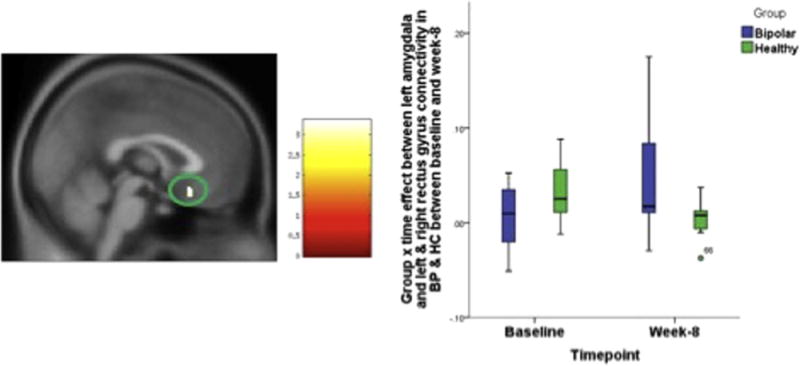
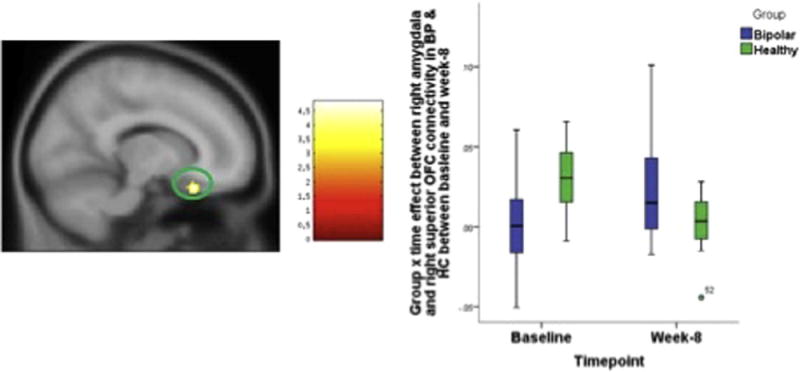
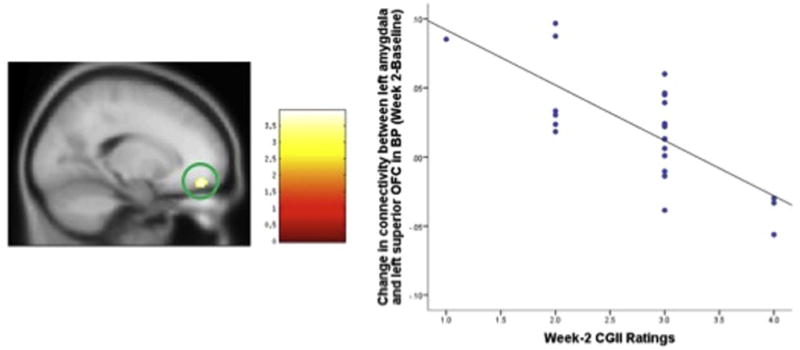
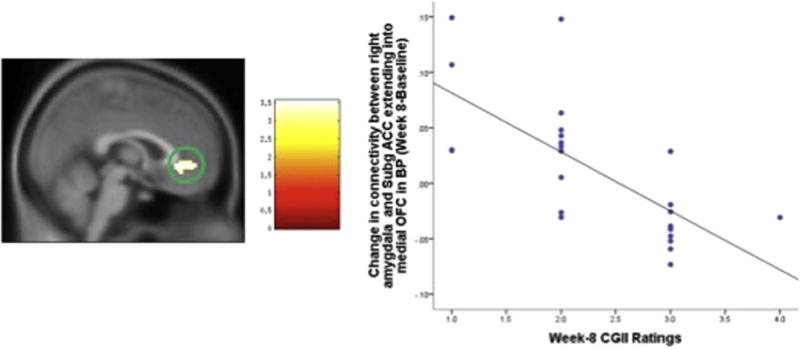
Results: Group by time interaction revealed that lithium monotherapy in patients was associated with increase in amygdala-medial OFC connectivity after 8 weeks of treatment (p = 0.05 (cluster-wise corrected)) compared to repeat testing in healthy controls. Increased amygdala-vMPFC connectivity correlated with clinical improvement at week 2 and week 8 as measured with the CGI-I scale.
Limitations: The results pertain to open-label treatment and do not account for non-treatment related improvement effects. Only functional connectivity was measured which does not give information regarding one regions effect on the other.
Conclusions: Lithium monotherapy in BP is associated with modulation of amygdala-vMPFC connectivity which correlates with state-independent global clinical improvement.
Copyright © 2017. Published by Elsevier B.V.
Conflict of interest statement
None of the authors have any conflict of interests pertaining to the work described in the manuscript.
Figures
References
-
- Accolla EA, Aust S, Merkl A, Schneider GH, Kuhn AA, Bajbouj M, Draganski B. Deep brain stimulation of the posterior gyrus rectus region for treatment resistant depression. J Affect Disord. 2016;194:33–37. - PubMed
-
- Adolphs R, Baron-Cohen S, Tranel D. Impaired recognition of social emotions following amygdala damage. J Cogn Neurosci. 2002;14:1264–1274. - PubMed
-
- Adolphs R, Sears L, Piven J. Abnormal processing of social information from faces in autism. J Cogn Neurosci. 2001;13:232–240. - PubMed
-
- Altshuler LL, Bartzokis G, Grieder T, Curran J, Mintz J. Amygdala enlargement in bipolar disorder and hippocampal reduction in schizophrenia: an MRI study demonstrating neuroanatomic specificity [letter] Arch General Psychiatry. 1998;55:663–664. - PubMed
MeSH terms
Substances
Grants and funding
LinkOut - more resources
Full Text Sources
Other Literature Sources
Medical
