. 2017 Jan 28;10(2):119.
doi: 10.3390/ma10020119.

Biogenic and Synthetic Peptides with Oppositely Charged Amino Acids as Binding Sites for Mineralization

Affiliations

Biogenic and Synthetic Peptides with Oppositely Charged Amino Acids as Binding Sites for Mineralization

Marie-Louise Lemloh et al. Materials (Basel). .

Abstract

Proteins regulate diverse biological processes by the specific interaction with, e.g., nucleic acids, proteins and inorganic molecules. The generation of inorganic hybrid materials, such as shell formation in mollusks, is a protein-controlled mineralization process. Moreover, inorganic-binding peptides are attractive for the bioinspired mineralization of non-natural inorganic functional materials for technical applications. However, it is still challenging to identify mineral-binding peptide motifs from biological systems as well as for technical systems. Here, three complementary approaches were combined to analyze protein motifs consisting of alternating positively and negatively charged amino acids: (i) the screening of natural biomineralization proteins; (ii) the selection of inorganic-binding peptides derived from phage display; and (iii) the mineralization of tobacco mosaic virus (TMV)-based templates. A respective peptide motif displayed on the TMV surface had a major impact on the SiO₂ mineralization. In addition, similar motifs were found in zinc oxide- and zirconia-binding peptides indicating a general binding feature. The comparative analysis presented here raises new questions regarding whether or not there is a common design principle based on acidic and basic amino acids for peptides interacting with minerals.

Keywords: Inorganic-binding peptides; biomineralization; phage display; silicification.


Conflict of interest statement

The authors declare no conflict of interest.

Figures
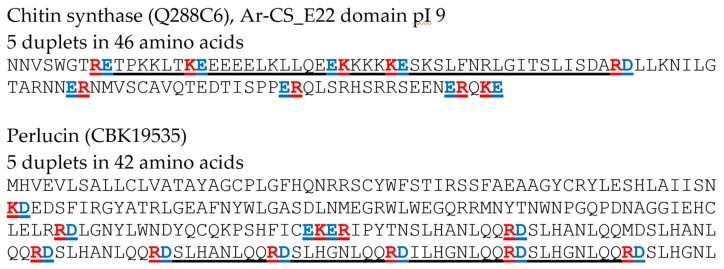
Figure 1
Figure 1
Examples for oppositely charged amino acid motifs in biomineralization proteins. R/K-E/D duplets are indicated (red and blue). Sequence region containing five such duplets are underlined (46 amino acids for chitin synthase domain and 42 amino acids for perlucin), see also Table 1.
Figure 2
Figure 2
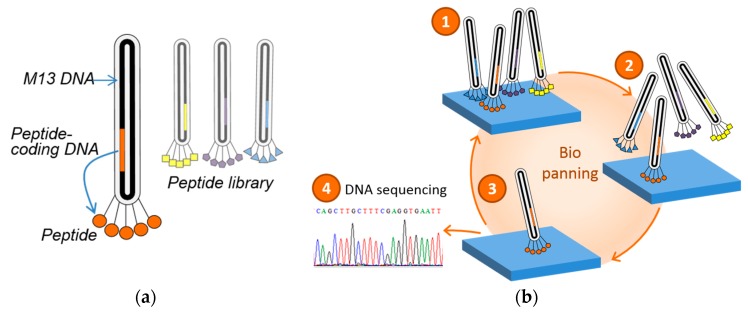
Scheme of phage display technique: (a) the peptide library is expressed fused to the minor coat protein pIII; and (b) selection process for the identification of interacting peptides, so called biopanning. (1) Incubation of the peptide library with target substrate; (2) non-interacting phages are eliminated from the peptide library; and (3) strongly bound phages are isolated. To increase the binding specificity, Steps 1 to 3 are repeated. Identification of the peptide sequence by sequencing the corresponding DNA fragment.
Figure 3
Figure 3
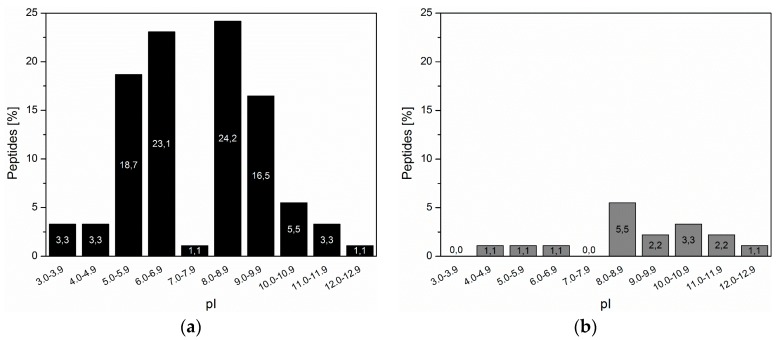
Percentage distribution of isolated ZrO2-binding peptides based on the calculated isoelectric point (pI): (a) percentage distribution of all selected peptides; and (b) percentage distribution of peptides with a duplet motif of the total number of peptides.
Figure 4
Figure 4
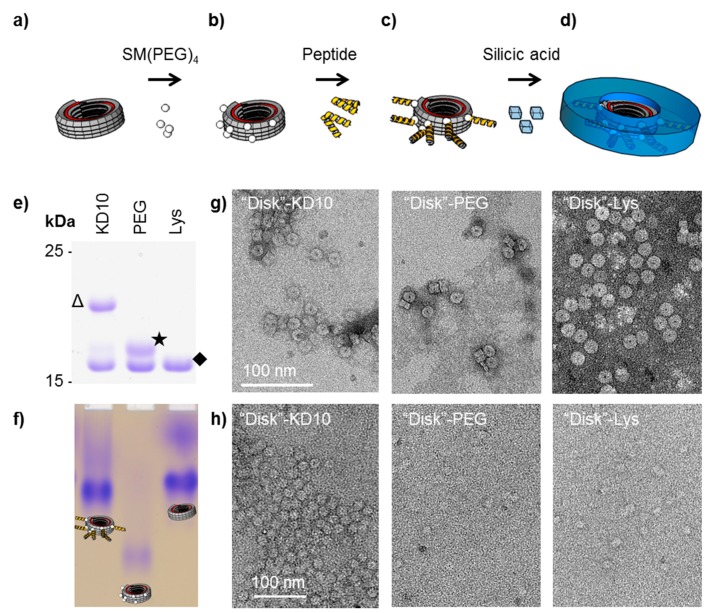
Mineralization of tobacco mosaic virus (TMV)-based nucleoprotein structures. Workflow and ring-shaped mineralization products obtained through peptide coupling and thus surface activation of TMV “disks”, and peptide-governed silica deposition. (a) Assembly of amino group-exposing engineered TMV CPs and a 204 nts RNA containing the TMV origin of assembly (OAs) into a short ring-like four-turn helix (“disk”-Lys). One amino group per CP is exposed to the outer ring surface allowing chemical modification. (b) Functionalization with hetero-bifunctional crosslinker molecules (succinimidyl-[(N-maleimidopropionamido)-tetratethyleneglycol] ester (SM(PEG)4)) results in “disk”-PEG; and (c) subsequent coupling of silica-deposition inducing peptide (KD)10C (yielding “disk”-KD10). (d) Silica shell formation guided by the peptide-equipped TMV-“disk” surface in the presence of hydrolyzed tetramethyl-orthosilicate (TMOS), i.e., a silicic acid substrate. (e) SDS-PAGE analysis indicates the proportion of chemically modified TMV CP after functionalization with the crosslinker (asterisk), and after peptide conjugation (triangle) compared to unmodified CP (diamond). Around 50% of the CPs are equipped with (KD)10C. (f) Native gel electrophoresis of intact “disks” displays altered electrophoretic mobility due to differently charged surfaces induced by the modifications. (g) TEM analysis of negatively stained (2% uranyl acetate) particles: “disks” are stable when diluted in deionized water. (h) TEM analysis of unstained “disks” exposed to silicic acid for 30 min: electron-dense contrast indicates mineralization only of the peptide-equipped “disk”-KD10.

References

    1. Begum G., Goodwin W.B., deGlee B.M., Sandhage K.H., Kröger N. Compartmentalisation of enzymes for cascade reactions through biomimetic layer-by-layer mineralization. J. Mater. Chem. 2015;3:5232–5240. doi: 10.1039/C5TB00333D. - DOI - PubMed
    1. Brena B.M., Batista-Viera F. Immobilization of Enzymes. In: Guisán J.M., editor. Immobilization of Enzymes and Cells. Volume 22. Humana Press; New York, NY, USA: 2006. pp. 15–30.
    1. Rothenstein D., Facey S.J., Ploss M., Hans P., Melcher M., Srot V., van Aken P.A., Hauer B., Bill J. Mineralization of gold nanoparticles using tailored M13 phages. Bioinsp. Biomim. Nanobiomater. 2013;2:173–185. doi: 10.1680/bbn.13.00004. - DOI
    1. Borg S., Rothenstein D., Bill J., Schüler D. Generation of Multishell Magnetic Hybrid Nanoparticles by Encapsulation of Genetically Engineered and Fluorescent Bacterial Magnetosomes with ZnO and SiO2. Small. 2015;11:4209–4217. doi: 10.1002/smll.201500028. - DOI - PubMed
    1. Rothenstein D., Shopova-Gospodinova D., Bakradze G., Jeurgens L.P.H., Bill J. Generation of luminescence in biomineralized zirconia by zirconia-binding peptides. CrystEngComm. 2015;17:1783–1790. doi: 10.1039/C4CE01510J. - DOI

LinkOut - more resources