


Cluster randomised trial of a school-community child health promotion and obesity prevention intervention: findings from the evaluation of fun 'n healthy in Moreland!
- PMID: 28774278
- PMCID: PMC5543738
- DOI: 10.1186/s12889-017-4625-9
Cluster randomised trial of a school-community child health promotion and obesity prevention intervention: findings from the evaluation of fun 'n healthy in Moreland!
Erratum in
-
Erratum to: BMC Public Health, Vol. 18.BMC Public Health. 2017 Sep 22;17(1):736. doi: 10.1186/s12889-017-4709-6. BMC Public Health. 2017. PMID: 28938882 Free PMC article. No abstract available.
Abstract
Background: Multi-level, longer-term obesity prevention interventions that focus on inequalities are scarce. Fun 'n healthy in Moreland! aimed to improve child adiposity, school policies and environments, parent engagement, health behaviours and child wellbeing.
Methods: All children from primary schools in an inner urban, culturally diverse and economically disadvantaged area in Victoria, Australia were eligible for participation. The intervention, fun 'n healthy in Moreland!, used a Health Promoting Schools Framework and provided schools with evidence, school research data and part time support from a Community Development Worker to develop health promoting strategies. Comparison schools continued as normal. Participants were not blinded to intervention status. The primary outcome was change in adiposity. Repeated cross-sectional design with nested longitudinal subsample.
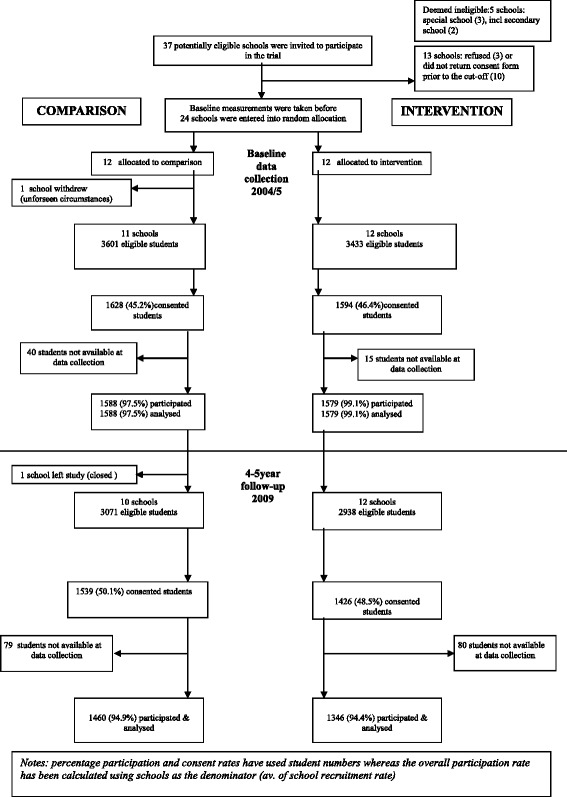
Results: Students from twenty-four primary schools (clusters) were randomised (aged 5-12 years at baseline). 1426 students from 12 intervention schools and 1539 students from 10 comparison schools consented to follow up measurements. Despite increased prevalence of healthy weight across all schools, after 3.5 years of intervention there was no statistically significant difference between trial arms in BMI z score post-intervention (Mean (sd): Intervention 0.68(1.16); Comparison: 0.72(1.12); Adjusted mean difference (AMD): -0.05, CI: -0.19 to 0.08, p = 0.44). Children from intervention schools consumed more daily fruit serves (AMD: 0.19, CI:0.00 to 0.37, p = 0.10), were more likely to have water (AOR: 1.71, CI:1.05 to 2.78, p = 0.03) and vegetables (AOR: 1.23, CI: 0.99 to 1.55, p = 0.07), and less likely to have fruit juice/cordial (AOR: 0.58, CI:0.36 to 0.93, p = 0.02) in school lunch compared to children in comparison schools. More intervention schools (8/11) had healthy eating and physical activity policies compared with comparison schools (2/9). Principals and schools highly valued the approach as a catalyst for broader positive school changes. The cost of the intervention per child was $65 per year.
Conclusion: The fun n healthy in Moreland! intervention did not result in statistically significant differences in BMI z score across trial arms but did result in greater policy implementation, increased parent engagement and resources, improved child self-rated health, increased fruit, vegetable and water consumption, and reduction in sweet drinks. A longer-term follow up evaluation may be needed to demonstrate whether these changes are sustainable and impact on childhood overweight and obesity.
Clinical trial registration: ACTRN12607000385448 (Date submitted 31/05/2007; Date registered 23/07/2007; Date last updated 15/12/2009).
Keywords: Child obesity prevention; Cluster RCT; Schools.
Conflict of interest statement
Ethics approval and consent to participate
Ethics approval was gained from the research institutions involved (Royal Children’s Hospital (EHRC # 24059), Deakin University (EC-248-2004), University of Melbourne
Consent for publication
Not applicable.
Competing interests
Authors CA and MT were employed by Merri Community Health Services at the time of the study.
The authors have no other financial or non-financial competing interests to declare.
Publisher’s Note
Springer Nature remains neutral with regard to jurisdictional claims in published maps and institutional affiliations.
References
-
- Commission on Ending Childhood Obesity: Report of the Commission on Ending Childhood Obesity. In. Geneva: World Health Organization; 2016.
-
- Waters E, de Silva-Sanigorski A, Hall BJ, Brown T, Campbell KJ, Gao G, Armstrong R, Prosser L, CD. S: Interventions for preventing obesity in children. The Cochrane Library 2011(December). - PubMed
-
- World Health Organisation: Ottawa Charter for Health Promotion. In. Ottawa: Department of Health and Welfare, World Health Organisation; 1986.
Publication types
MeSH terms
Associated data
LinkOut - more resources
Full Text Sources
Other Literature Sources
Medical
