. 2017 Jul 20:11:358.
doi: 10.3389/fnhum.2017.00358. eCollection 2017.

Anterior Thalamic High Frequency Band Activity Is Coupled with Theta Oscillations at Rest

Affiliations

Anterior Thalamic High Frequency Band Activity Is Coupled with Theta Oscillations at Rest

Catherine M Sweeney-Reed et al. Front Hum Neurosci. .

Abstract

Cross-frequency coupling (CFC) between slow and fast brain rhythms, in the form of phase-amplitude coupling (PAC), is proposed to enable the coordination of neural oscillatory activity required for cognitive processing. PAC has been identified in the neocortex and mesial temporal regions, varying according to the cognitive task being performed and also at rest. PAC has also been observed in the anterior thalamic nucleus (ATN) during memory processing. The thalamus is active during the resting state and has been proposed to be involved in switching between task-free cognitive states such as rest, in which attention is internally-focused, and externally-focused cognitive states, in which an individual engages with environmental stimuli. It is unknown whether PAC is an ongoing phenomenon during the resting state in the ATN, which is modulated during different cognitive states, or whether it only arises during the performance of specific tasks. We analyzed electrophysiological recordings of ATN activity during rest from seven patients who received thalamic electrodes implanted for treatment of pharmacoresistant focal epilepsy. PAC was identified between theta (4-6 Hz) phase and high frequency band (80-150 Hz) amplitude during rest in all seven patients, which diminished during engagement in tasks involving an external focus of attention. The findings are consistent with the proposal that theta-gamma coupling in the ATN is an ongoing phenomenon, which is modulated by task performance.

Keywords: anterior thalamic nucleus; cross-frequency coupling; gamma; high frequency band; intracranial EEG; phase amplitude coupling; resting state; theta.


Figures
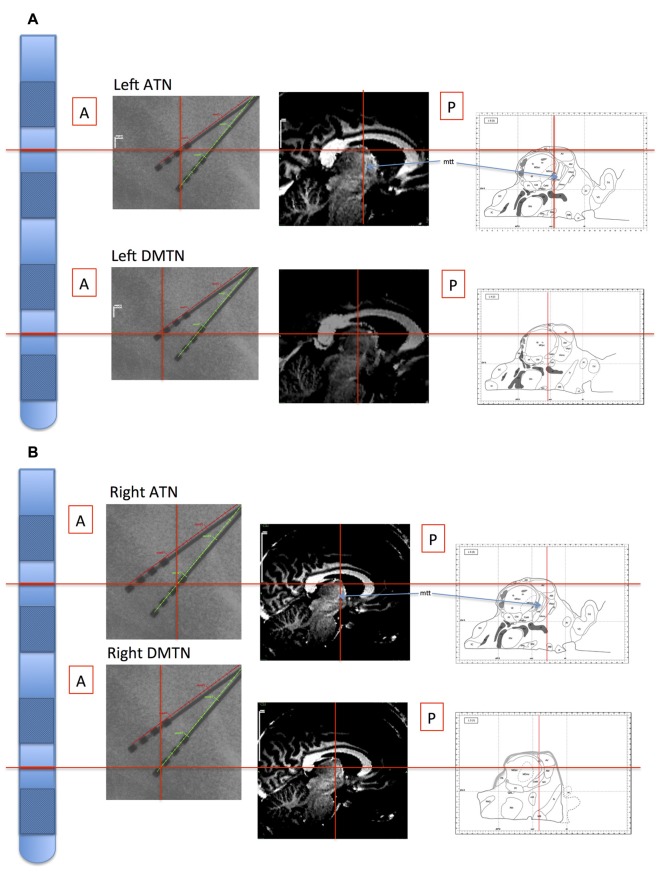
Figure 1
Figure 1
Illustration of location of recording sites in Patient 4. The electrode probes are represented on the far left, and the levels of the inter-contact points, corresponding with the bipolar channel for each thalamic nucleus, are indicated with horizontal red lines. Left panels: the intra-operative stereotactic X-ray images (lateral view) from which location coordinates were derived. Middle panels: the corresponding locations are superimposed on the pre-operative structural MRI images. By co-registering the images with post-operative CT images, the coordinate positions were determined with reference to atlases (Schaltenbrand and Wahren, ; Morel, ; Buentjen et al., 2014). Right panels: channel locations with reference to the Morel atlas. (Line drawings from Morel (2007): Copyright © 2007. From “Stereotactic Atlas of the Human Thalamus and Basal Ganglia” by A. Morel. Reproduced by permission of Taylor and Francis Group, LLC, a division of Informa plc). (A) Left channels. (B) Right channels. ATN, anterior thalamic nucleus; DMTN, dorsomedial thalamic nucleus; mtt, mammillothalamic tract.
Figure 2
Figure 2
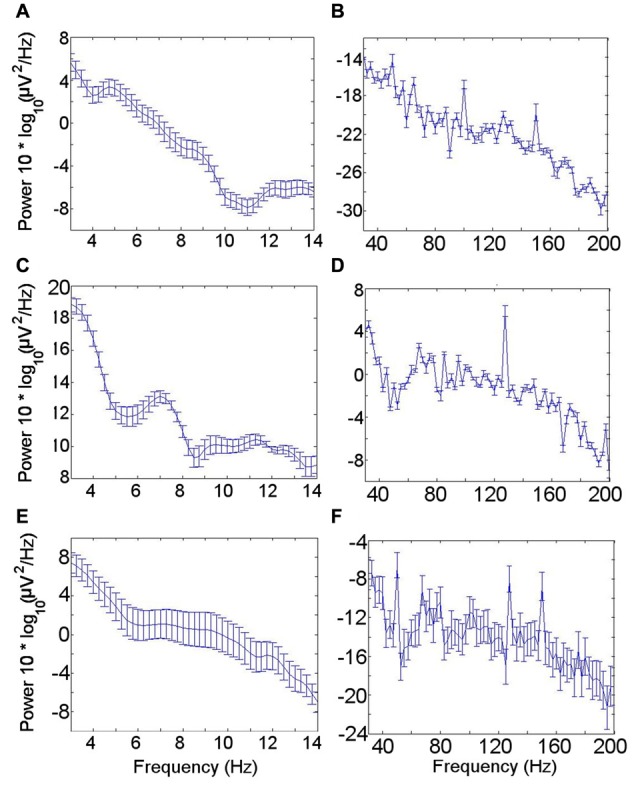
Low frequency oscillation (LFO) and high frequency band (HFB) power spectra. (A) LFO during rest. A peak in the theta frequency range is visible in the mean power spectrum across all seven participants during the resting condition. (B) HFB during rest. No clear gamma peak corresponding with the gamma frequency range coupled with the theta rhythm was identified. (C) LFO during encoding task. (D) HFB during encoding task. (E) LFO during novelty oddball task. (F) HFB during novelty oddball task. Error bars indicate the standard error of the mean across participants.
Figure 3
Figure 3
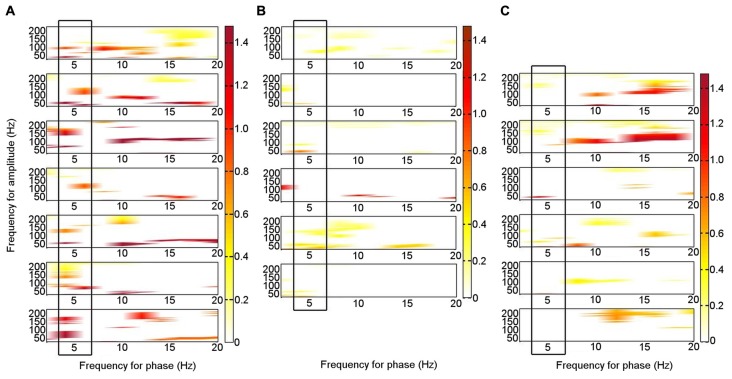
Phase–amplitude coupling (PAC) between theta phase and high frequency band amplitude in the left ATN in seven individual participants. PAC is shown when it was significant (permutation test: criterion p < 0.05). The panels are aligned such that PAC from the same patient is shown in each row. The panels are for Patients 1–7, from the top down. (A) At rest. (B) During memory encoding task. (C) During novelty oddball task. The boxes highlight the consistent PAC pattern across participants during rest (A), which is not seen during the externally focused tasks (B,C).
Figure 4
Figure 4
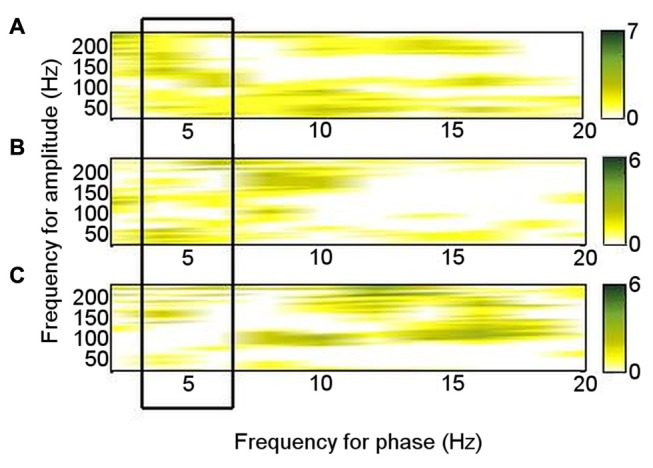
Phase–amplitude coupling (PAC) pattern for each condition. Each frequency–frequency point was given a binary value according to whether PAC was significant in each individual, and these values were summed over the total number of participants who performed each task. (A) During rest. (B) During encoding task. (C) During novelty oddball paradigm.
Figure 5
Figure 5
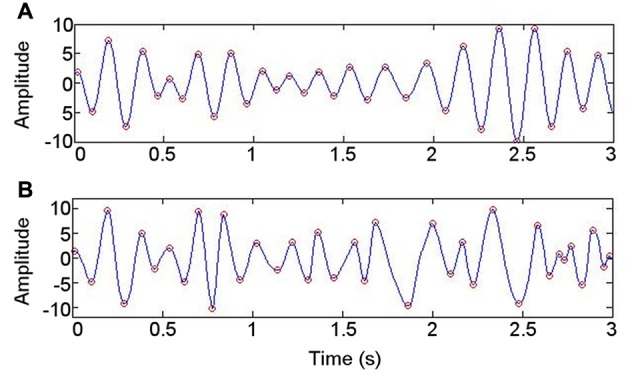
Illustration of approach to evaluating whether data are nonsinusoidal. (A) Bandpass filtering at 4–6 Hz. (B) Intrinsic mode function with spectral peak in 4–6 Hz range, derived using empirical mode decomposition.
Figure 6
Figure 6
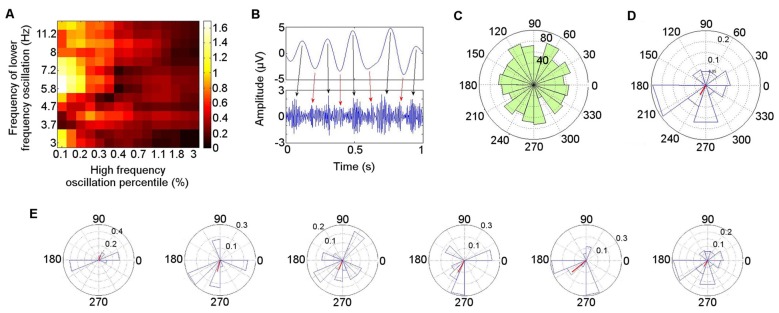
Detailed illustration of phase–amplitude coupling (PAC) during rest in Patient 4. (A) Low frequency oscillatory range at which coupling with high frequency band (80–150 Hz) amplitude was greatest. (B) Coupling between theta (4–6 Hz) phase and gamma (80–150 Hz) amplitude in bandpass filtered signals. (C) Polar representation of PAC calculated over 30 s pooled across all seven participants. The theta phase is shown radially, with mean resultant vector length (red) representing consistency of the phase over windows with the highest gamma amplitude (Miyakoshi et al., 2013). (D) PAC over 30 s in Patient 4. (E) PAC in Patient 4, in 5 s time windows.

References

    1. Aggleton J. P. (2012). Multiple anatomical systems embedded within the primate medial temporal lobe: implications for hippocampal function. Neurosci. Biobehav. Rev. 36, 1579–1596. 10.1016/j.neubiorev.2011.09.005 - DOI - PubMed
    1. Aggleton J. P., O’Mara S. M., Vann S. D., Wright N. F., Tsanov M., Erichsen J. T. (2010). Hippocampal-anterior thalamic pathways for memory: uncovering a network of direct and indirect actions. Eur. J. Neurosci. 31, 2292–2307. 10.1111/j.1460-9568.2010.07251.x - DOI - PMC - PubMed
    1. Andrade A. O., Nasuto S., Kyberd P., Sweeney-Reed C. M., Van Kanijn F. R. (2006). EMG signal filtering based on empirical mode decomposition. Biomed. Signal Process. Control 1, 44–55. 10.1016/j.bspc.2006.03.003 - DOI
    1. Aru J., Aru J., Priesemann V., Wibral M., Lana L., Pipa G., et al. (2015). Untangling cross-frequency coupling in neuroscience. Curr. Opin. Neurobiol. 31, 51–61. 10.1016/j.conb.2014.08.002 - DOI - PubMed
    1. Axmacher N., Henseler M. M., Jensen O., Weinreich I., Elger C. E., Fell J. (2010). Cross-frequency coupling supports multi-item working memory in the human hippocampus. Proc. Natl. Acad. Sci. U S A 107, 3228–3233. 10.1073/pnas.0911531107 - DOI - PMC - PubMed

LinkOut - more resources